
Posts

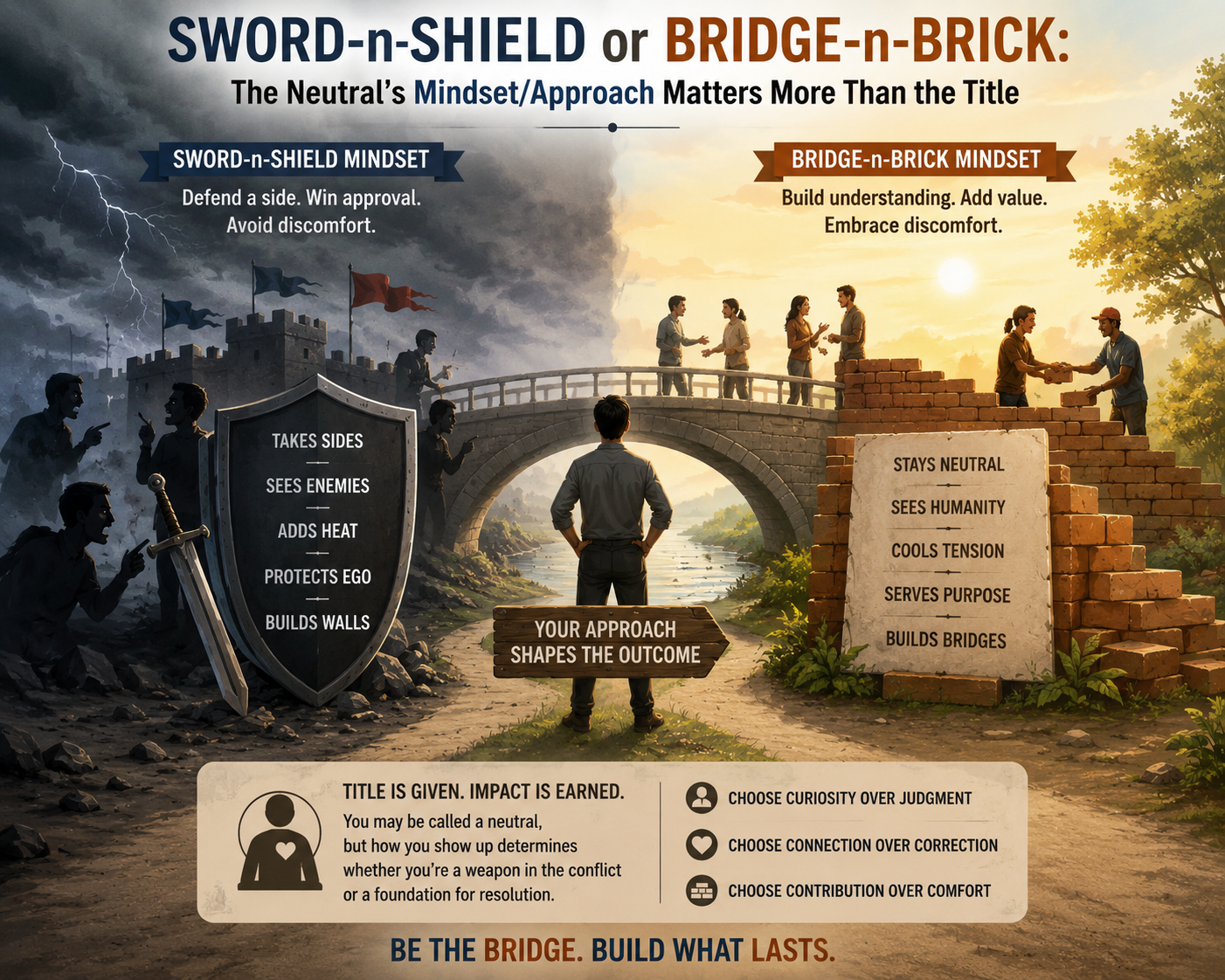
“Sword-n-Shield or Bridge-n-Brick”: The Neutral’s Mindset/Approach Matters More Than the Title

By Stanley Zamor

When preparing to mediate, parties often spend significant time selecting the “most experienced” neutral. They look at years of litigation, judicial appointments, verdict history, or the prestige what a resume/curriculum vitae demonstrate. But mediation was never designed to be a continuation of litigation by another name.

The real question is not simply who knows the law best.
The question is: Who understands conflict best, and how to create an opportunity to amicably address/resolve a dispute?

Too often, the mediation consumers reward the “Sword & Shield” mindset — a system rooted in positional leverage, predictive analysis, authority, and adversarial conditioning. Rarely concerned that it often violates procedural ethics and party self-determination. While those skills may have value in litigation, mediation requires something fundamentally different and much more. It requires the ability to build dialogue where communication has collapsed. It requires emotional intelligence, patience, strategic listening, encouraging empowerment and the discipline to protect party self-determination even when tension rises.

Mediation is not supposed to become a shadow courtroom.

This is where the “Bridge & Brick” philosophy becomes essential. A skilled neutral is not merely attempting to predict outcomes or pressure concessions. A true mediator is constructing opportunities for understanding, empowerment, reframing conflict, restoring communication, relationship building and helping participants move from entrenchment toward intentional decision-making.

Every word, pause, caucus, and question becomes a brick placed carefully toward resolution.

The challenge facing the ADR profession today is that many still confuse litigation experience with mediation competency. They are not the same discipline. Trial advocacy teaches persuasion. Conflict resolution teaches transformation and amicable resolve. One prepares professionals to win positions. The other prepares neutrals to manage human dynamics, emotions, perception, identity, and communication breakdowns.

That distinction matters.

The Florida Rules for Certified and Court-Appointed Mediators remind us that mediation is a voluntary, party-centered process grounded in neutrality, impartiality, empowerment and self-determination. Those principles cannot survive if the process becomes dominated by ego, predictive pressure, or evaluative influence disguised as facilitation.

The promise of mediation was never about manufacturing settlements at all costs.
It was about creating a process where people could make informed, empowered, and authentic decisions for themselves.

That requires more than a résumé.

It requires intention-trained conflict-resolution practitioners who understand that the mediator’s greatest power is not authority — it is influence earned through trust, credibility, emotional discipline, and integrity…”Process-over-Profit”. 

The future of ADR will belong to those who can build bridges, not merely carry shields. Stanley Zamor is a Florida Supreme Court Certified Circuit/Family/County Mediator, Primary Trainer and Qualified Arbitrator.  Mr. Zamor serves on several federal and state mediation/arbitration rosters and mediates with Salmon and Dulberg. As an ADR consultant/professional he regularly lectures on a variety of topics from ethics to Family/Business relationships. To calendar time with Stanley visit: https://sd-adr.com/attorney/stanley-zamor/ ; email: ZamorADRExpert@gmail.com ; www.effectivemediationconsultants.com; www.LinkedIn.com/in/stanleyzamoradr. (954) 261-8600
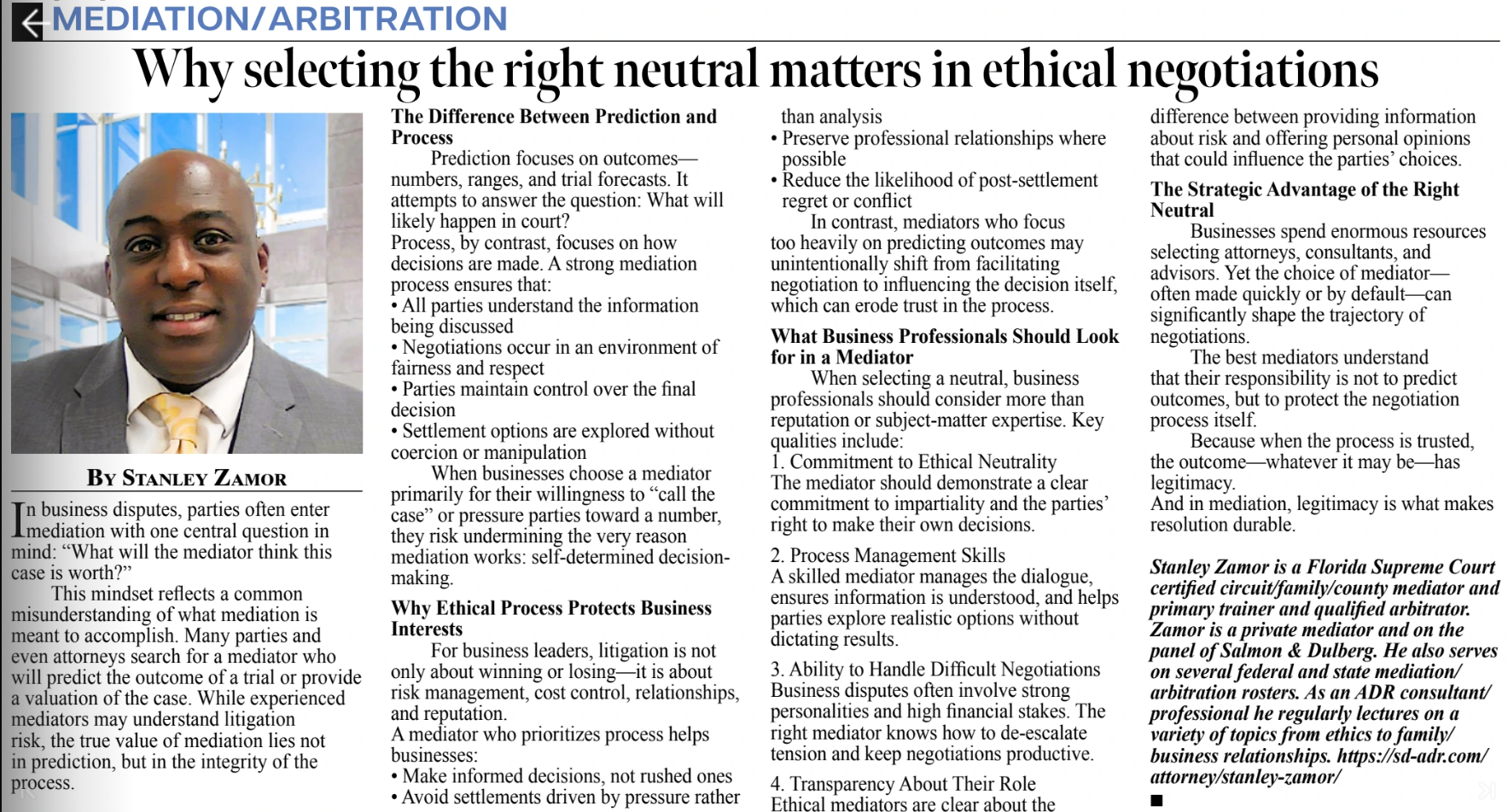
Process Over Prediction: “Why Selecting the Right Neutral Matters in Ethical Negotiations”

By Stanley Zamor

In business disputes, parties often enter mediation with one central question in mind: “What will the mediator think this case is worth?”

This mindset reflects a common misunderstanding of what mediation is meant to accomplish. Many parties and even attorneys search for a mediator who will predict the outcome of a trial or provide a valuation of the case. While experienced mediators may understand litigation risk, the true value of mediation lies not in prediction, but in the integrity of the process.

The Difference Between Prediction and Process

Prediction focuses on outcomes—numbers, ranges, and trial forecasts. It attempts to answer the question: What will likely happen in court?

Process, by contrast, focuses on how decisions are made. A strong mediation process ensures that:

  • All parties understand the information being discussed
  • Negotiations occur in an environment of fairness and respect
  • Parties maintain control over the final decision
  • Settlement options are explored without coercion or manipulation

When businesses choose a mediator primarily for their willingness to “call the case” or pressure parties toward a number, they risk undermining the very reason mediation works: self-determined decision-making.

Why Ethical Process Protects Business Interests

For business leaders, litigation is not only about winning or losing—it is about risk management, cost control, relationships, and reputation.

A mediator who prioritizes process helps businesses:

  • Make informed decisions, not rushed ones
  • Avoid settlements driven by pressure rather than analysis
  • Preserve professional relationships where possible
  • Reduce the likelihood of post-settlement regret or conflict

In contrast, mediators who focus too heavily on predicting outcomes may unintentionally shift from facilitating negotiation to influencing the decision itself, which can erode trust in the process.

What Business Professionals Should Look for in a Mediator

When selecting a neutral, business professionals should consider more than reputation or subject-matter expertise. Key qualities include:

1. Commitment to Ethical Neutrality
The mediator should demonstrate a clear commitment to impartiality and the parties’ right to make their own decisions.

2. Process Management Skills
A skilled mediator manages the dialogue, ensures information is understood, and helps parties explore realistic options without dictating results.

3. Ability to Handle Difficult Negotiations
Business disputes often involve strong personalities and high financial stakes. The right mediator knows how to de-escalate tension and keep negotiations productive.

4. Transparency About Their Role
Ethical mediators are clear about the difference between providing information about risk and offering personal opinions that could influence the parties’ choices.

The Strategic Advantage of the Right Neutral

Businesses spend enormous resources selecting attorneys, consultants, and advisors. Yet the choice of mediator—often made quickly or by default—can significantly shape the trajectory of negotiations.

The best mediators understand that their responsibility is not to predict outcomes, but to protect the negotiation process itself.

Because when the process is trusted, the outcome—whatever it may be—has legitimacy.

And in mediation, legitimacy is what makes resolution durable.

Stanley Zamor is a Florida Supreme Court Certified Circuit/Family/County Mediator & Primary Trainer and Qualified Arbitrator.  Mr. Zamor is a private mediator and on the panel of Salmon & Dulberg. He also serves on several federal and state mediation/arbitration rosters. As an ADR consultant/professional he regularly lectures on a variety of topics from ethics to Family/Business relationships. https://sd-adr.com/attorney/stanley-zamor/  ZamorADRExpert@gmail.com ; www.effectivemediationconsultants.com; www.LinkedIn.com/in/stanleyzamoradr. (954) 261-8600
Beyond the Gray: Why Alternative Dispute Resolution Must Evolve Through Intention-Trained[1] Conflict-Resolution Practitioners

A Companion Reflection of Reimagining the Neutral: From Legal Retiree to Conflict-Resolution Practitioner
By: Stanley Zamor


The conversation around the “graying” of Alternative Dispute Resolution (ADR) is not merely about age, it is about pipeline, identity, and professional evolution. ADR, at its core, was never meant to be an extension of litigation. It was designed as something fundamentally different, a system where process, dialogue, and human dynamics take precedence over positional advocacy and adversarial wins.  Yet today, the field remains heavily populated, and often dominated by retired judges and seasoned litigators. While their legal acumen experience is valuable, the question must be asked:

Is ADR being practiced as it was intended—or simply repackaged litigation in softer clothing?

What ADR and Mediation Actually Require

At its highest level, ADR is not about law—it is about managing perspectives/personalities and conflict-discourse.

The process demands:

  • Deep understanding of conflict dynamics,
  • Mastery of communication systems and human behavior,
  • Skills in de-escalation, reframing, and emotional intelligence,
  • The ability to design and guide a structured yet flexible process,

Mediation, in particular, is not decision-making; it is process design and facilitation. It is about helping parties move from:

  • Positions → Interests
  • Reaction → Reflection
  • Conflict → Resolution

This requires more than legal knowledge. It requires intentional training in conflict analysis and resolution.

The Missing Professional Class in ADR

Here is the uncomfortable truth; ADR has underutilized the very professionals who are academically and practically trained to do this work. Graduates from programs in Conflict Analysis and Resolution (CAR)—such as those offered by Nova Southeastern University’s School of Social and Systemic Studies or Pepperdine’s Master of Dispute Resolution (MDR)—are specifically educated in:

  • Systems thinking and conflict mapping
  • Negotiation theory and applied practice
  • Peace studies and human systems design
  • Organizational Development and Design
  • Cultural competency and power dynamics
  • Facilitation, mediation, ombuds and dialogue communication-processes.

These are not incidental skills. No is innately born with these skills and the techniques to understand when/how to use them. These skills from a soft science can hit the hardest of resolution marks when wielded by a trainer and “ethical” neutral. They are the core competencies of effective ethical neutrals.

A graduate degree, master’s degree or PhD in dispute resolution, for example, is designed to teach conflict dynamics, negotiation strategies, and sustainable resolution models across industries—precisely the skillset ADR demands.

Yet, these professionals remain underrepresented in court rosters, lawyer preferred lists, mediation panels, and institutional ADR systems.

The Structural Problem: How ADR Selects Its Neutrals

In an article written by Nelson Edward Timken “The Graying of Alternative Dispute Resolution: Do Bar Association Sponsorships of Institutional Providers Stifle Professional Growth and Diversity?”, he eludes that the current ADR ecosystem largely selects neutrals based on:

  • Years in litigation,
  • Judicial experience,
  • Subject-matter expertise.

What it often overlooks are:

  • Formal training in conflict resolution systems,
  • Competency in the human-condition and human-centered process design,
  • Skill in navigating psychological and emotional barriers
  • the ability to provide a flexible process where disputants can exercise self-determination, empowerment, while free to create/explore alternatives.

This creates a paradox: The field designed to move beyond litigation continues to be staffed primarily by those trained and conditioned within it. And the skills they are primarily conditioned to use, and limited by, are adversarial in approach, tone and context. 

What Nelson Edward Timken Identifies—And What Must Follow

Nelson Edward Timken’s observations about the “graying” of ADR highlight a critical concern: the sustainability and evolution of the profession. But the issue is not simply generational, it is directional. His article, “The Graying of Alternative Dispute Resolution: Do Bar Association Sponsorships of Institutional Providers Stifle Professional Growth and Diversity?” firmly notes the future of ADR should not just be young lawyers transitioning/building their book of business and navigating the gatekeepers of Bar Associations and exiting neutrals. The ADR industry is better served if it actively includes those who are intentional-trained neutrals.

The Case for Conflict-Resolution Educated Practitioners

Integrating CAR-trained professionals into ADR is not about exclusion, it is about expansion and elevation. These practitioners bring:

1. Process Integrity Over Outcome Pressure (“Process over Profit”[1] mentality)

They are trained to protect the process itself, not just drive settlement numbers.

2. Advanced Conflict Diagnostics

They can identify (not predict):

  • Hidden interests
  • Power imbalances
  • Systemic barriers to agreement

3. Human-Centered Mediation

They understand that disputes are not just legal, they are:

  • Emotional
  • Relational
  • Cultural
  • Natural and normal  

4. Adaptive Communication Strategies

They move beyond shuttle diplomacy into:

  • Dialogue facilitation
  • Narrative reframing
  • Meaning-making conversations

A Hybrid Future: Where Law Meets Conflict Science


The answer is not to replace lawyer-mediators. The answer is to rebalance the field.

Imagine an ADR ecosystem where:

  • Lawyers bring legal clarity and advocacy  
  • Judges bring evaluative perspective and finality
  • CAR professionals bring collaboration, consensus, process integrity, self-determination, and empowerment within the human condition.

That is not fragmentation—that is evolution and the fulfilling the promise of ADR.

A Call to Action: Redefining Competency in ADR

If ADR is to remain credible, ethical, and effective, institutions- Gate Keepers must:

  • Expand mediator qualification pathways beyond legal backgrounds
  • Safeguard and put guard rails protecting those engaged in the varying ADR processes
  • Encourage and Integrate CAR degree holders into court and private panels
  • Reevaluate what “competency” truly means in ADR and mediation
  • Invest in interdisciplinary training models
  • Increase disciplinary actions against those willfully continuing unethical neutral practices

Because the future neutral should not only be experienced, but they must also promote the use and understanding of a process that safeguards those who must live with the consequences/decisions of the outcome. Stanley Zamor is a Florida Supreme Court Certified Circuit/Family/County Mediator, Primary Trainer and Qualified Arbitrator.  Mr. Zamor serves on several federal and state mediation/arbitration rosters and mediates with Salmon and Dulberg. As an ADR consultant/professional he regularly lectures on a variety of topics from ethics to Family/Business relationships.  ZamorADRExpert@gmail.com ; www.effectivemediationconsultants.com; www.LinkedIn.com/in/stanleyzamoradr. (954) 261-8600

DOWNLOAD THE ARTICLE


[1] Intention-Trained Neutrals I postulate are ADR practitioners who have receive advanced and/or formal training within the field of Behavioral Sciences, Conflict Analysis and Resolutions, Peace Studies and other like disciplines. They often, but are not limited, to have earned a graduate certificate, a Master’s Degree, and/or PhD in an Conflict Resolution focused degree.

[2] Stanley Zamor has created and produced Advanced Negotiation & Mediation Advocacy seminars regarding his “Process over Profit” mindset. He has a Youtube.com channel and created some social media postings introducing the “Process over Profit” mindset and approach to negotiations.

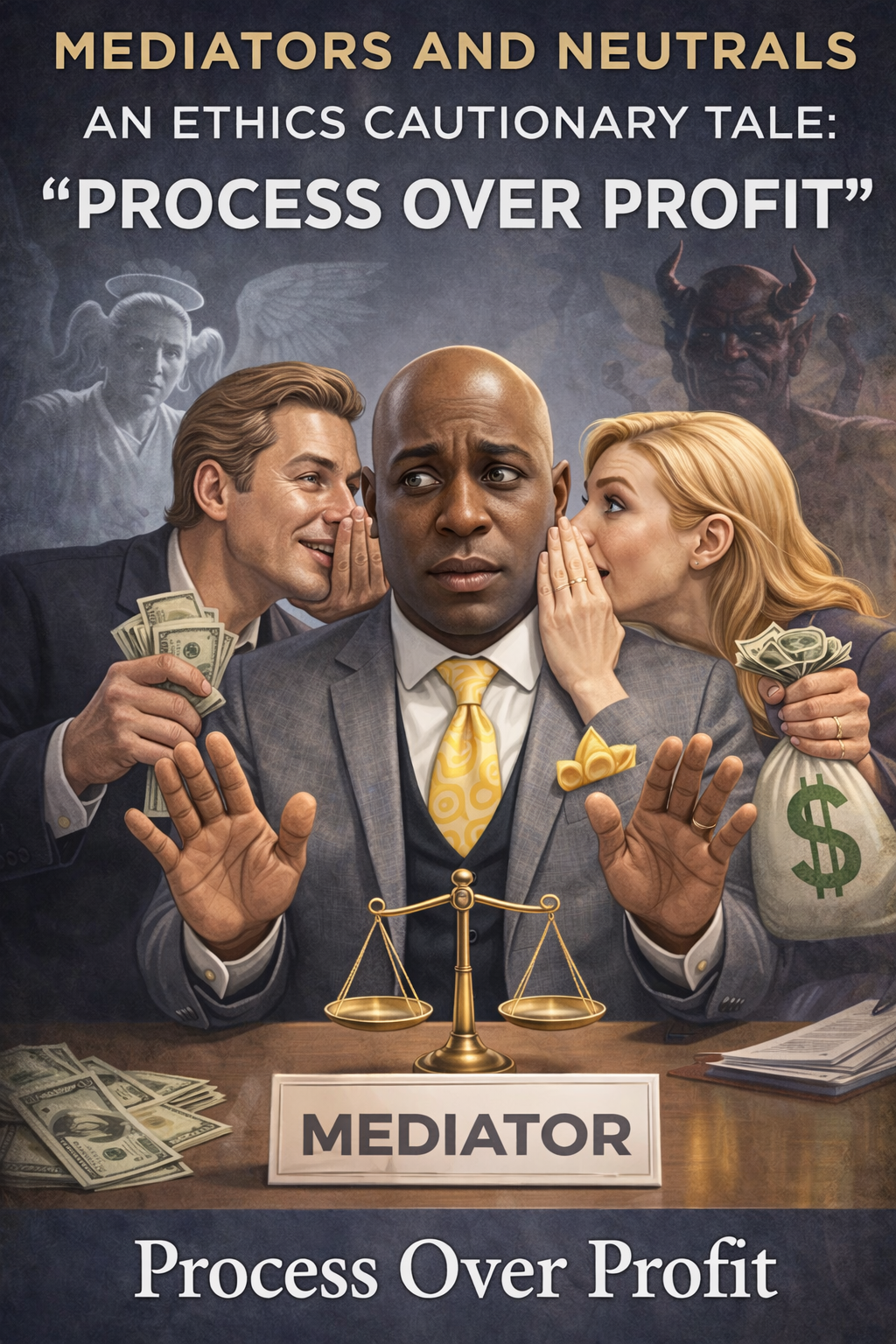
An Ethics Cautionary Tale: Process Over Profit — Translations, How About You?

By Stanley Zamor — Podcast Summary

In the podcast episode “An Ethics Cautionary Tale: Process Over Profit — Translations, How About You?”, Stanley Zamor reflects on a recent mediation experience that raises an issue many neutrals encounter but few openly discuss: the ethical responsibility surrounding proper translation during mediation and the mediator’s duty to safeguard understanding throughout the process.

At the core of the discussion is a foundational principle of mediation — the parties, not the attorneys or the mediator, are the ultimate decision-makers. Because settlement decisions can carry life-altering consequences, mediators have an ongoing obligation to ensure that every participant fully understands the process, the proposals being discussed, and the “parties/litigants” understand implications of their choices. This responsibility does not end once a translator is present; rather, it requires continual monitoring, clarification, and vigilance throughout the mediation session.

The episode highlights an incident that happened during a real litigation commercial case and how ethical obligations, that may seem minor or procedural to other professionals are, in mediation, central to the integrity of the process. Failure to address translation issues, misunderstandings, or communication gaps can undermine self-determination and compromise fairness — both core values of professional mediation practice.

Zamor emphasizes that mediators carry duties that extend beyond client satisfaction or case resolution. Their responsibility is owed simultaneously to the parties, the profession, the mediation process itself, and the courts that rely on mediators to uphold ethical standards. These obligations often differ sharply from the role of advocates, whose focus is understandably aligned with advancing their clients’ interests. This tension can create ethical crossroads for neutrals who must decide whether to prioritize efficiency or procedural integrity.

A central question posed in the podcast challenges mediators directly: How many neutrals truly place process before profit? While the answer may seem obvious in theory, Zamor argues that the reality is more complex. Mediators operate businesses and face economic pressures, making ethical decision-making less straightforward than many assume. The willingness to pause, slow down, or even challenge participants when ethical concerns arise may conflict with business incentives — yet it is precisely in these moments that professional integrity is tested.

The discussion also references the Florida Rules for Certified and Court-Appointed Mediators, which clearly articulate the mediator’s ethical obligations, as well as multiple opinions issued by the Mediator Ethics Advisory Committee (MEAC) addressing translation and communication issues. Despite this guidance, translation concerns remain common and are frequently mishandled, underscoring the need for continued dialogue and education.

Ultimately, the episode serves as both cautionary tale and call to reflection. It challenges mediators to examine their own practices and ask whether they are consistently putting the integrity of the process ahead of convenience or financial considerations. In doing so, Zamor invites the mediation community to reaffirm that ethical vigilance — especially in seemingly routine details — is what protects party self-determination and sustains trust in the profession.

The question lingering at the end is simple but profound: When ethical tensions arise, will you choose process over profit?

Click here for the podcast: https://youtu.be/B2oL-ExMOHo

====================================================================

Stanley Zamor is a Florida Supreme Court Certified Circuit/Family/County Mediator & Primary Trainer and Qualified Arbitrator. Mr. Zamor is a private mediator and serves on several federal and state mediation/arbitration rosters. As an ADR consultant/professional he regularly lectures on a variety of topics from ethics, diversity/culture, bullying, Community Resolution Design, and Family/Business relationships. ZamorADRExpert@gmail.com ; www.effectivemediationconsultants.com; www.LinkedIn.com/in/stanleyzamoradr. (954) 261-8600

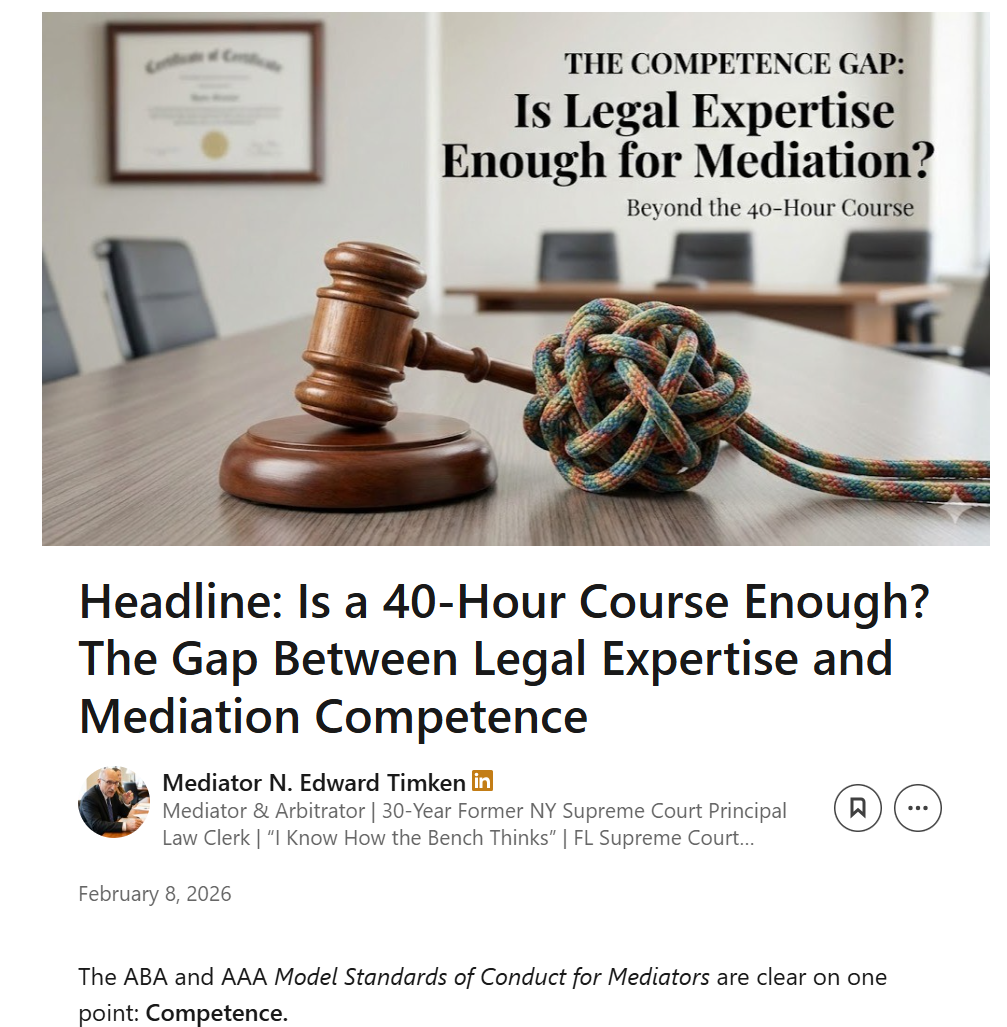
Beyond the 40-Hour Course: Why New Mediators Must Treat Mediation as a Profession — Not a Credential

By Stanley Zamor

Companion Article Inspired by “Is a 40-Hour Course Enough? The Gap Between Legal Expertise and Mediation Competence”

The debate surrounding mediator competency is not new, but it has resurfaced with urgency as more experienced lawyers and retired judges enter the mediation field. The recent discussion raised by Mediator N. Edward Timken challenges a longstanding assumption: that decades of legal or judicial experience, combined with a standard 40-hour certification course, automatically produce a competent mediator.

The short answer is no — and the profession must be honest about why.

Mediation Is a Distinct Skill Set, Not a Legal Extension

The ABA/AAA Model Standards emphasize that mediators should act only when they possess the qualifications necessary to meet reasonable party expectations. Competence is not measured solely by legal knowledge or years in litigation; it is rooted in process mastery, communication skill, emotional intelligence, and the ability to facilitate self-determination.

A judge is trained to decide.

A litigator is trained to persuade.

A mediator is trained to facilitate.

These roles overlap but are fundamentally different. The transition from advocate or decision-maker to neutral facilitator often requires unlearning habits developed over decades — a transformation that cannot realistically be achieved in one week of coursework.

The Instant Competency Myth

One of the most persistent misconceptions in the ADR field is the “instant expert” belief: the idea that prior professional prestige automatically translates into mediation skill.

In reality:

  • Legal analysis does not equal conflict analysis.
  • Case evaluation does not equal process design.
  • Authority does not equal neutrality.

Experienced professionals often possess exceptional substantive knowledge, yet mediation demands something else entirely: the ability to hold competing narratives without endorsing any of them, manage emotional dynamics, and resist the urge to direct outcomes. As the original article notes, mediation is process expertise, not substantive law practice.

Why 40 Hours Is Only the Beginning

The 40-hour training model was designed as an introduction — a structured entry point into mediation principles. It provides vocabulary, ethics frameworks, and exposure to facilitative techniques. It does not, however, produce mastery.

True competency typically requires:

  • Deliberate Practice: Repeated application in varied dispute contexts.
  • Mentorship and Observation: Learning from seasoned neutrals who model advanced techniques.
  • Co-Mediation: Sharing responsibility while receiving real-time feedback.
  • Reflective Development: Continuous self-assessment and improvement.

No serious profession assumes competency after introductory training alone. Pilots, therapists, and surgeons all undergo supervised practice before working independently. Mediation should be no different.

The Lawyer-Mediator Transition: A Psychological Shift

For attorneys and judges entering mediation, the challenge is often psychological rather than intellectual.

Common hurdles include:

  • The instinct to evaluate rather than explore.
  • A tendency to narrow issues instead of expanding possibilities.
  • Overreliance on legal frameworks when parties are driven by emotional, relational, or identity-based concerns.

Effective mediators learn to slow down, invite ambiguity, and tolerate uncertainty — skills rarely rewarded in adversarial legal systems.

The Risk to the Profession

When mediation is treated as a “second-career add-on” rather than a disciplined profession, several risks emerge:

  1. Parties may receive process-poor mediation disguised as legal evaluation.
  2. Public trust in mediation outcomes may weaken.
  3. New mediators may struggle silently, mistaking difficulty for personal failure rather than an expected stage of professional growth.

Raising competency standards is not about gatekeeping; it is about protecting the integrity of the process and ensuring parties receive the quality of facilitation they reasonably expect.

What Serious Skill Development Looks Like

Aspiring and new mediators should approach the profession as an ongoing craft:

  • Engage in advanced negotiation and psychology training.
  • Study conflict dynamics, not just settlement strategies.
  • Seek feedback after every mediation.
  • Develop skills in active listening, reframing, emotional regulation, and rapport building.
  • Participate in peer consultation groups or mentor circles.

The most respected mediators are rarely those with the longest legal résumés — they are often those who treated mediation as its own discipline and committed to continuous learning.

A Call to the Next Generation of Mediators

The mediation field is evolving. Parties increasingly expect neutrals who can manage complexity, emotion, and power imbalance while preserving self-determination. Meeting that expectation requires humility: recognizing that a certification is a beginning, not a declaration of mastery.

The question is not whether a 40-hour course is valuable — it absolutely is. The question is whether we are willing to acknowledge that true mediator competence begins only after the course ends.

For new mediators, the message is clear:

Take the craft seriously. Study deeply. Practice intentionally. Seek mentorship relentlessly.

Because mediation is not a title you earn — it is a skill you continually develop.

Reference: https://www.linkedin.com/pulse/headline-40-hour-course-enough-gap-between-legal-timken–nm30e/?trackingId=X1%2BP7SLPQRWw%2Fx4fe1V0qQ%3D%3D

https://www.linkedin.com/pulse/headline-40-hour-course-enough-gap-between-legal-timken–nm30e/?trackingId=X1%2BP7SLPQRWw%2Fx4fe1V0qQ%3D%3D

How I-DEAL: The Shadow of Mediation

This short podcast is a discussion to introduce the “The Shadow of Mediation”; which is the timeframe that occurs after a mediation conference is held and has ended. The majority of professionals who participate in mediation often behave like once a mediation has concluded, the mediator’s ethical obligations has ended. They are wrong! A mediator’s ethical duty is to the process, profession, parties and the court and does not end when the process does. So neutrals should be be careful.

Stanley Zamor conducts periodic advanced negotiation and mediation advocacy trainings throughout the year where this and other nuances are discussed. During these advanced negotiation/mediation trainings techniques are discussed and demonstrated.

Subscribe, comment about this video and share it with others. If you have any questions for suggestions for future discussions or a question, please forward them to ZamorADRExpert@gmail.com with the subject line “Podcast Inquiry”

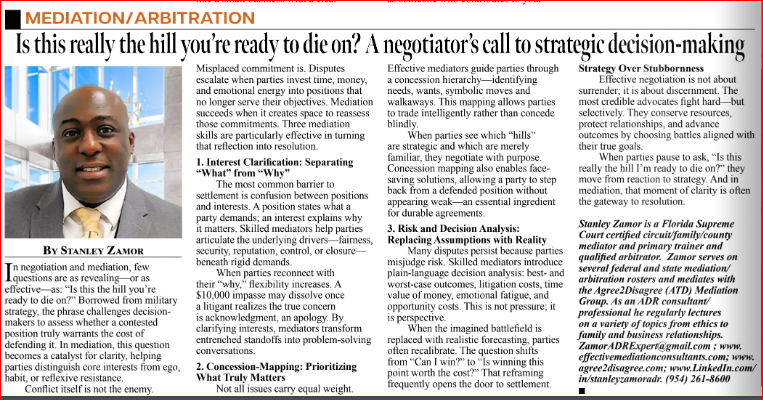
“Is This Really the Hill You’re Ready to Die On?”A Negotiator’s Call to Strategic Decision-Making

By Stanley Zamor

In negotiation and mediation, few questions are as revealing—or as effective—as: “Is this the hill you’re ready to die on?”  Borrowed from military strategy, the phrase challenges decision-makers to assess whether a contested position truly warrants the cost of defending it. In mediation, this question becomes a catalyst for clarity, helping parties distinguish core interests from ego, habit, or reflexive resistance.

Conflict itself is not the enemy. Misplaced commitment is. Disputes escalate when parties invest time, money, and emotional energy into positions that no longer serve their objectives. Mediation succeeds when it creates space to reassess those commitments. Three mediation skills are particularly effective in turning that reflection into resolution.

1. Interest Clarification: Separating “What” from “Why”

The most common barrier to settlement is confusion between positions and interests. A position states what a party demands; an interest explains why it matters. Skilled mediators help parties articulate the underlying drivers—fairness, security, reputation, control, or closure—beneath rigid demands.

When parties reconnect with their “why,” flexibility increases. A $10,000 impasse may dissolve once a litigant realizes the true concern is acknowledgment, an apology. By clarifying interests, mediators transform entrenched standoffs into problem-solving conversations.

2. Concession-Mapping: Prioritizing What Truly Matters

Not all issues carry equal weight. Effective mediators guide parties through a concession hierarchy—identifying needs, wants, symbolic moves and walkaways.  This mapping allows parties to trade intelligently rather than concede blindly.

When parties see which “hills” are strategic and which are merely familiar, they negotiate with purpose. Concession mapping also enables face-saving solutions, allowing a party to step back from a defended position without appearing weak—an essential ingredient for durable agreements.

3. Risk and Decision Analysis: Replacing Assumptions with Reality

Many disputes persist because parties misjudge risk. Skilled mediators introduce plain-language decision analysis: best- and worst-case outcomes, litigation costs, time value of money, emotional fatigue, and opportunity costs. This is not pressure; it is perspective.

When the imagined battlefield is replaced with realistic forecasting, parties often recalibrate. The question shifts from “Can I win?” to “Is winning this point worth the cost?” That reframing frequently opens the door to settlement.

Strategy Over Stubbornness

Effective negotiation is not about surrender; it is about discernment. The most credible advocates fight hard—but selectively. They conserve resources, protect relationships, and advance outcomes by choosing battles aligned with their true goals.

When parties pause to ask, “Is this really the hill I’m ready to die on?” they move from reaction to strategy. And in mediation, that moment of

 clarity is often the gateway to resolution.

Stanley Zamor is a Florida Supreme Court Certified Circuit/Family/County Mediator & Primary Trainer and Qualified Arbitrator.  Mr. Zamor is a private mediator and is on the panel of mediators at Salmon & Dulberg. He also serves on several federal and state mediation/arbitration rosters. As an ADR consultant/professional he regularly lectures on a variety of topics from ethics to Family/Business relationships.  To SCHEDULE A MEDIATION click the link to Stanley Zamor’s calendar https://sd-adr.com/attorney/stanley-zamor/ email his case manager: mariana@sd-adr.com

For direct contact ZamorADRExpert@gmail.com ; www.effectivemediationconsultants.com; www.LinkedIn.com/in/stanleyzamoradr. (954) 261-8600
“An Offer They Can Understand”: Mediation Lessons Through the Lens of The Godfather

“An Offer They Can Understand”: Mediation Lessons Through the Lens of The Godfather

By Stanley Zamor

PART 1

How a cinematic classic reveals enduring truths about negotiation, power dynamics, and the human side of conflict resolution

Few films capture the complexity of human conflict and negotiation as vividly as The Godfather. Although the movie centers on organized crime—a world far removed from professional mediation—its storytelling is steeped in themes of power, loyalty, persuasion, and conflict management. When stripped of its violence and illegality, the film offers surprisingly rich insights into how people navigate disputes, build consensus, and reach agreements under pressure.

This article explores the practice and philosophy of mediation through the lens of The Godfather, focusing on the behaviors, principles, and psychological frameworks that skilled mediators embody.


1. Understanding Interests Beneath Positions: Don Corleone’s Quiet Genius

One of the clearest lessons comes from Don Vito Corleone’s approach to negotiation. He listens carefully, quietly watched, asks open-ended questions, and seeks to understand what each party truly wants, and why. With every single ask, he posed a deeper inquiry which was uncomfortable and revealed the true nature of the want and need.

When Bonasera requests “justice,” the Don reframes the request to uncover the deeper interests—respect, acknowledgment, dignity.
This mirrors a core mediation principle:

People state positions, but they settle based on interests.

A mediator, like Don Corleone in that opening scene, must:

  • Listen beyond the spoken demand
  • Identify underlying motivators
  • Reframe issues into solvable components
  • Recognize emotional drivers (e.g., fear, loyalty, pride)

Successful mediation rests not on adjudicating right and wrong, but on decoding the human needs fueling each party’s stance.


2. Neutrality and Perceived Impartiality: A Lesson in Credibility

Although Don Corleone is not neutral in the political world of the Five Families, he often functions as an impartial convener during disputes. His reputation for fairness, consistency, and honor makes him a trusted figure—even by rivals.

In mediation:

  • Credibility is currency
  • Process fairness builds trust
  • Consistency fosters cooperation
  • Trust is given when competence in the desired want is understood

Participants will not negotiate in good faith if they suspect bias. The mediator’s ability to maintain neutrality—real and perceived—is essential to productive dialogue.

The Godfather demonstrates that neutrality is not the absence of opinion but the disciplined management of influence.


3. “A Man Who Doesn’t Spend Time With His Family…”: Balancing Power and Relationship

Mediation recognizes that relationships are assets, not obstacles. Don Corleone’s strength comes not from fear, but from the deep loyalty of those around him. He builds alliances through respect, reciprocity, and understanding.

Similarly, mediation emphasizes:

  • Preserving relationships where possible
  • Reducing unnecessary hostility
  • Building solutions that allow ongoing cooperation
  • Encouraging parties to see each other as partners, not enemies

Even in business disputes, family conflicts, employment disagreements, or commercial cases, resolution often requires people to continue working together. The Corleone model reminds us that maintaining dignity and relationships often creates more durable outcomes than “winning.”


4. The Power of Framing: “It’s Not Personal, It’s Strictly Business”

Perhaps the most famous line in the film offers a profound mediation truth:
Parties often personalize conflict that is fundamentally structural or systemic.

Mediators help reframe:

  • Emotion → Interests
  • Blame → Understanding
  • Past injuries → Future solutions

This reframing lowers defensiveness and clears space for creative problem-solving. It allows parties to see disputes not as existential threats but as solvable challenges.


5. Managing Power Imbalances: Lessons from the Five Families Summit

During the historic meeting of the Five Families, cooler heads prevail. Each representative brings power, resources, and entrenched perspectives—but the conversation is structured to prevent escalation.

Key mediation parallels:

  • Establish clear ground rules
  • Normalize diverse viewpoints
  • Encourage equal voice despite unequal power
  • Redirect aggressive tactics into constructive dialogue

Effective mediators, like Don Corleone in this scene, leverage calm authority to manage high-conflict personalities and keep the conversation focused on resolution.


6. Timing and Opportunity: “I’ll Wait”

Much of The Godfather revolves around the strategic use of timing. Don Corleone and Michael both understand the importance of waiting for the right moment to engage, negotiate, or respond.

In mediation, timing is often the hidden variable determining success:

  • Parties may need emotional readiness
  • External pressures (deadlines, costs, risk) can create openings for agreement
  • Settlement momentum builds when both parties face meaningful incentives

Skilled mediators read these cues and guide the process accordingly.


7. Respect: The Foundation of Effective Conflict Resolution

Throughout the film, respect is a universal cultural currency. Disputes arise not only from substantive issues, but from perceived affronts, broken trust, or violations of dignity.

Mediation recognizes that:

  • Respect is the gateway to communication
  • Parties engage more constructively when they feel heard
  • Acknowledgment of harm often matters more than remedies

The Corleone philosophy—“You come into my house…with respect”—underscores a core mediation tenet:
Respectful dialogue is the foundation for sustainable agreements.


Conclusion: What The Godfather Teaches Us About Mediation

While The Godfather is not a model of lawful dispute resolution, its narrative illuminates timeless truths about human behavior and negotiation:

  • Understanding interests is more powerful than reacting to positions
  • Neutrality and credibility anchor the process
  • Relationships shape outcomes
  • Reframing creates space for solutions
  • Power dynamics must be managed, not ignored
  • Timing matters
  • Respect transforms conflict

In mediation—as in the world of The Godfather—resolution is ultimately about human psychology. It is about creating processes where people feel heard, respected, and empowered to make decisions they can live with.

The film’s most enduring lesson for mediators may be this:

When you understand people—what they fear, what they value, and what they hope for—you can help them find agreements that were previously unthinkable.

“Conflict is inevitable, so is the resolve…”  -Stanley Zamor

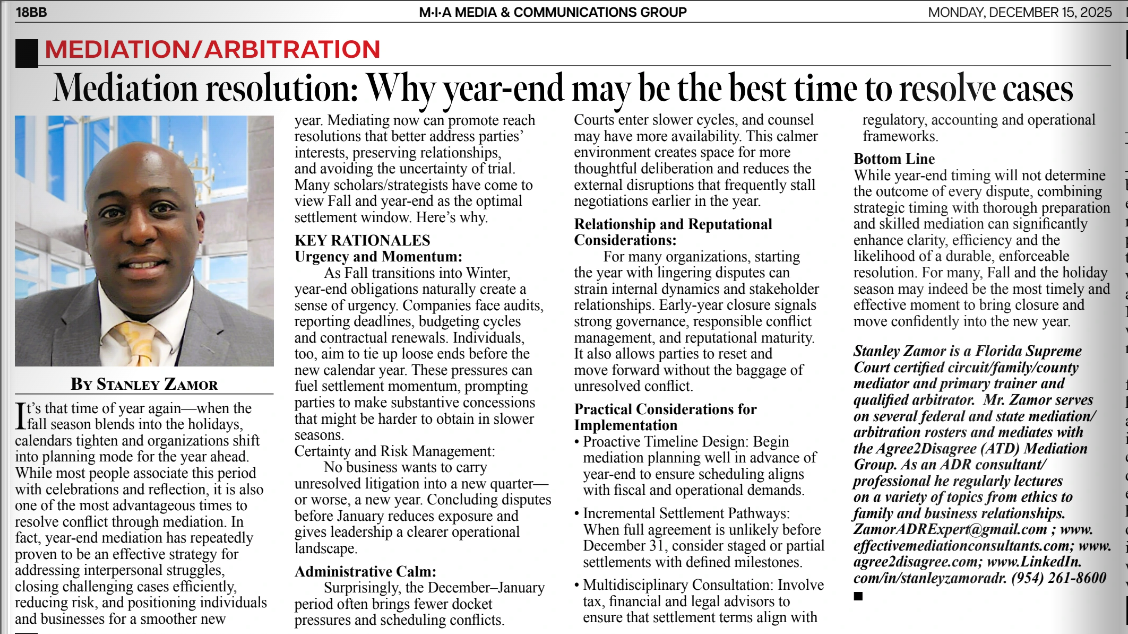
Why Year-End May Be the Best Time to Resolve Cases

Mediation Resolution: Why Year-End May Be the Best Time to Resolve Cases
By Stanley Zamor

It’s that time of year again—when the fall season blends into the holidays, calendars tighten, and organizations shift into planning mode for the year ahead. While most people associate this period with celebrations and reflection, it is also one of the most advantageous times to resolve conflict through mediation. In fact, year-end mediation has repeatedly proven to be an effective strategy for addressing interpersonal struggles, closing challenging cases efficiently, reducing risk, and positioning individuals and businesses for a smoother new year. Mediating now can promote reach resolutions that better address parties’ interests, preserving relationships, and avoiding the uncertainty of trial. Many scholars/strategist have come to view Fall and year-end as the optimal settlement window. Here’s why.

Key Rationales

Urgency and Momentum:
As Fall transitions into Winter, year-end obligations naturally create a sense of urgency. Companies face audits, reporting deadlines, budgeting cycles, and contractual renewals. Individuals, too, aim to tie up loose ends before the new calendar year. These pressures can fuel settlement momentum, prompting parties to make substantive concessions that might be harder to obtain in slower seasons.

Certainty and Risk Management:
No business wants to carry unresolved litigation into a new quarter—or worse, a new year. Concluding disputes before January reduces exposure and gives leadership a clearer operational landscape.

Administrative Calm:
Surprisingly, the December–January period often brings fewer docket pressures and scheduling conflicts. Courts enter slower cycles, and counsel may have more availability. This calmer environment creates space for more thoughtful deliberation and reduces the external disruptions that frequently stall negotiations earlier in the year.

Relationship and Reputational Considerations:
For many organizations, starting the year with lingering disputes can strain internal dynamics and stakeholder relationships. Early-year closure signals strong governance, responsible conflict management, and reputational maturity. It also allows parties to reset and move forward without the baggage of unresolved conflict.

Practical Considerations for Implementation

  • Proactive Timeline Design: Begin mediation planning well in advance of year-end to ensure scheduling aligns with fiscal and operational demands.
  • Incremental Settlement Pathways: When full agreement is unlikely before December 31, consider staged or partial settlements with defined milestones.
  • Multidisciplinary Consultation: Involve tax, financial, and legal advisors to ensure that settlement terms align with regulatory, accounting, and operational frameworks.

Bottom Line

While year-end timing will not determine the outcome of every dispute, combining strategic timing with thorough preparation and skilled mediation can significantly enhance clarity, efficiency, and the likelihood of a durable, enforceable resolution. For many, Fall and the holiday season may indeed be the most timely and effective moment to bring closure and move confidently into the new year.


Stanley Zamor is a Florida Supreme Court Certified Circuit/Family/County Mediator & Primary Trainer and Qualified Arbitrator.  Mr. Zamor serves on several federal/state mediation/arbitration rosters and mediates with the Agree2Disagree (ATD) Mediation Group. As an ADR consultant/professional he regularly lectures on a variety of topics from ethics to Family/Business relationships.  ZamorADRExpert@gmail.com ; www.effectivemediationconsultants.com

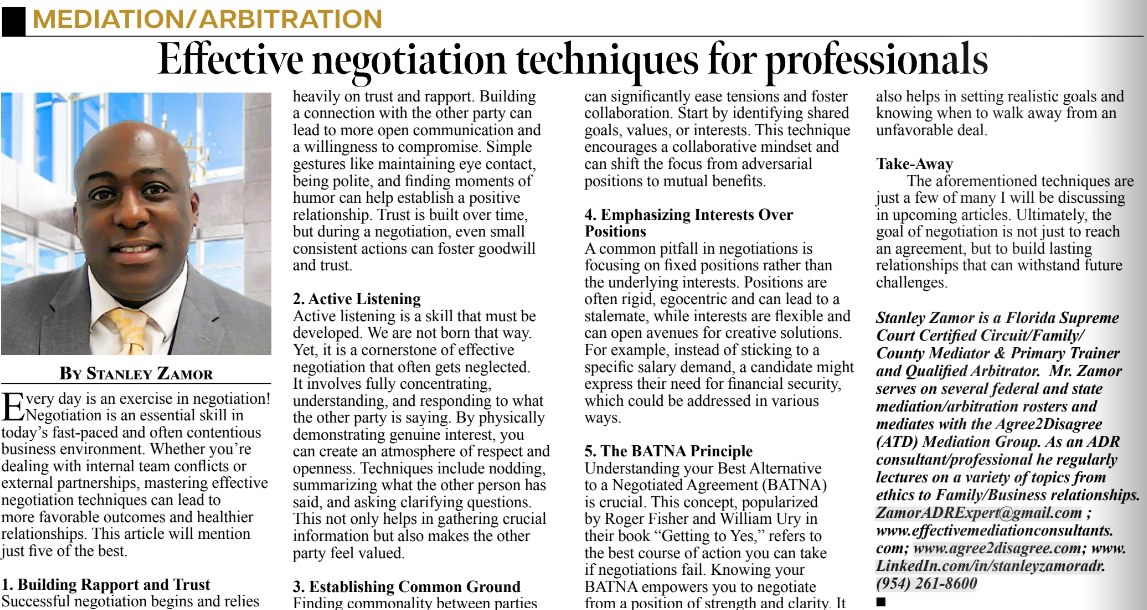
Effective Negotiation Techniques for Professionals

Mediation/Arbitration

“Effective Negotiation Techniques for Professionals”

Every day is an exercise in negotiation! Negotiation is an essential skill in today’s fast-paced and often contentious business environment. Whether you’re dealing with internal team conflicts or external partnerships, mastering effective negotiation techniques can lead to more favorable outcomes and healthier relationships. This article will mention just five of the best negotiation techniques that professionals can utilize.

 1. Building Rapport and Trust

Successful negotiation begins/relies heavily on trust and rapport. Building a connection with the other party can lead to more open communication and a willingness to compromise. Simple gestures like maintaining eye contact, being polite, and finding moments of humor can help establish a positive relationship. Trust is built over time, but during a negotiation even small, consistent actions can foster goodwill/Trust.


 2. Active Listening

Active listening is a skill that must be developed. We are not born active listeners. Yet active listening is a cornerstone of effective negotiation that often gets neglected. It involves fully concentrating, understanding, and responding to what the other party is saying. By physically demonstrating genuine interest, you create an atmosphere of respect and openness. Techniques include nodding, summarizing what the other person has said, and asking clarifying questions. This not only helps in gathering crucial information but also makes the other party feel valued.

 3. Establishing Common Ground

Finding commonality between parties can significantly ease tensions and foster collaboration. Start by identifying shared goals, values, or interests. This technique encourages a collaborative mindset and can shift the focus from adversarial positions to mutual benefits.

4. Emphasizing Interests Over Positions

A common pitfall in negotiations is focusing on fixed positions rather than the underlying interests. Positions are often rigid egocentric and can lead to a stalemate, while interests are flexible and can open avenues for creative solutions. For example, instead of sticking to a specific salary demand, a candidate might express their need for financial security, which could be addressed in various ways.  

5. The BATNA Principle

Understanding your Best Alternative to a Negotiated Agreement (BATNA) is crucial. This concept, popularized by Roger Fisher and William Ury in their book “Getting to Yes,” refers to the best course of action you can take if negotiations fail. Knowing your BATNA empowers you to negotiate from a position of strength and clarity. It helps in setting realistic goals and knowing when to walk away from an unfavorable deal.


 Take-Away

The aforementioned techniques are just a few of many I will be discussing in upcoming articles. Ultimately, the goal of negotiation is not just to reach an agreement, but to build lasting relationships that can withstand future challenges.

Stanley Zamor is a Florida Supreme Court Certified Circuit/Family/County Mediator & Primary Trainer and Qualified Arbitrator.  Mr. Zamor serves on several federal and state mediation/arbitration rosters and mediates with the Agree2Disagree (ATD) Mediation Group. As an ADR consultant/professional he regularly lectures on a variety of topics from ethics to Family/Business relationships.  ZamorADRExpert@gmail.com ; www.effectivemediationconsultants.com; www.agree2disagree.com; www.LinkedIn.com/in/stanleyzamoradr. (954) 261-8600