
Posts

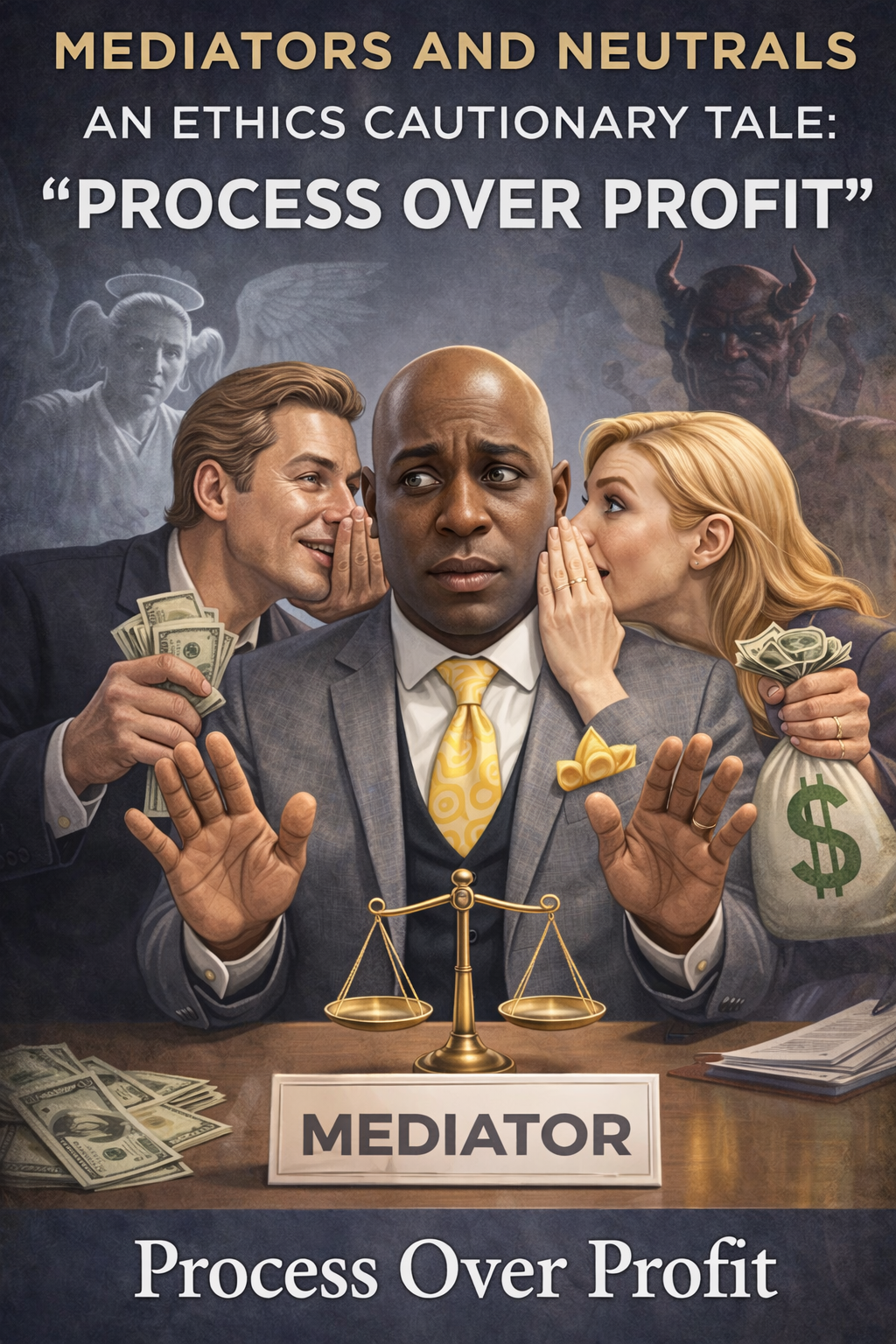
An Ethics Cautionary Tale: Process Over Profit — Translations, How About You?

By Stanley Zamor — Podcast Summary

In the podcast episode “An Ethics Cautionary Tale: Process Over Profit — Translations, How About You?”, Stanley Zamor reflects on a recent mediation experience that raises an issue many neutrals encounter but few openly discuss: the ethical responsibility surrounding proper translation during mediation and the mediator’s duty to safeguard understanding throughout the process.

At the core of the discussion is a foundational principle of mediation — the parties, not the attorneys or the mediator, are the ultimate decision-makers. Because settlement decisions can carry life-altering consequences, mediators have an ongoing obligation to ensure that every participant fully understands the process, the proposals being discussed, and the “parties/litigants” understand implications of their choices. This responsibility does not end once a translator is present; rather, it requires continual monitoring, clarification, and vigilance throughout the mediation session.

The episode highlights an incident that happened during a real litigation commercial case and how ethical obligations, that may seem minor or procedural to other professionals are, in mediation, central to the integrity of the process. Failure to address translation issues, misunderstandings, or communication gaps can undermine self-determination and compromise fairness — both core values of professional mediation practice.

Zamor emphasizes that mediators carry duties that extend beyond client satisfaction or case resolution. Their responsibility is owed simultaneously to the parties, the profession, the mediation process itself, and the courts that rely on mediators to uphold ethical standards. These obligations often differ sharply from the role of advocates, whose focus is understandably aligned with advancing their clients’ interests. This tension can create ethical crossroads for neutrals who must decide whether to prioritize efficiency or procedural integrity.

A central question posed in the podcast challenges mediators directly: How many neutrals truly place process before profit? While the answer may seem obvious in theory, Zamor argues that the reality is more complex. Mediators operate businesses and face economic pressures, making ethical decision-making less straightforward than many assume. The willingness to pause, slow down, or even challenge participants when ethical concerns arise may conflict with business incentives — yet it is precisely in these moments that professional integrity is tested.

The discussion also references the Florida Rules for Certified and Court-Appointed Mediators, which clearly articulate the mediator’s ethical obligations, as well as multiple opinions issued by the Mediator Ethics Advisory Committee (MEAC) addressing translation and communication issues. Despite this guidance, translation concerns remain common and are frequently mishandled, underscoring the need for continued dialogue and education.

Ultimately, the episode serves as both cautionary tale and call to reflection. It challenges mediators to examine their own practices and ask whether they are consistently putting the integrity of the process ahead of convenience or financial considerations. In doing so, Zamor invites the mediation community to reaffirm that ethical vigilance — especially in seemingly routine details — is what protects party self-determination and sustains trust in the profession.

The question lingering at the end is simple but profound: When ethical tensions arise, will you choose process over profit?

Click here for the podcast: https://youtu.be/B2oL-ExMOHo

====================================================================
Stanley Zamor is a Florida Supreme Court Certified Circuit/Family/County Mediator & Primary Trainer and Qualified Arbitrator. Mr. Zamor is a private mediator and serves on several federal and state mediation/arbitration rosters. As an ADR consultant/professional he regularly lectures on a variety of topics from ethics, diversity/culture, bullying, Community Resolution Design, and Family/Business relationships. ZamorADRExpert@gmail.com ; www.effectivemediationconsultants.com; www.LinkedIn.com/in/stanleyzamoradr. (954) 261-8600
Beyond the 40-Hour Course: Why New Mediators Must Treat Mediation as a Profession — Not a Credential

By Stanley Zamor

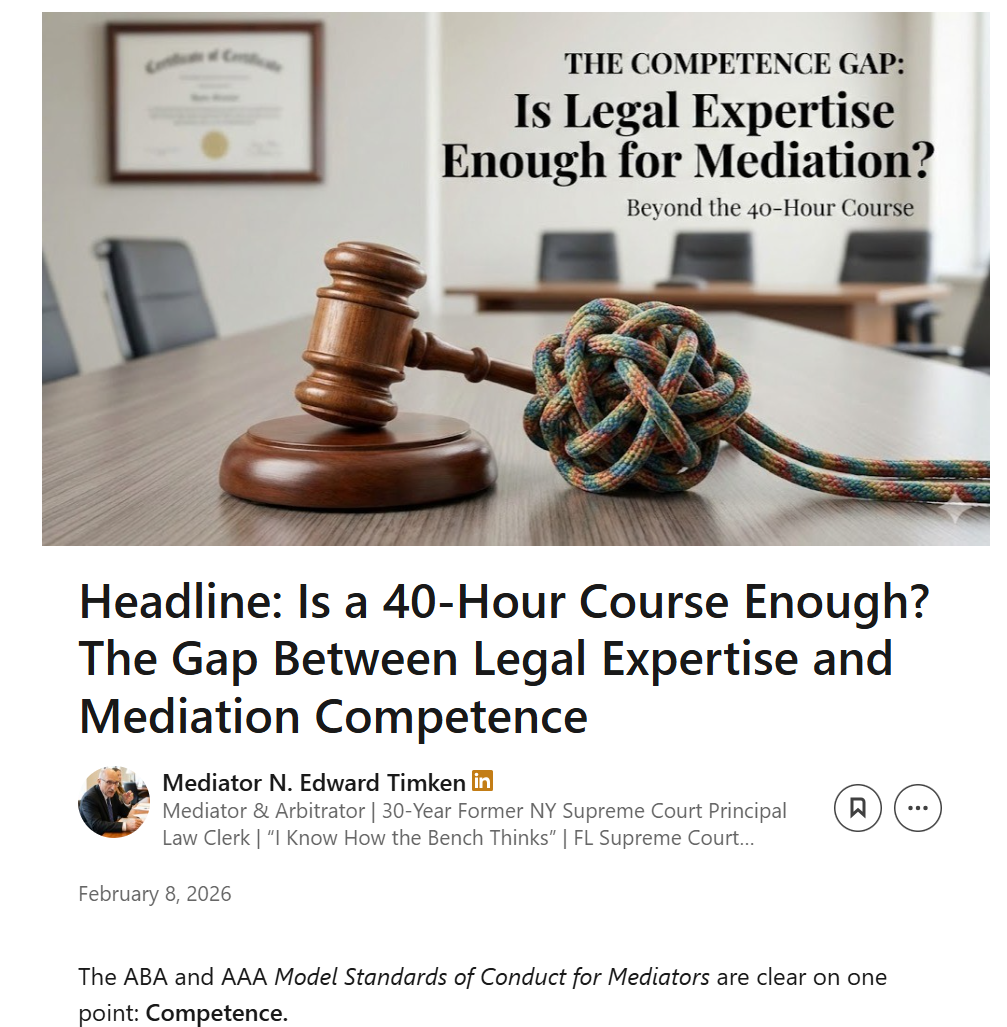
Companion Article Inspired by “Is a 40-Hour Course Enough? The Gap Between Legal Expertise and Mediation Competence”

The debate surrounding mediator competency is not new, but it has resurfaced with urgency as more experienced lawyers and retired judges enter the mediation field. The recent discussion raised by Mediator N. Edward Timken challenges a longstanding assumption: that decades of legal or judicial experience, combined with a standard 40-hour certification course, automatically produce a competent mediator.

The short answer is no — and the profession must be honest about why.

Mediation Is a Distinct Skill Set, Not a Legal Extension

The ABA/AAA Model Standards emphasize that mediators should act only when they possess the qualifications necessary to meet reasonable party expectations. Competence is not measured solely by legal knowledge or years in litigation; it is rooted in process mastery, communication skill, emotional intelligence, and the ability to facilitate self-determination.

A judge is trained to decide.

A litigator is trained to persuade.

A mediator is trained to facilitate.

These roles overlap but are fundamentally different. The transition from advocate or decision-maker to neutral facilitator often requires unlearning habits developed over decades — a transformation that cannot realistically be achieved in one week of coursework.

The Instant Competency Myth

One of the most persistent misconceptions in the ADR field is the “instant expert” belief: the idea that prior professional prestige automatically translates into mediation skill.

In reality:

  • Legal analysis does not equal conflict analysis.
  • Case evaluation does not equal process design.
  • Authority does not equal neutrality.

Experienced professionals often possess exceptional substantive knowledge, yet mediation demands something else entirely: the ability to hold competing narratives without endorsing any of them, manage emotional dynamics, and resist the urge to direct outcomes. As the original article notes, mediation is process expertise, not substantive law practice.

Why 40 Hours Is Only the Beginning

The 40-hour training model was designed as an introduction — a structured entry point into mediation principles. It provides vocabulary, ethics frameworks, and exposure to facilitative techniques. It does not, however, produce mastery.

True competency typically requires:

  • Deliberate Practice: Repeated application in varied dispute contexts.
  • Mentorship and Observation: Learning from seasoned neutrals who model advanced techniques.
  • Co-Mediation: Sharing responsibility while receiving real-time feedback.
  • Reflective Development: Continuous self-assessment and improvement.

No serious profession assumes competency after introductory training alone. Pilots, therapists, and surgeons all undergo supervised practice before working independently. Mediation should be no different.

The Lawyer-Mediator Transition: A Psychological Shift

For attorneys and judges entering mediation, the challenge is often psychological rather than intellectual.

Common hurdles include:

  • The instinct to evaluate rather than explore.
  • A tendency to narrow issues instead of expanding possibilities.
  • Overreliance on legal frameworks when parties are driven by emotional, relational, or identity-based concerns.

Effective mediators learn to slow down, invite ambiguity, and tolerate uncertainty — skills rarely rewarded in adversarial legal systems.

The Risk to the Profession

When mediation is treated as a “second-career add-on” rather than a disciplined profession, several risks emerge:

  1. Parties may receive process-poor mediation disguised as legal evaluation.
  2. Public trust in mediation outcomes may weaken.
  3. New mediators may struggle silently, mistaking difficulty for personal failure rather than an expected stage of professional growth.

Raising competency standards is not about gatekeeping; it is about protecting the integrity of the process and ensuring parties receive the quality of facilitation they reasonably expect.

What Serious Skill Development Looks Like

Aspiring and new mediators should approach the profession as an ongoing craft:

  • Engage in advanced negotiation and psychology training.
  • Study conflict dynamics, not just settlement strategies.
  • Seek feedback after every mediation.
  • Develop skills in active listening, reframing, emotional regulation, and rapport building.
  • Participate in peer consultation groups or mentor circles.

The most respected mediators are rarely those with the longest legal résumés — they are often those who treated mediation as its own discipline and committed to continuous learning.

A Call to the Next Generation of Mediators

The mediation field is evolving. Parties increasingly expect neutrals who can manage complexity, emotion, and power imbalance while preserving self-determination. Meeting that expectation requires humility: recognizing that a certification is a beginning, not a declaration of mastery.

The question is not whether a 40-hour course is valuable — it absolutely is. The question is whether we are willing to acknowledge that true mediator competence begins only after the course ends.

For new mediators, the message is clear:

Take the craft seriously. Study deeply. Practice intentionally. Seek mentorship relentlessly.

Because mediation is not a title you earn — it is a skill you continually develop.

Reference: https://www.linkedin.com/pulse/headline-40-hour-course-enough-gap-between-legal-timken–nm30e/?trackingId=X1%2BP7SLPQRWw%2Fx4fe1V0qQ%3D%3D

https://www.linkedin.com/pulse/headline-40-hour-course-enough-gap-between-legal-timken–nm30e/?trackingId=X1%2BP7SLPQRWw%2Fx4fe1V0qQ%3D%3D

How I-DEAL: The Shadow of Mediation

This short podcast is a discussion to introduce the “The Shadow of Mediation”; which is the timeframe that occurs after a mediation conference is held and has ended. The majority of professionals who participate in mediation often behave like once a mediation has concluded, the mediator’s ethical obligations has ended. They are wrong! A mediator’s ethical duty is to the process, profession, parties and the court and does not end when the process does. So neutrals should be be careful.

Stanley Zamor conducts periodic advanced negotiation and mediation advocacy trainings throughout the year where this and other nuances are discussed. During these advanced negotiation/mediation trainings techniques are discussed and demonstrated.

Subscribe, comment about this video and share it with others. If you have any questions for suggestions for future discussions or a question, please forward them to ZamorADRExpert@gmail.com with the subject line “Podcast Inquiry”

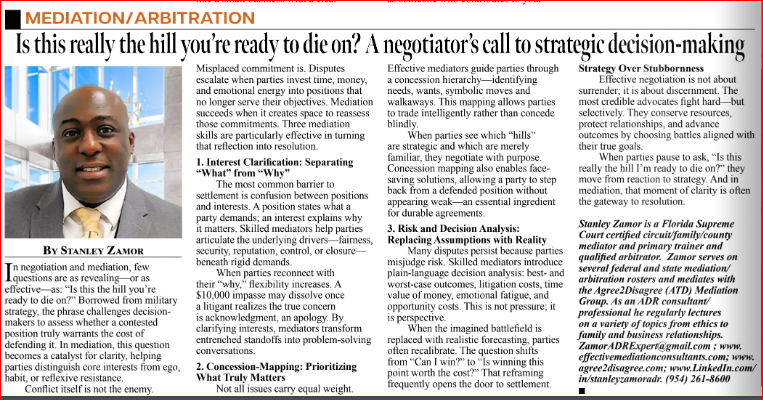
“Is This Really the Hill You’re Ready to Die On?”A Negotiator’s Call to Strategic Decision-Making

By Stanley Zamor

In negotiation and mediation, few questions are as revealing—or as effective—as: “Is this the hill you’re ready to die on?”  Borrowed from military strategy, the phrase challenges decision-makers to assess whether a contested position truly warrants the cost of defending it. In mediation, this question becomes a catalyst for clarity, helping parties distinguish core interests from ego, habit, or reflexive resistance.

Conflict itself is not the enemy. Misplaced commitment is. Disputes escalate when parties invest time, money, and emotional energy into positions that no longer serve their objectives. Mediation succeeds when it creates space to reassess those commitments. Three mediation skills are particularly effective in turning that reflection into resolution.

1. Interest Clarification: Separating “What” from “Why”

The most common barrier to settlement is confusion between positions and interests. A position states what a party demands; an interest explains why it matters. Skilled mediators help parties articulate the underlying drivers—fairness, security, reputation, control, or closure—beneath rigid demands.

When parties reconnect with their “why,” flexibility increases. A $10,000 impasse may dissolve once a litigant realizes the true concern is acknowledgment, an apology. By clarifying interests, mediators transform entrenched standoffs into problem-solving conversations.

2. Concession-Mapping: Prioritizing What Truly Matters

Not all issues carry equal weight. Effective mediators guide parties through a concession hierarchy—identifying needs, wants, symbolic moves and walkaways.  This mapping allows parties to trade intelligently rather than concede blindly.

When parties see which “hills” are strategic and which are merely familiar, they negotiate with purpose. Concession mapping also enables face-saving solutions, allowing a party to step back from a defended position without appearing weak—an essential ingredient for durable agreements.

3. Risk and Decision Analysis: Replacing Assumptions with Reality

Many disputes persist because parties misjudge risk. Skilled mediators introduce plain-language decision analysis: best- and worst-case outcomes, litigation costs, time value of money, emotional fatigue, and opportunity costs. This is not pressure; it is perspective.

When the imagined battlefield is replaced with realistic forecasting, parties often recalibrate. The question shifts from “Can I win?” to “Is winning this point worth the cost?” That reframing frequently opens the door to settlement.

Strategy Over Stubbornness

Effective negotiation is not about surrender; it is about discernment. The most credible advocates fight hard—but selectively. They conserve resources, protect relationships, and advance outcomes by choosing battles aligned with their true goals.

When parties pause to ask, “Is this really the hill I’m ready to die on?” they move from reaction to strategy. And in mediation, that moment of

 clarity is often the gateway to resolution.

Stanley Zamor is a Florida Supreme Court Certified Circuit/Family/County Mediator & Primary Trainer and Qualified Arbitrator.  Mr. Zamor is a private mediator and is on the panel of mediators at Salmon & Dulberg. He also serves on several federal and state mediation/arbitration rosters. As an ADR consultant/professional he regularly lectures on a variety of topics from ethics to Family/Business relationships.  To SCHEDULE A MEDIATION click the link to Stanley Zamor’s calendar https://sd-adr.com/attorney/stanley-zamor/ email his case manager: mariana@sd-adr.com

For direct contact ZamorADRExpert@gmail.com ; www.effectivemediationconsultants.com; www.LinkedIn.com/in/stanleyzamoradr. (954) 261-8600

“An Offer They Can Understand”: Mediation Lessons Through the Lens of The Godfather

“An Offer They Can Understand”: Mediation Lessons Through the Lens of The Godfather

By Stanley Zamor

PART 1

How a cinematic classic reveals enduring truths about negotiation, power dynamics, and the human side of conflict resolution

Few films capture the complexity of human conflict and negotiation as vividly as The Godfather. Although the movie centers on organized crime—a world far removed from professional mediation—its storytelling is steeped in themes of power, loyalty, persuasion, and conflict management. When stripped of its violence and illegality, the film offers surprisingly rich insights into how people navigate disputes, build consensus, and reach agreements under pressure.

This article explores the practice and philosophy of mediation through the lens of The Godfather, focusing on the behaviors, principles, and psychological frameworks that skilled mediators embody.


1. Understanding Interests Beneath Positions: Don Corleone’s Quiet Genius

One of the clearest lessons comes from Don Vito Corleone’s approach to negotiation. He listens carefully, quietly watched, asks open-ended questions, and seeks to understand what each party truly wants, and why. With every single ask, he posed a deeper inquiry which was uncomfortable and revealed the true nature of the want and need.

When Bonasera requests “justice,” the Don reframes the request to uncover the deeper interests—respect, acknowledgment, dignity.
This mirrors a core mediation principle:

People state positions, but they settle based on interests.

A mediator, like Don Corleone in that opening scene, must:

  • Listen beyond the spoken demand
  • Identify underlying motivators
  • Reframe issues into solvable components
  • Recognize emotional drivers (e.g., fear, loyalty, pride)

Successful mediation rests not on adjudicating right and wrong, but on decoding the human needs fueling each party’s stance.


2. Neutrality and Perceived Impartiality: A Lesson in Credibility

Although Don Corleone is not neutral in the political world of the Five Families, he often functions as an impartial convener during disputes. His reputation for fairness, consistency, and honor makes him a trusted figure—even by rivals.

In mediation:

  • Credibility is currency
  • Process fairness builds trust
  • Consistency fosters cooperation
  • Trust is given when competence in the desired want is understood

Participants will not negotiate in good faith if they suspect bias. The mediator’s ability to maintain neutrality—real and perceived—is essential to productive dialogue.

The Godfather demonstrates that neutrality is not the absence of opinion but the disciplined management of influence.


3. “A Man Who Doesn’t Spend Time With His Family…”: Balancing Power and Relationship

Mediation recognizes that relationships are assets, not obstacles. Don Corleone’s strength comes not from fear, but from the deep loyalty of those around him. He builds alliances through respect, reciprocity, and understanding.

Similarly, mediation emphasizes:

  • Preserving relationships where possible
  • Reducing unnecessary hostility
  • Building solutions that allow ongoing cooperation
  • Encouraging parties to see each other as partners, not enemies

Even in business disputes, family conflicts, employment disagreements, or commercial cases, resolution often requires people to continue working together. The Corleone model reminds us that maintaining dignity and relationships often creates more durable outcomes than “winning.”


4. The Power of Framing: “It’s Not Personal, It’s Strictly Business”

Perhaps the most famous line in the film offers a profound mediation truth:
Parties often personalize conflict that is fundamentally structural or systemic.

Mediators help reframe:

  • Emotion → Interests
  • Blame → Understanding
  • Past injuries → Future solutions

This reframing lowers defensiveness and clears space for creative problem-solving. It allows parties to see disputes not as existential threats but as solvable challenges.


5. Managing Power Imbalances: Lessons from the Five Families Summit

During the historic meeting of the Five Families, cooler heads prevail. Each representative brings power, resources, and entrenched perspectives—but the conversation is structured to prevent escalation.

Key mediation parallels:

  • Establish clear ground rules
  • Normalize diverse viewpoints
  • Encourage equal voice despite unequal power
  • Redirect aggressive tactics into constructive dialogue

Effective mediators, like Don Corleone in this scene, leverage calm authority to manage high-conflict personalities and keep the conversation focused on resolution.


6. Timing and Opportunity: “I’ll Wait”

Much of The Godfather revolves around the strategic use of timing. Don Corleone and Michael both understand the importance of waiting for the right moment to engage, negotiate, or respond.

In mediation, timing is often the hidden variable determining success:

  • Parties may need emotional readiness
  • External pressures (deadlines, costs, risk) can create openings for agreement
  • Settlement momentum builds when both parties face meaningful incentives

Skilled mediators read these cues and guide the process accordingly.


7. Respect: The Foundation of Effective Conflict Resolution

Throughout the film, respect is a universal cultural currency. Disputes arise not only from substantive issues, but from perceived affronts, broken trust, or violations of dignity.

Mediation recognizes that:

  • Respect is the gateway to communication
  • Parties engage more constructively when they feel heard
  • Acknowledgment of harm often matters more than remedies

The Corleone philosophy—“You come into my house…with respect”—underscores a core mediation tenet:
Respectful dialogue is the foundation for sustainable agreements.


Conclusion: What The Godfather Teaches Us About Mediation

While The Godfather is not a model of lawful dispute resolution, its narrative illuminates timeless truths about human behavior and negotiation:

  • Understanding interests is more powerful than reacting to positions
  • Neutrality and credibility anchor the process
  • Relationships shape outcomes
  • Reframing creates space for solutions
  • Power dynamics must be managed, not ignored
  • Timing matters
  • Respect transforms conflict

In mediation—as in the world of The Godfather—resolution is ultimately about human psychology. It is about creating processes where people feel heard, respected, and empowered to make decisions they can live with.

The film’s most enduring lesson for mediators may be this:

When you understand people—what they fear, what they value, and what they hope for—you can help them find agreements that were previously unthinkable.

“Conflict is inevitable, so is the resolve…”  -Stanley Zamor

Why Year-End May Be the Best Time to Resolve Cases

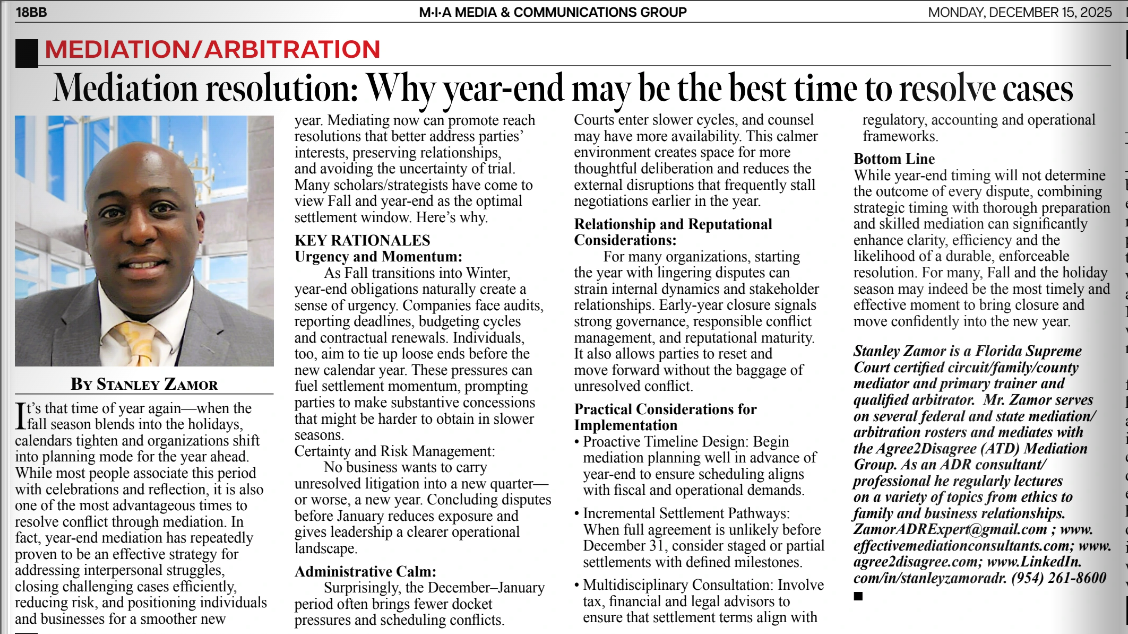
Mediation Resolution: Why Year-End May Be the Best Time to Resolve Cases
By Stanley Zamor

It’s that time of year again—when the fall season blends into the holidays, calendars tighten, and organizations shift into planning mode for the year ahead. While most people associate this period with celebrations and reflection, it is also one of the most advantageous times to resolve conflict through mediation. In fact, year-end mediation has repeatedly proven to be an effective strategy for addressing interpersonal struggles, closing challenging cases efficiently, reducing risk, and positioning individuals and businesses for a smoother new year. Mediating now can promote reach resolutions that better address parties’ interests, preserving relationships, and avoiding the uncertainty of trial. Many scholars/strategist have come to view Fall and year-end as the optimal settlement window. Here’s why.

Key Rationales

Urgency and Momentum:
As Fall transitions into Winter, year-end obligations naturally create a sense of urgency. Companies face audits, reporting deadlines, budgeting cycles, and contractual renewals. Individuals, too, aim to tie up loose ends before the new calendar year. These pressures can fuel settlement momentum, prompting parties to make substantive concessions that might be harder to obtain in slower seasons.

Certainty and Risk Management:
No business wants to carry unresolved litigation into a new quarter—or worse, a new year. Concluding disputes before January reduces exposure and gives leadership a clearer operational landscape.

Administrative Calm:
Surprisingly, the December–January period often brings fewer docket pressures and scheduling conflicts. Courts enter slower cycles, and counsel may have more availability. This calmer environment creates space for more thoughtful deliberation and reduces the external disruptions that frequently stall negotiations earlier in the year.

Relationship and Reputational Considerations:
For many organizations, starting the year with lingering disputes can strain internal dynamics and stakeholder relationships. Early-year closure signals strong governance, responsible conflict management, and reputational maturity. It also allows parties to reset and move forward without the baggage of unresolved conflict.

Practical Considerations for Implementation

  • Proactive Timeline Design: Begin mediation planning well in advance of year-end to ensure scheduling aligns with fiscal and operational demands.
  • Incremental Settlement Pathways: When full agreement is unlikely before December 31, consider staged or partial settlements with defined milestones.
  • Multidisciplinary Consultation: Involve tax, financial, and legal advisors to ensure that settlement terms align with regulatory, accounting, and operational frameworks.

Bottom Line

While year-end timing will not determine the outcome of every dispute, combining strategic timing with thorough preparation and skilled mediation can significantly enhance clarity, efficiency, and the likelihood of a durable, enforceable resolution. For many, Fall and the holiday season may indeed be the most timely and effective moment to bring closure and move confidently into the new year.


Stanley Zamor is a Florida Supreme Court Certified Circuit/Family/County Mediator & Primary Trainer and Qualified Arbitrator.  Mr. Zamor serves on several federal/state mediation/arbitration rosters and mediates with the Agree2Disagree (ATD) Mediation Group. As an ADR consultant/professional he regularly lectures on a variety of topics from ethics to Family/Business relationships.  ZamorADRExpert@gmail.com ; www.effectivemediationconsultants.com

Effective Negotiation Techniques for Professionals

Mediation/Arbitration

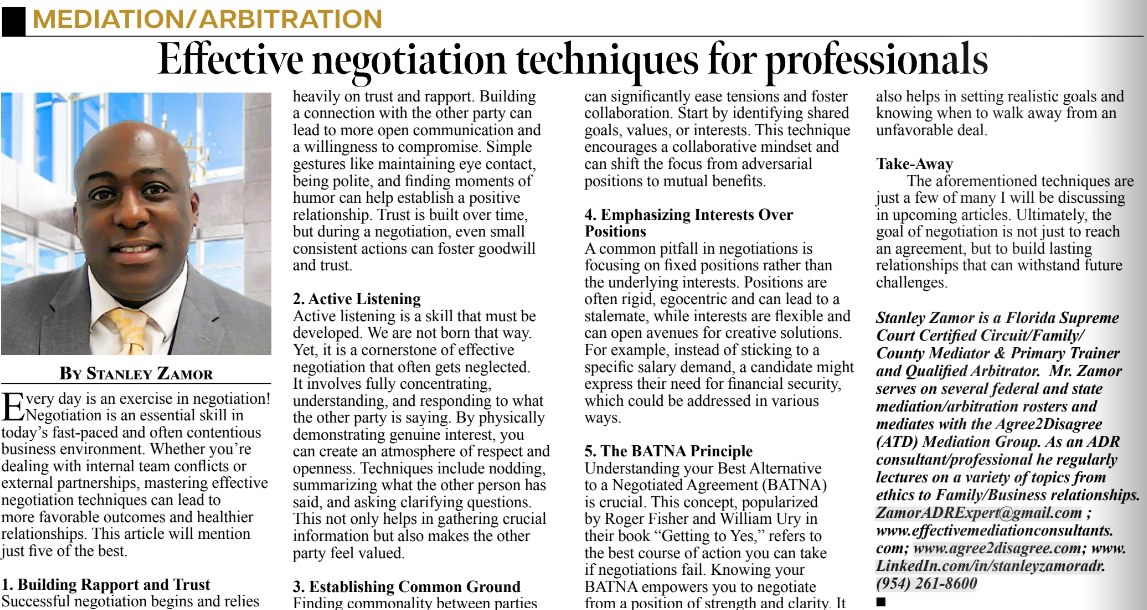
“Effective Negotiation Techniques for Professionals”

Every day is an exercise in negotiation! Negotiation is an essential skill in today’s fast-paced and often contentious business environment. Whether you’re dealing with internal team conflicts or external partnerships, mastering effective negotiation techniques can lead to more favorable outcomes and healthier relationships. This article will mention just five of the best negotiation techniques that professionals can utilize.

 1. Building Rapport and Trust

Successful negotiation begins/relies heavily on trust and rapport. Building a connection with the other party can lead to more open communication and a willingness to compromise. Simple gestures like maintaining eye contact, being polite, and finding moments of humor can help establish a positive relationship. Trust is built over time, but during a negotiation even small, consistent actions can foster goodwill/Trust.


 2. Active Listening

Active listening is a skill that must be developed. We are not born active listeners. Yet active listening is a cornerstone of effective negotiation that often gets neglected. It involves fully concentrating, understanding, and responding to what the other party is saying. By physically demonstrating genuine interest, you create an atmosphere of respect and openness. Techniques include nodding, summarizing what the other person has said, and asking clarifying questions. This not only helps in gathering crucial information but also makes the other party feel valued.

 3. Establishing Common Ground

Finding commonality between parties can significantly ease tensions and foster collaboration. Start by identifying shared goals, values, or interests. This technique encourages a collaborative mindset and can shift the focus from adversarial positions to mutual benefits.

4. Emphasizing Interests Over Positions

A common pitfall in negotiations is focusing on fixed positions rather than the underlying interests. Positions are often rigid egocentric and can lead to a stalemate, while interests are flexible and can open avenues for creative solutions. For example, instead of sticking to a specific salary demand, a candidate might express their need for financial security, which could be addressed in various ways.  

5. The BATNA Principle

Understanding your Best Alternative to a Negotiated Agreement (BATNA) is crucial. This concept, popularized by Roger Fisher and William Ury in their book “Getting to Yes,” refers to the best course of action you can take if negotiations fail. Knowing your BATNA empowers you to negotiate from a position of strength and clarity. It helps in setting realistic goals and knowing when to walk away from an unfavorable deal.


 Take-Away

The aforementioned techniques are just a few of many I will be discussing in upcoming articles. Ultimately, the goal of negotiation is not just to reach an agreement, but to build lasting relationships that can withstand future challenges.

Stanley Zamor is a Florida Supreme Court Certified Circuit/Family/County Mediator & Primary Trainer and Qualified Arbitrator.  Mr. Zamor serves on several federal and state mediation/arbitration rosters and mediates with the Agree2Disagree (ATD) Mediation Group. As an ADR consultant/professional he regularly lectures on a variety of topics from ethics to Family/Business relationships.  ZamorADRExpert@gmail.com ; www.effectivemediationconsultants.com; www.agree2disagree.com; www.LinkedIn.com/in/stanleyzamoradr. (954) 261-8600

Avoiding The F –Bomb While Mediating, Is that Possible?

Ok. I have to finally say it! There just seems to be no way around the F-bomb being dropped or used during mediations (or a negotiation).  I mean, if it is not used by the parties, then it will be used by their advocates/representatives.  And advocates/representatives drop the F-bomb more than most, because as advocates/representatives, that is their job. I get it. I’ve been told that divorce/family attorneys, must drop that F-bomb during their opening presentations or they’ll be perceived as not doing their job? Wow! And as a third-party neutral the F-bomb almost makes the hairs on my neck, stand-on-end. Because once I hear them start their statement, end their statement, or even worse, look me in and say in an inquisitive AND probing tone, “Isn’t that ‘fair’ Mr. Mediator”… “I just want what is fair for my client”…. “We’re trying to be ‘fair’ here” … “We are being more than ‘fair’”…   Yes, Fair. That F-Bomb can completely make a mediation negotiation go left. 

So I ask, is it possible to avoid the F-bomb during a mediation? The simple answer is no.  The more complex answer is, “maybe” or “so what”.  What is fair? Fair is about perspective. When negotiating it is completely subjective. When dealing with heightened emotions it cannot be achieved because the parties and their advocates believe only their perspective is the best and more fair and reasonable (shhhhh! The R-Bomb, that’s for another article). 

Expanding Fair

The perception of what is fair; or being fair in mediation negotiation hinges on several key factors, one of which is the ability of the parties involved to set aside their ego. When disputants are entrenched in their positions, driven by personal pride or a fear of losing face, it becomes challenging to engage in constructive dialogue. Here are a few reasons why letting go of ego is essential when trying to be fair in mediation negotiations:

1. Openness to Compromise: When individuals prioritize their ego, they become less flexible and more focused on winning rather than finding a mutually beneficial solution. Letting go of ego allows for a willingness to consider alternative viewpoints and compromise.

2. Active Listening: Fair negotiation requires active listening, where each party genuinely seeks to understand the other’s perspective. Ego can hinder this process, as individuals may be more focused on defending their stance rather than listening to the other side.

3. Building Trust: Negotiations thrive on trust. If parties are defensive or overly concerned with their self-image, it can create an atmosphere of suspicion. By minimizing ego, negotiators can foster an environment of mutual respect and collaboration.

4. Focus on Interests, Not Positions: Effective negotiation involves focusing on underlying interests rather than rigid positions. Letting go of ego enables parties to explore their true needs and desires, leading to more creative and satisfactory solutions.

5. Reducing Conflict: Ego-driven negotiations often escalate into conflicts. By setting aside personal pride, parties can approach the negotiation with a problem-solving mindset rather than a combative one, reducing the likelihood of confrontation.

The Take-Away

In summary, fair negotiation is only achievable when parties can transcend their egos, allowing for open communication, trust-building, and a focus on collaborative solutions. This shift not only enhances the negotiation process but also fosters better relationships moving forward. A skilled mediator is tasked with continually adjusting and refocusing the participants throughout the mediation negotiation process. It is therefore the skilled, and ethical mediator that is essential in assisting the participants negotiate beyond the ego. A subsequent article will better explore mediator’s best practices and ethical skills that addresses ego and creative solution building.

So rather than debate and attempt to convince why opposing parties are wrong, third-party neutrals should help acknowledge the emotion in the dispute then focus the parties on adjusting the emotional component and reframing it as what makes good “business sense” or what are the best ways to maximize outcomes given the circumstance as they appear that day.  By helping the parties adjust their lens regarding receiving justice and reaching/giving what is fair, they are more open to reaching a agreement that is acceptable that they helped craft.  

So, there is no “fair” in mediation negotiation in the sense that most expect. There is accepting an idea that being fair is not going to be the same for everyone involved in the conflict. And, there is respecting another’s perspective of fair and adjusting participants’ ego while negotiating so a mutually acceptable resolve can be achieved if that is the common goal.   

May 2019 New Administrative Order! Fresh, New & Responsive

[fusion_builder_container hundred_percent=”no” equal_height_columns=”no” menu_anchor=”” hide_on_mobile=”small-visibility,medium-visibility,large-visibility” class=”” id=”” background_color=”” background_image=”” background_position=”center center” background_repeat=”no-repeat” fade=”no” background_parallax=”none” parallax_speed=”0.3″ video_mp4=”” video_webm=”” video_ogv=”” video_url=”” video_aspect_ratio=”16:9″ video_loop=”yes” video_mute=”yes” overlay_color=”” video_preview_image=”” border_size=”” border_color=”” border_style=”solid” padding_top=”” padding_bottom=”” padding_left=”” padding_right=””][fusion_builder_row][fusion_builder_column type=”1_1″ layout=”1_1″ background_position=”left top” background_color=”” border_size=”” border_color=”” border_style=”solid” border_position=”all” spacing=”yes” background_image=”” background_repeat=”no-repeat” padding_top=”” padding_right=”” padding_bottom=”” padding_left=”” margin_top=”0px” margin_bottom=”0px” class=”” id=”” animation_type=”” animation_speed=”0.3″ animation_direction=”left” hide_on_mobile=”small-visibility,medium-visibility,large-visibility” center_content=”no” last=”no” min_height=”” hover_type=”none” link=””][fusion_text columns=”” column_min_width=”” column_spacing=”” rule_style=”default” rule_size=”” rule_color=”” hide_on_mobile=”small-visibility,medium-visibility,large-visibility” class=”” id=””]

From Anticipated Changes to Innovative Responses, This New Administrative Order Responds to What Many Have Been Waiting For….

A new administrative order governing the certification and renewal of mediators has been issued and is effective immediately.  Some changes you will note:

  • Allowing mentorship activities (up to four hours) and lecturing to count as a live method of continuing mediator education (CME);
  • Elimination of the four-hour appellate specific CME requirement for certified appellate mediators;
  • Including attendance at court alternative dispute resolution (ADR) committee and board meetings for time spent on mediation topics as a live method of CME;
  • Inclusion of pre-suit homeowner association (HOA) disputes, within the jurisdiction of the circuit court, mediated by a certified circuit mediator, to qualify for circuit mentorship;
  • Inclusion of the process for the Florida Department of Law Enforcement (FDLE) background screening for mediators seeking certification and certified mediators adding an area of certification;
  • Adoption of the expanded interpersonal violence (IPV) definition for CME activities; and
  • Consolidation of administrative orders AOSC11-1 and AOSC12-48.

There were no increases to the fees for certification or renewal.

AOSC19-26 Governing Certification of Mediators

[/fusion_text][/fusion_builder_column][/fusion_builder_row][/fusion_builder_container]

A New Year of Resolve:  Saying Goodbye to LAST-YEAR’S Litigation and Hello to THIS-YEAR’S Agreed Settlement

By Stanley Zamor                                                                                                                                                            

“It’s 20XX.  Time to let LAST-YEAR go!  You decide.  It is time to accept and expect THIS-YEAR to be the year of RESOLVE!”  During the various mediations I facilitated in 20XX, a common theme I heard by participants to explain their discourse, was that 20XX was a year of build-up, peculiarity and conflicts that seemed to spiral out of control; so the parties (and their attorneys) were ready to settle.  Although parties, and their counsel, self-described the dispute(s) as being “simple”, as the mediation process progressed, simple issues revealed themselves more intractable.  As a professional neutral I am not surprised by parties being unrealistic about the simplicity of their issues (and their resolve).  Managing expectation is not a problem, and it is what a trained professional neutral is trained to do.


So, how do mediation participants leave the past and the old year behind (analogous to litigation);  and move forward like a New Year’s Eve countdown, eager to see the ball drop in Times Square, and at the stroke of midnight, be ready to usher in a new year, a new resolve, an agreed settlement?  The anticipation and expectations of a new year bring new hopes, new dreams, and the achievement of new goals.  But timing is the key; and unless participants are ready to reach a resolution, they will not settle.  To gauge unsure participants and their preparedness to settle, after their 2013 cynical statements, I offered for consideration, “…Preparing a mediation settlement agreement is like preparing for a new year, with New Year’s resolutions.  You craft your goals, and how you want your present and future to be; while litigation focuses on the past year that is now gone.  Litigation forces you to relive regrets, wrongs, missed opportunities and hurts.  Although litigation is your right, and allows you to receive a decision, others ultimately assign a value to your position, with which you may not agree.  Your hurt feelings and intangible concerns are rarely addressed in litigation; and the ‘I SHOULDAS, I WOULDAS, I COULDAS…But I DIDN’T…’ do not get expressed.  However, during a mediation session, there is usually an opportunity to address such concerns and that is when it becomes easier to start fresh, new, and agree to resolve the matter through an agreed settlement…”


After further dialogue and self-assessments, most of the participants saw the value of reaching a settlement agreement that day and were ready to resolve the matter.  I was told that after the mediation session, the settlement agreement created gave them the ability to move forward, onward and upward.  Holding on to the past through litigation felt like dwelling on the “yesterday”, it held them back; and also, living to litigate a case, continued to hurt more than help.  While creating and preparing a settlement agreement, helped set clear future goals, let them be heard and more importantly, allowed for forgiveness and the acceptance of an, “I’m sorry…”.  HAPPY NEW YEAR!


(updated, 2018)