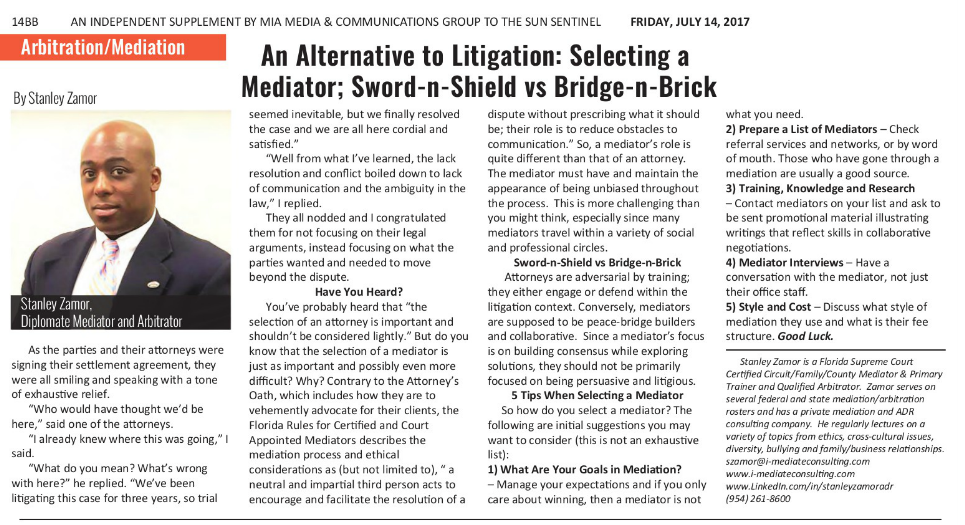
“Selecting a Mediator? Sword-n-Shield vs Bridge-n-Brick”

As the parties and their attorneys were signing their settlement agreement they were all smiling and speaking with a tone of exhaustive relief. One of the attorney stated, “Who would have thought we’d be here…” Smiling, I already knew where this was going, I said, “What do you mean? What’s wrong with here?” He replied, “Well, we’ve been litigating this case for three years so trial seemed inevitable, but we finally resolved the case and we are all here cordial and satisfied.” I responded, “Well from what I’ve learned, the lack resolution and conflict boiled down to lack of communication and the ambiguity in the law.” They all nodded and I congratulated them for not focusing on their legal arguments and focusing on what the parties wanted and needed to move beyond the dispute.  

Have You Heard?

You’ve probably heard that, “…the selection of an attorney is important and shouldn’t be considered lightly…” But do you know that the selection of a mediator is just as important and possibly even more difficult? Why? Well contrary to the Attorney’s Oath which includes how they are to vehemently advocate for their clients; the Florida Rules for Certified and Court Appointed Mediators describes the mediation process and ethical considerations as (but not limited to), “… a neutral and impartial third person acts to encourage and facilitate the resolution of a dispute without prescribing what it should be…their role is to reduce obstacles to communication…” So, a mediator’s role is quite different than that of an attorney. The mediator must be, and maintain, the appearance of being unbiased throughout the process.  This is more challenging than you might think, especially since many mediators travel within a variety of social/professional circles.  

Sword-n-Shield vs Bridge-n-Brick

Attorneys are adversarial by training; they either engage or defend within the litigation context.  Conversely, mediators are supposed to be peace-bridge builders and collaborative.  Since a mediator’s focus is on building consensus while exploring solutions; they should not be primarily focused on being persuasive and litigious.

5 Tips When Selecting a Mediator

So how do you select a mediator?  The following are initial suggestions you may want to consider (this is not an exhaustive list):

  1. What Are Your Goals in Mediation – Manage your expectations and if you only care about “Winning”, then a mediator is not what you need.  
  2. Prepare a List of Mediators – Check referral services/networks, or by word of mouth. Those who have gone through a mediation are usually a good source.
  3. Training, Knowledge & Research –  Contact mediators on your list and ask to be sent promotional material illustrating writings that reflect skills in collaborative negotiations.
  4. Mediator Interviews – Have a conversation with the mediator, NOT, just their office staff.
  5. Style and Cost – Discuss what style of mediation they use and what is their fee structure.

Good Luck.

To see the article as it appeard in the Miami-Herald/Sun Sentinel CLICK HERE

Stanley Zamor is a Florida Supreme Court Certified Circuit/Family/County Mediator & Primary Trainer and Qualified Arbitrator.  Mr. Zamor serves on several federal and state mediation/arbitration rosters and has a private mediation and ADR consulting company.  He regularly lectures on a variety of topics from ethics, cross-cultural issues, diversity, bullying, and Family/Business relationships.  

szamor@i-mediateconsulting.com

www.i-mediateconsulting.com

www.LinkedIn.com/in/stanleyzamoradr

(954) 261-8600

DEATH OF A MEDIATOR (inspired by actual and true events)

I come to you with a heavy heart. I am gravely saddened for our community of professional neutrals because we have lost yet another dedicated certified mediator. Although Albert D. Results, Esq. (“A.D.R”), principal of the 15 year old firm, Sensible Mediation, Inc. is very much alive, he has shut down his Sensible Mediation, Inc. forever, after a 24-month battle against declining revenues.  The closing of Sensible Mediation, Inc. not only effects its principle, who has decided not to recertify and leave Florida, but also its 4 person staff, who are now out of work.

A.D.R  was a well-established litigator (over 25 years) who decided to leave the practice of law and answer, what became the feeling of a higher calling, being a certified mediator.  It was not solely a profession, a side business, or just another way to supplement income like most attorneys turned mediator. It became a way to impact those who participated in the process of mediation who seeking legal justice.  He dedicated himself to conflict resolution and practicing “mindfulness” when mediating.

The circumstances that lead to the death of Sensible Mediation, Inc. is not shocking, just sad and disturbing to know that many dedicated mediators are at risk to the same fate.  Some can speculate that it was today’s unstable economy or the inability to adapt to the millennial business climate.  No. being more aware than that, A.D.R knew it was cronyism and unethical local mediator practices that Sensible Mediation, Inc. refused to bend to.  The large firm cronyism is keeping only certain mediators busy due to personal relationships, while large insurance companies will only select mediators they know serve their interest by conducting mediation how they want.  So, remaining true to its ethics, maintaining principles of mediation and practicing more mindfulness cost Sensible Mediation, Inc. its life.

So farewell Sensible Mediation, Inc. and its principle. You fought the good fight and maintain true to what the promise of mediation is. And although your certified mediator life has come to its end, carry on and good luck with your other endeavors.


This is based on real events. The names have been changed to keep the privacy of the principle and those involved.

A.D.R. has given me permission to write this piece and have asked advocates of ADR and mediators who have taken the time to read this, to stand firm and maintain the dignity of the profession by not letting “Large Firm X” or “BIG Company” control how the profession evolves and how mediation is conducted.


Article_Death_of_a_Mediator

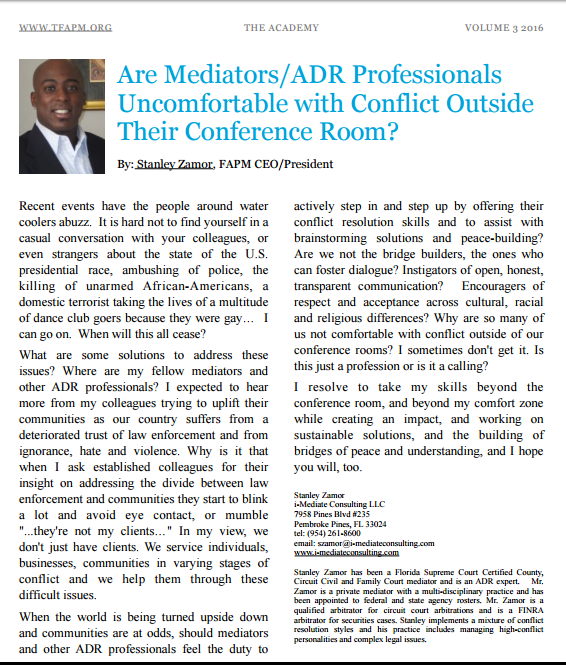
Are Mediators/ADR Professionals Uncomfortable w/ Conflict Outside Their Conference Room?

Appeared in “The Caucus” a publication from The Florida Academy of Professional Mediators Fall 2016 ed.

Fla. Supreme Court Appointments Stanley Zamor to Mediator Ethics Advisory Committee (MEAC)

I am proud to have been recognized and appointed by the Florida Supreme Court to serve on the Mediator Ethics Advisory Committee (MEAC) till 6/30/2020. The MEAC is responsible for rendering ethical opinions based upon written questions from mediators who are subject to the Rules for Certified and Court-Appointed Mediators, rules 10.200-10.690.  View the appointment.MEAC Appointment AOSC16-36    MEAC opinions are published on the Courts website at www.flcourts.org

MEAC Appointment June 2016

The Promise of Mediation: Medical Malpractice and Litigation Made More Humane, It’s Possible

“When in the worst of circumstances, we can find the best in people…” This is a statement I use during mediations. Whether mediating between disputing companies or families, all disputes must have at least two people prepared to negotiate and address high emotional concerns. Similarly, when a patient is dealing with the perception of improper care, misdiagnosis, or wrongful death due to negligence, they feel emotionally hurt, betrayed and demand satisfaction. The harmed and damaged patient seeks legal counsel and they usually file suit, a malpractice claim against the physician, his/her practice and any other person who can be attached to the claim. When a physician is faced with a malpractice claim, they also feel emotionally hurt and betrayed by the patient and immediately seek the advice of their insurer and legal counsel in order to protect themselves, preserve certain rights they may have, and to avoid admitting negligence. The physician often never gets a chance to speak directly to the patient again, and the patient often never gets a chance to address the physician directly with their concerns and emotional pain. With a legal action filed, the adversarial lines are drawn, the litigation process engaged, and the dispute is now reduced to numbers, statistics, and expert opinions. At this point, is it possible to address both parties’ needs/wants and provide each party with a resolution that resolves the case in a less adversarial manner? Yes, through the process of mediation. Mediation offers an opportunity to reach an amicable resolution often not found in litigation. Mediation offers its participants an opportunity to share their story (in their own words), to humanize the dispute, to share and gain perspective of what happened, and often it gives an opportunity to say “sorry” (should an apology be appropriate).


Florida has long been a known as the “…So Sue Me State…” where tort reform remains a hot topic and precedent continues to be made on both sides of the issue. Recognizing the time, cost and the immense consumption of resources involved when litigating a medical malpractice case, the use of mediation as an alternative to litigation is now being seen as an invaluable way to resolve disputes. Under Florida Statute 766.108, Mandatory mediation and mandatory settlement conference in medical negligence actions

(1) Within 120 days after the suit is filed, unless such period is extended by mutual agreement of all parties, all parties shall attend in-person mandatory mediation in accordance with s. 44.102 if binding arbitration under s. 766.207 has not been agreed to by the parties. The Florida Rules of Civil Procedure shall apply to mediation held pursuant to this section…

This provision of the Florida Statutes provides for the process of mediation to be engaged and used to resolve mediation medical malpractice disputes.


The Process of Mediation

Mediation needs to be referred to as a “process” or “conference”; it is not a court hearing or a court session. Mediation is not an extension of the court system, and should not be considered something you check-off in a box on the way to trial. Mediation is a confidential, voluntary process facilitated by a mediator who is an unbiased neutral (an expert at resolution and not solely an expert in a particular subject matter). Whether court appointed or agreed to by both parties, a mediator is engaged (not hired) to assist with the negotiation process under the unwavering principle of party self-determination. Mediation is an opportunity to reach a settlement agreement that is mutually sufficient; and is an alternative to litigation where disputes pertaining to wrongful death, catastrophic injury and negligence can be resolved. Mediation seeks to reach a “Win/Win” solution to a dispute. The mediator can be Circuit Civil Supreme Court Certified and posses the ability and skill to assist the parties with their dispute. Although often court ordered, a mediation is not a court event, but rather it is an informal conference where the parties can appear pro se (self-represented) or with legal representation. Whether the parties have an attorney, or appear pro se, it is the mediator’s role and task to ensure a fair and balanced process.

There are various aspects of the mediation process, but none as important as the Opening Statement. An Opening Statement is where the mediator introduces themselves, the process and has the opportunity to set up the entire process. The Opening allows for the mediator to build rapport and the tone for a fair and balanced process is set with a good opening statement.

Mediations are only effective when both parties are prepared to explore settlement opportunities and they wish to make a good faith effort to resolve the case. Attending mediation with the sole purpose to persuade the other party that their case is weak, and you’ve to proof it, is a recipe to failure. The mediation conference can be held at one of the attorney’s office or at a neutral location selected by the mediator. Mediators are ethically bound and strictly prohibited, from giving legal advice, opinions, and can not assist with legal strategy. A mediator’s role is to assist with consensus building, creating a non-adversarial nonthreatening environment and to help create options for an amicable settlement.

A Medical Malpractice mediation is an emotional process, but with a skilled mediator who understands how to help the parties communicate their needs and reach consensus, it can be an opportunity for venting and allowing the parties to feel their emotional concerns are heard and valued. Mediation can explore different settlement options with all parties and help everyone reach a comfortable plan of action. If the parties are ready to resolve the case, a settlement agreement will be drafted and signed by the mediation participants that same day. The mediator would then file a mediation report and the attorneys would file the appropriate documents ending the case. If a settlement agreement is not reached, then the mediator files a report with the court, only stating that there was no agreement, and the litigation process proceeds.


The Promise

Litigation can be a long and painful, where often litigation participants have to relive painful events repeatedly. Even when a case seems to be a simple win for one party because the facts appear to be strongly supporting their case, there are never any guarantees that a judge or jury will see the same set of facts, in the same way. Litigants rarely have closure and are unable to move forward as the cost, anxiety and the uncertainty of litigation is pending for years. Litigation in a medical malpractice case can cost anywhere from tens of thousands to millions of dollars, and can last for up to 3 years (or even longer). Contrary to the cost, timing, and uncertainty of a court decision, mediation offers an opportunity to be more time and cost efficient, address participants concerns in their own voice and create options and solutions that are often not seen in litigation. Medical Malpractice mediation can take several hours and costs as fractions of what litigation. The promise of mediation is in its process, and how the process of mediation can transform an adversarial painful dispute into an opportunity where all parties mutually benefit from a settlement they created and agree to. When facilitated by a skilled mediator the harmed party feels heard as often emotional needs are met. Simultaneously, the physician can also feel heard, address their emotionally concerns, preserves lost trust and the physician gets a chance to share their humanity during the process. Mediation can truly be a win/win for all.


====================================================================

Stanley Zamor is a Florida Supreme Court Certified Circuit Civil/Family/County Mediator & Trainer and Florida Supreme Court Qualified Arbitrator. He is the current President, Florida Academy of Professional Mediators, Inc. (Florida’s first statewide ADR not-for-profit, est. 1988) and has a private ADR company where he mediates/arbitrates, facilitates workshops and regularly lectures on a variety of topics from cross-cultural issues, diversity, bullying, dispute resolution.


Ethical/Moral Obligations of a Mediator: The Issue Regarding the Disbarred Attorney Participant…

So, our issues begins…. A Mediation was scheduled regarding a Circuit Civil matter. All of the noticed parties were present, the mediator, Plaintiff’s Counsel (“PC”),a Plaintiff’s corporate representative (“PR”) with “full authority” to settle, and the Defendant. Before commencing the mediation, the Defendant stated that they recently retained counsel, who will be filing notice of appearance with the Court, so she would like to wait for them to participate in mediation as they are on their way. The mediation conference was scheduled to start promptly at 1:30 pm. The PC and PR stated that they did not mind, so it was decided to wait for the Defendant’s Attorney (“DA”). After 20 minutes, the(“DA”) still did not arrive, but called twice saying they were delayed during the lunch-time traffic. In the effort to move the mediation forward, all the parties agreed to proceed with the DAparticipating via telephone, until he arrived physically. When the DA eventually arrived, now 45 minutes late, he was updated as to the mediations progress. Throughout the mediation process, the DA was uncooperative, disruptive at times, and constantly stated his position not to concede to anything and to leave the mediation. Although the process was contentious, the case was settled, drafted, and signed by the parties and their counsels. After the mediation ended,it was observed that the DA was overly friendly with one of the paralegals and support staffemployees within the office assisting with copies. So, after everyone left, the mediator asked the paralegal if she knew the DA involved in the mediation. The paralegal timidly nodded, smiled and suggested that the mediator conduct a name search on the Bar’s website. The search revealed that the DA had been recently disbarred. Here are just a few of the many issues/questions that we as Mediators must consider.


  1. Is the mediation settlement agreement valid?
  2. Given this circumstance should the mediator obligated to ensure a Notice of Appearance was appropriately filed? What about a mediation participant’s right to self-determination?
  3. Does the mediator have an obligation to inform the Defendant that their attorney, who was not helpful during the process, has been disbarred?