
Prepared. Lawyered-Up. We’re Ready to Fight…But Not Settle

“No One Wins a War…” & “Litigation is War…”

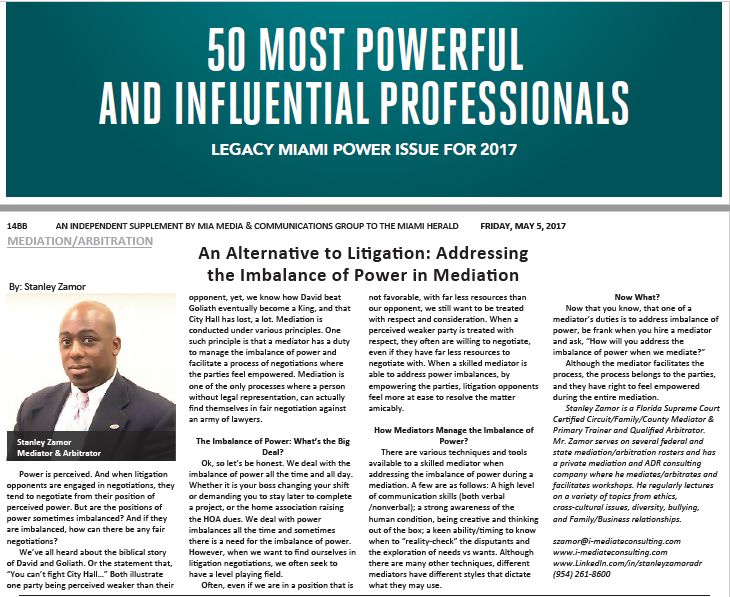
As I closed the door. Exhaled and turned to take my seat at the head of the sixteen person table. I again noticed the impressive tech-heavy modern conference room.  As I looked at the adverse parties and observed the mountains of papers, binders, notes, pens, highlighters and personnel on both sides. I surmised, “Wow, both sides came prepared to ‘war’”.  

My opening statement was short, concise, and I focused on being open to exploring the value of a diversity of perspectives and ideas. LMAO! Once I saw the Plaintiff’s attorney’s smirk and give a “low key” grin I paused, broke protocol, stood up and said to that attorney, “Why are you hear today?” They were silent and appeared caught off guard. Then I turned to the other attorney, “Did you come here to WIN, or negotiate?” Again, another facial surprised expression…” I continued. “We are here to negotiate. We are here to hear and explore opportunities of resolution that may not be what we saw possible. Mediation is not an opportunity to impress upon the mediator how sound your case is or how flawed is the opposing side is, or how “Stare decisis law” compels your legal position… Although you may feel the merits of your case is just. It is the ambiguity that has not allowed you to prevail yet… So! Here, we are. What do you want? And how much are you willing to mutually agree to so you can fight the next fight, move past this issue so you can engage in more pressing ones?”

The room was silent, but the faces were easily understood.  This mediation was not going to be like others. And mediation never has to be a continuation of what they see/feel/do/exercise/experience in court.  Mediation is an opportunity to learn, grow, explore solutions and go beyond what the strategic moves litigation offers.  Litigation is WAR, MEDIATION is the FIRST AND ONLY TIME WHERE SELF-DETERMINATON CAN BE ACHIEVED!

So, as you engage and prepare with your legal team and/or legal counsel, ask yourself, “At the end of the day what do I want to achieve?”  If you want to destroy your adversary; embarrass your former spouse; business partner, relative, friend or employer… mediation may not be what you need/expect.  I have seen the harshest/ugliest of relationships find solace, healing, empathy, understanding and respect within the construct of a “well-facilitated” mediation process, by a full-time dedicated skilled neutral (not a part-timer). Do You Really Want War or Mutual Agreement?

Stanley Zamor is a Florida Supreme Court Certified Circuit/Family/County Mediator & Primary Trainer and Qualified.  Mr. Zamor serves on several federal and state mediation/arbitration rosters and mediates with the Agree2Disagree (ATD) Mediation Group. As an ADR consultant he regularly lectures on a variety of topics from ethics, cross-cultural issues, diversity, bullying, and Family/Business relationships. 

szamor@effectivemediationconsultants.com

www.effectivemediationconsultants.com

www.LinkedIn.com/in/stanleyzamoradr

(954) 261-8600

“When You Negotiate/Mediate BEWARE WHO YOU BRING!?!”

By Stanley Zamor

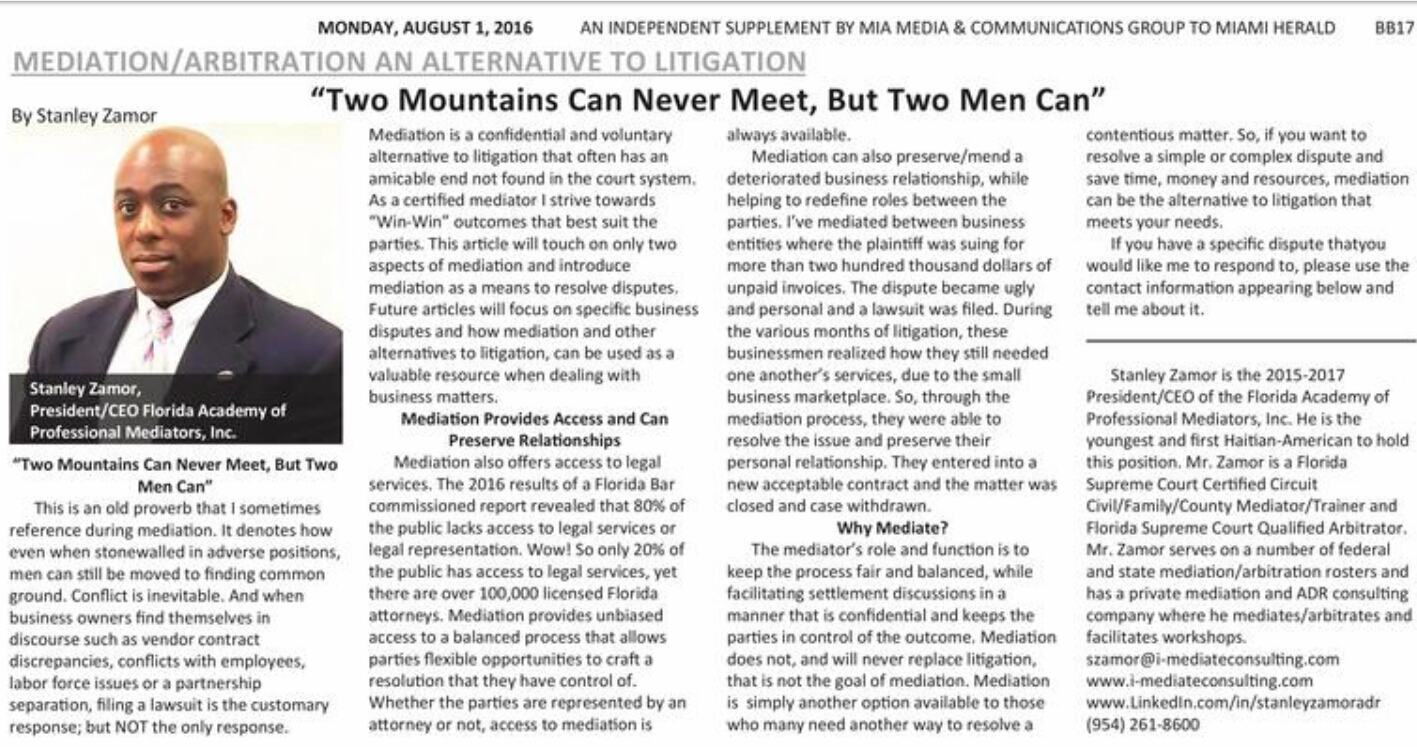
I was recently called by a mediator colleague who seemed hushed, rushed & speaking in a whispering tone. He was at the commencement of a mediation and excused himself to secretly call me in private.  He nervously explained that as he was about to start a commercial mediation conference, and while ushering the Plaintiff and his attorney into the conference room, they abruptly stopped, turned around and refused to enter after seeing the Defendant and the Defendant’s attorney were sitting with a third person unrelated to the lawsuit. The Plaintiff was highly upset and marched into a smaller conference room stating that he refused to mediate if the other person stayed in the mediation. The Plaintiff felt that the third person is largely responsible for most of the dispute.  The Defendants insisted the third person stay.  The Defendants being sued is a small family business and its principal individually.  The third person identified himself as an Attorney-CPA but wanted to participate in support of his cousin (the business owner) and as a friend of the business; he initially assisted with the company’s accounting, vendor accounts and setup.

My colleague stated that he knew the intricacies of the Florida Mediation rules/statutes/ procedures but was stuck. He did not know quite what to do since both sides appeared so ridged and this mediation took months to set up.  What to do?

INSIGHT, PARTY SELF-DETERMINATION

Mediation is a consensual process whereby parties have the unique opportunity to be in control of their own destiny.  Unlike being in court or an arbitration parties can determine how they negotiate and with who.  Often one side may bring someone to the mediation that they other side feels disrupts negotiations. A skilled mediator will know the difference and will encourage a constructive process and dialogue.  

MY SUGGESTION, HOW TO DISCUSS PARTICIPATION

With the Defendant, discuss that only named parties/parties of interest participate in mediation. However, if the Plaintiff agrees there will be restrictions that must be adhered to. The mediator will ask the third party to leave if his behavior less than constructive.

With the Plaintiff, discuss how a third party may have a value and influence on how the Defendant negotiates by setting them at ease. People usually negotiate better when they feel supported, less stress and anxiety doesn’t cloud their judgement.  

OUTCOME

I was later told that the third-party participated in the mediation conference and offered several strategies regarding how to resolve the matter while maintaining vital portions of the business relationship. They settled in four hours.

Stanley Zamor is a Florida Supreme Court Certified Circuit/Family/County Mediator & Primary Trainer and Qualified Arbitrator.  Mr. Zamor serves on several federal and state mediation/arbitration rosters and mediates with the Agree2Disagree (ATD) Mediation Group. As an ADR consultants he regularly lectures on a variety of topics from ethics, cross-cultural issues, diversity, bullying, and Family/Business relationships. 

szamor@effectivemediationconsultants.com

www.effectivemediationconsultants.com

www.LinkedIn.com/in/stanleyzamoradr

(954) 261-8600

Turning Water Into Wine

Turning Water Into Wine[1]

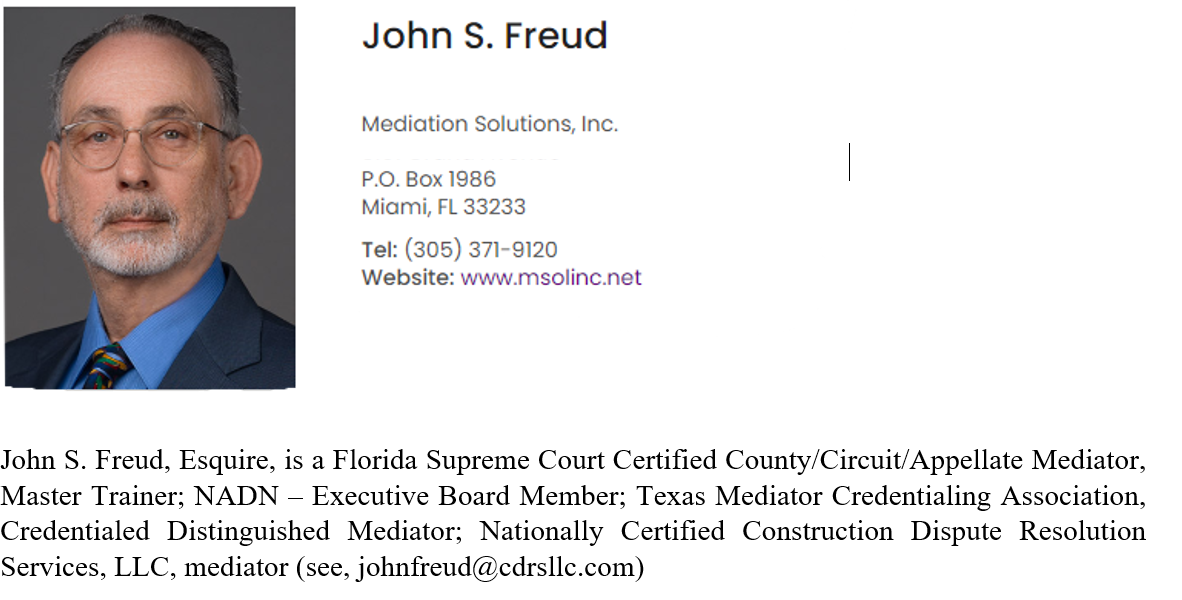
By John S. Freud

“Be like water making its way through cracks. Do not be assertive, but adjust to the object, and you shall find a way around or through it. If nothing within you stays rigid, outward things will disclose themselves…”

–Bruce Lee

Miracles don’t just happen.  They occur, and are then revealed.  For many if not most of us, we must take a giant leap of faith to even begin to be open to the possibility that Miracles can, or could, happen.  Others might argue that Miracles are present for those that choose to acknowledge or recognize the “miraculous” for what it is, or may be – an unexplained phenomenon for which there is no easy answer as to how or why it seemingly, or simply, is.

Christ’s Turning Water Into Wine story (John 2:1-11) is, to his believers, a seminal example of the “miraculous”.  But whether miraculous or not, is interestingly, not the point.  It’s the Belief in the metaphorical outcome of the story that provides the enduringly powerful message to all of us, rather than its historical accuracy or its factual efficacy.  And that message is, anything is possible.

Which leads us to Bruce Lee.  The analogy is not a stretch.  Imaging we are “ water making its way through cracks” might seem at first blush farfetched.  Just like Jesus turning water into wine. But the sentiments underlying both images are the same.  Anything is possible.  What Lee does – and what Jesus omits – is how to make anything possible:

“Do not be assertive, but adjust to the object…nothing within you stays rigid…”

Lee’s “how to” admonitions may be summed up thusly – when adversity comes calling, rather than stiffening your response, soften your resolve.  One “shall find a way around or through” adversity or deep conflict in mediation – “like water finding its way through cracks” – until suddenly “outward things will disclose themselves”.

In a negotiation in mediation, the disclosure of “outward things” – drivers of decision making by principals, motivation of lawyers and insurers, and the like – must reveal themselves in order to find the space necessary for compromise.  Belief – and its discontents – must give way to decision-making that opens parties in deep conflict to the possibility for “anything is possible”, which in mediation includes voluntary resolution of the dispute.

Is the mediation environment a crucible for miracles, or as the saying goes, “mediation magic”?  No.  However, it can be, with fully engaged participants and a skilled mediator committed to “anything is possible”, an environment where unexpected, voluntary resolutions for parties in conflict “disclose themselves”.  

If that is Turning Water Into Wine, I’ll have a glass of your finest!


[1] This is a companion piece to “Mediate, Like Water My Friend – Reflecting on Bruce Lee” By Stanley Zamor, September 2022

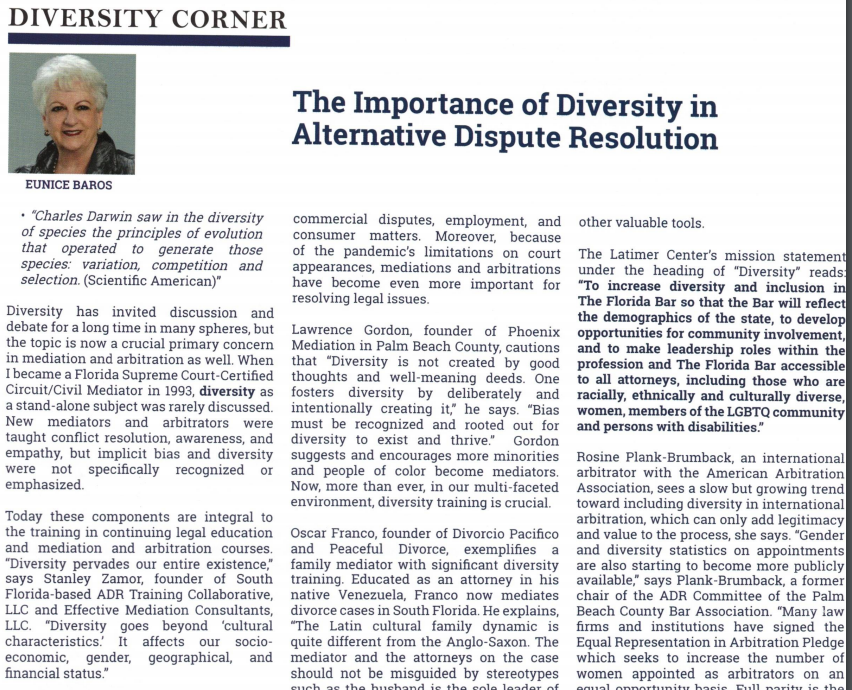
Quotes from “The Importance of Diversity in Alternative Dispute Resolution” June 2021

Baros, Eunice, Palm Beach County Bar Bulletin on Diversity.Mediation

Notable article quotes: (Click here for article)
“Diversity pervades our entire existence …Diversity goes beyond cultural characteristics. If affects our socio-economic, gender, geographical, and financial status.”
“The Covid-19 pandemic has forced us all to be aware of others and not just ourselves. We need to emphasize fairness, equity, values, empowerment and self-determination at every level of our interaction and in every situation in our lives now.”
“We are diverse. We want to be valued, we want to be recognized, we want to be respected. Diversity is what we are. It’s part of the human condition.”


MEDIATION-PTSD. IS THAT A THING?

Post-Traumatic Stress Disorder can develop after a person is exposed to
a traumatic event…

“… You’re a what!?! Did you say a Mediator?!” As I tried to understand his repulsed face he continued. “Sorry I didn’t mean to interrupt your conversation Stanley, but as I passed by and heard you say you’re heading to do a mediation my stomach turned, my blood ran cold and I was immediately brought back to 8 years ago when I meditated for 12 hours! It was horrible! I HATE mediation, and mediators are worse than lawyers! I mean my lawyer, said that this retired judge was pushy and often was used because she was good at getting deals done. And she can give us a look at what another judge might do. It was the worst decision of my life. Well second worst, staying in my marriage 9 years to long was the 1st. And after 12 hours NOTHING got done. 12 hours man! And, I tell you what. If the judge, I mean mediator, always came in beating me up on me and saying, ‘As a judge, I would rule this way or that- way, or, ‘You know she could get permanent alimony due to her disability… I would strongly consider that when I was on the bench’. I mean come on! Talk about against the man in a divorce. I refused to settle after that… No! she was completely biased and on my wife’s side. It was a pity-party that didn’t need to be done because my ex only uses her disability issue when she wants. And the mediator never wanted to hear that. My ex was a complete bully to me and her family which is why they were all my witnesses at the trial 8 months later. Sorry. But I just hate mediation…”
Wow! I was shocked at how expressive Mr. Jay was. Since I’ve known him for about 18 months and after many conversations after the gym, he never had such a harsh tone… So, with an empathic-understanding tone, I said. “I hear you, Jay. And yeah, many mediators are not well trained in conflict resolution but rather stay within their adversarial-approach to conflict resolution even as they mediate. But I know some fantastic former judge mediators, so do not lump them all the same. And I am sorry you feel that way about mediation. Mediation really is an awesome process and is supposed to be a balanced process. Even in our Florida ethical rules, like 10.200, it promotes the ‘…use, understanding and satisfaction of the process for the parties’”.
Jay shook his head saying, “What I experienced should be illegal. It’s too late now, and I should have done something before, but what, I do not know. I was so distraught from the hurricane of the divorce. I didn’t think I could do anything anyway, she was a judge, what could I do. I was in no place mentally or emotionally to deal with it. Divorce is just such a terrible thing. But now I am thinking, how many other people did she do that too… it’s just wrong…”
We continued to speak where I hopefully showed him that although his experience was not exclusive, and it does happen quite often, it is not the process or the profession that is at fault, it’s the practitioner and lack of training.

MEDIATION IS NOT ABOUT THE DEAL…
WE HAVE A DUTY TO THE PARTIES, PROCESS, PROFESSION & COURT…
TRAINING MATTERS…

The Positive-Impasse: Video-Mediation Observation Recap Discussion

A Positive Impasse? Insurance Property Loss. Kris (mentee) and I discuss and debrief about what she observed and learned by watching Stanley Zamor mediate a First Party Home Insurance case. Debriefing and discussing the process is advantageous for both the observer and a seasoned skilled mediator. The learning process never ends and only makes you better. Every mediation is essentially different, and the dynamics of how parties negotiate is paramount to the process. This mediation ultimately resolved a few days later even though it ended in an no agreement initially. This recap highlights the following (but not limited it): 1) Negotiation styles 2) The stark differences between the Attorney to client relationship and how they negotiation throughout the process 3) Party empowerment 4) Party self-determination 5) The Mediators ethics – Opinion and Advice 6) How to promote negotiations after an impasse 7) Issue presented by advocates/attorneys who may not want to resolve cases.

An Alternative to Litigation: “3 Effective Negotiation Strategies”

“Ultimate excellence lies not in winning every battle, but in defeating the enemy without ever fighting…” –Sun Tzu.


As a mediator I continue to study the Sun Tzu’s the “Art of War”. Not because I support War/conflict but rather, I believe that to effectuate collaborative solutions one must be prepared for multiple manners of “warring”. The Art of War offers a great amount of wisdom that can be used in a variety of industries.  As a mediator I have observed disputants being counterproductive throughout a mediation conference because they are too focused on winning, although they both were very interested in avoiding a trial.  It takes a great amount of awareness to help those achieve what they say they want, without them feeling like they gave up what they need


Negotiation opponents often think that the only way to negotiate is to intimidate and by a show of power.  There are a multitude negotiation approaches/styles and they all have distinct advantages and disadvantages. The following are the 3 that I’ve seen initially be more effective:


3 Negotiation Strategies


  • Reduce the Conflict – Conflict is expensive.  Before you engage in a lengthy litigation matter or negotiation effort, be honest and strategize on the business of conflict.  If there are a multitude of issues, try reducing them to the most essential points of conflict. Often when you have a chance to narrow down the issues that need to be address, you narrow down the cost/time that may be incurred.


  • “Enlarge the Pie”– A rarely used technique is to creatively broaden the options of agreeable outcomes. Often disputants only come to negotiate with limited ideas of what is owed or due to them. So, in turn they negotiate with a limited view of possible outcomes.  When you negotiate from a position of having plenty of outcomes you tend to be more flexible and reach agreement easier.  By “enlarging the pie” you create the tone that greater options are available to those with the willingness to seek greater options.


  • Separate the Person from the Issue – “If it is only business, keep it that way!” Behavior during negotiation is key, and perception is everything. When parties state “…it is just business, this is a simple case…”, I always expect more much more.  We are all human and therefore what should be simple can easily turn into frustration and lashing out when the other side just doesn’t see how wrong you think they are. Be mindful of harsh negotiations turning into name-calling or personality trait bashing.  To reduce the frustration/emotions, it is always better to objectively remain on the matter in dispute and not who is doing the negotiating.


Mediation is artfully delicate process and should be facilitated by a professional neutral with the unique skill sets that promote collaboration, party self-determination while encouraging negotiations.


Stanley Zamor is a Florida Supreme Court Certified Circuit/Family/County Mediator & Primary Trainer and Qualified Arbitrator.  Mr. Zamor serves on several federal and state mediation/arbitration rosters and has a private mediation and ADR consulting company.  He regularly lectures on a variety of topics from ethics, cross-cultural issues, diversity, bullying, and Family/Business relationships.


A New Year of Resolve:  Saying Goodbye to LAST-YEAR’S Litigation and Hello to THIS-YEAR’S Agreed Settlement

By Stanley Zamor                                                                                                                                                            

“It’s 20XX.  Time to let LAST-YEAR go!  You decide.  It is time to accept and expect THIS-YEAR to be the year of RESOLVE!”  During the various mediations I facilitated in 20XX, a common theme I heard by participants to explain their discourse, was that 20XX was a year of build-up, peculiarity and conflicts that seemed to spiral out of control; so the parties (and their attorneys) were ready to settle.  Although parties, and their counsel, self-described the dispute(s) as being “simple”, as the mediation process progressed, simple issues revealed themselves more intractable.  As a professional neutral I am not surprised by parties being unrealistic about the simplicity of their issues (and their resolve).  Managing expectation is not a problem, and it is what a trained professional neutral is trained to do.


So, how do mediation participants leave the past and the old year behind (analogous to litigation);  and move forward like a New Year’s Eve countdown, eager to see the ball drop in Times Square, and at the stroke of midnight, be ready to usher in a new year, a new resolve, an agreed settlement?  The anticipation and expectations of a new year bring new hopes, new dreams, and the achievement of new goals.  But timing is the key; and unless participants are ready to reach a resolution, they will not settle.  To gauge unsure participants and their preparedness to settle, after their 2013 cynical statements, I offered for consideration, “…Preparing a mediation settlement agreement is like preparing for a new year, with New Year’s resolutions.  You craft your goals, and how you want your present and future to be; while litigation focuses on the past year that is now gone.  Litigation forces you to relive regrets, wrongs, missed opportunities and hurts.  Although litigation is your right, and allows you to receive a decision, others ultimately assign a value to your position, with which you may not agree.  Your hurt feelings and intangible concerns are rarely addressed in litigation; and the ‘I SHOULDAS, I WOULDAS, I COULDAS…But I DIDN’T…’ do not get expressed.  However, during a mediation session, there is usually an opportunity to address such concerns and that is when it becomes easier to start fresh, new, and agree to resolve the matter through an agreed settlement…”


After further dialogue and self-assessments, most of the participants saw the value of reaching a settlement agreement that day and were ready to resolve the matter.  I was told that after the mediation session, the settlement agreement created gave them the ability to move forward, onward and upward.  Holding on to the past through litigation felt like dwelling on the “yesterday”, it held them back; and also, living to litigate a case, continued to hurt more than help.  While creating and preparing a settlement agreement, helped set clear future goals, let them be heard and more importantly, allowed for forgiveness and the acceptance of an, “I’m sorry…”.  HAPPY NEW YEAR!


(updated, 2018)