ebook dispute resolution, mediation, odr

eBook: “TeDR The Future of Dispute Resolution” Stanley’s Dedication
Salutations!!!

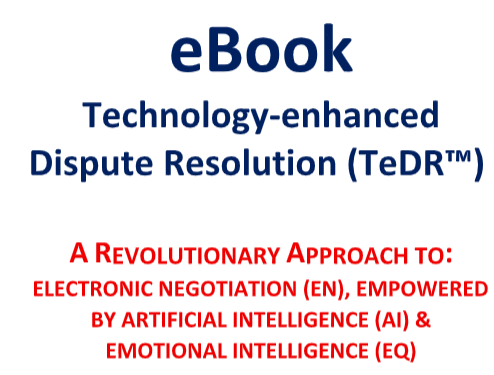
A big milestone has finally be achieved! I am thrilled and proud to announce the launch of our new eBook: “TeDR: The Future of Dispute Resolution” was published today.

Thanks to the vision and drive of the founder and my co-author David Puckett of the TeDR Methodology. It has been under development for over a decade, including two patent application processes. In about 90 days, the book will be available on Amazon for free, but for Facebook friends and family, it will be available for free download!

DOWNLOAD: https://cognitive-rs.com/

Here is my dedication:

“I’d like to dedicate this book first to my devoted parents Jean and Paulette Zamor without their firm hands, guidance, “tough-love”, encouragement I would have never accomplished anything. They came to this country as Haitian immigrants not speaking the language or understanding the American culture and they worked extremely hard and taught my four siblings and I that you have to earn your place in this world. And with consistent hard work/study with an open mind and a faithful heart God will always provide. Thank you.

To my children, whose love and laughter fill my life with joy and purpose. You all inspire me every day. And my commitment to lead by example is continuously making me strive for more. You can do anything and everything you want. The only limits you have are those you accept or place on yourself, so never stop.

To my favorite cousins (you know who you are) for the countless memories and the bonds of family that enrich my life. I know I am seen and always referred to as the wild-cousin, so thank you for accepting me for me!

To my teachers at Ss Joachim and Anne and Immaculate Conception private Catholic school in Queens, New York, you pushed me harder than I wanted to and ignited my passion for learning, faith and instilled in me the values of curiosity and critical thinking.

To my piano and guitar teacher(s), who opened the door to a world of music and expression, from 400 year old concert classics, shredding riffs to the Southern Blues, you all always encouraged me to embrace my creativity and never stay in the shadows. Challenge myself, stay humble, remain consistent and yes I do belong on any stage I choose.

To my team sports coaches/tennis coaches, martial arts instructors and Sensei(s) the discipline learned in music is great but I found the measure of my inner strength and what I can handle in what you all put me through, the competitions and tournaments where I succeeded and failed. I always faced bigger and tougher competition but no one person, was tougher than what I had to overcome inside. Thank you.

To my undergraduate Pre-law professors, who provided me with the tools to follow and expand on my dedication in law and a legal professional path. To my esteemed post graduate professors at Nova Southeastern University School of Humanities and Social Sciences, Department of Conflict Analysis and Resolution, whose insights deepened my understanding of the human condition, social science, peace-studies and the importance of empathy in resolving conflicts.

To my co-author David Puckett, WOW! It’s been over a decade since we started this journey and I’ve never lost faith in your vision. Many have come and gone but I believed that your Kentucky charm, vision, natural industry disruptive nature and your shared passion to impact the conflict resolution space would lead us to this very moment. We did it buddy!

With heartfelt gratitude to all of you and to those I may have missed, thank you for your guidance, support, and inspiration throughout my journey.”

Effective Negotiation Techniques for Professionals

Mediation/Arbitration

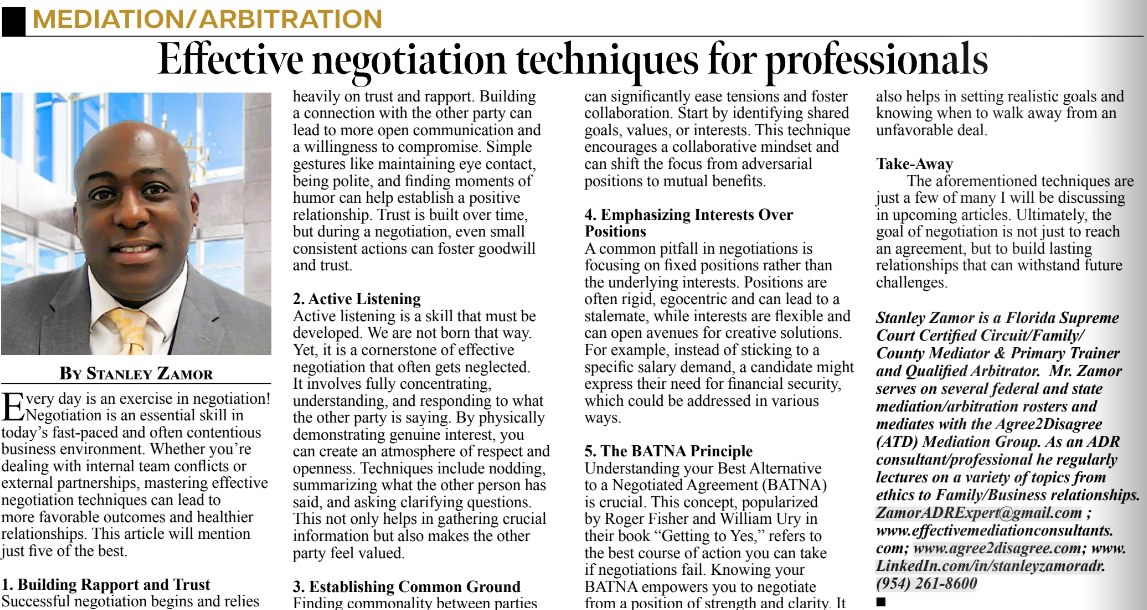
“Effective Negotiation Techniques for Professionals”

Every day is an exercise in negotiation! Negotiation is an essential skill in today’s fast-paced and often contentious business environment. Whether you’re dealing with internal team conflicts or external partnerships, mastering effective negotiation techniques can lead to more favorable outcomes and healthier relationships. This article will mention just five of the best negotiation techniques that professionals can utilize.

 1. Building Rapport and Trust

Successful negotiation begins/relies heavily on trust and rapport. Building a connection with the other party can lead to more open communication and a willingness to compromise. Simple gestures like maintaining eye contact, being polite, and finding moments of humor can help establish a positive relationship. Trust is built over time, but during a negotiation even small, consistent actions can foster goodwill/Trust.


 2. Active Listening

Active listening is a skill that must be developed. We are not born active listeners. Yet active listening is a cornerstone of effective negotiation that often gets neglected. It involves fully concentrating, understanding, and responding to what the other party is saying. By physically demonstrating genuine interest, you create an atmosphere of respect and openness. Techniques include nodding, summarizing what the other person has said, and asking clarifying questions. This not only helps in gathering crucial information but also makes the other party feel valued.

 3. Establishing Common Ground

Finding commonality between parties can significantly ease tensions and foster collaboration. Start by identifying shared goals, values, or interests. This technique encourages a collaborative mindset and can shift the focus from adversarial positions to mutual benefits.

4. Emphasizing Interests Over Positions

A common pitfall in negotiations is focusing on fixed positions rather than the underlying interests. Positions are often rigid egocentric and can lead to a stalemate, while interests are flexible and can open avenues for creative solutions. For example, instead of sticking to a specific salary demand, a candidate might express their need for financial security, which could be addressed in various ways.  

5. The BATNA Principle

Understanding your Best Alternative to a Negotiated Agreement (BATNA) is crucial. This concept, popularized by Roger Fisher and William Ury in their book “Getting to Yes,” refers to the best course of action you can take if negotiations fail. Knowing your BATNA empowers you to negotiate from a position of strength and clarity. It helps in setting realistic goals and knowing when to walk away from an unfavorable deal.


 Take-Away

The aforementioned techniques are just a few of many I will be discussing in upcoming articles. Ultimately, the goal of negotiation is not just to reach an agreement, but to build lasting relationships that can withstand future challenges.

Stanley Zamor is a Florida Supreme Court Certified Circuit/Family/County Mediator & Primary Trainer and Qualified Arbitrator.  Mr. Zamor serves on several federal and state mediation/arbitration rosters and mediates with the Agree2Disagree (ATD) Mediation Group. As an ADR consultant/professional he regularly lectures on a variety of topics from ethics to Family/Business relationships.  ZamorADRExpert@gmail.com ; www.effectivemediationconsultants.com; www.agree2disagree.com; www.LinkedIn.com/in/stanleyzamoradr. (954) 261-8600

When Negotiating: “Stop Expecting the F-Bomb”

After more than twenty years as a professional neutral I’ve postulated that there seems to be no way around the F-bomb being used or sought-after during mediation negotiations. And if it is not used by the parties, then it’s used by their advocates/representatives. And when a party presses the need for the F-bomb like, “Isn’t that ‘fair’ Mr. Mediator”; “I just want what is fair for my client”; “We are being more than ‘fair… etc., the negotiations usually goes left.  Yes, “fair” is the F-bomb. And expecting an adverse party to give you what is “fair” can stagnate negotiations.   

So, I ask, is it possible to avoid the F-bomb during mediation? The simple answer is no.  The more complex answer is, “maybe”.  Fair is about perspective, the emotional connectivity to the dispute, and is completely subjective.    

Disrupting Fair

The perception of what is fair; or being fair in a negotiation hinge on several key factors, one of which is the ability of the negotiation participants to set aside their ego. When disputants are entrenched in their positions, driven by personal pride or a fear of losing face, it becomes challenging to engage in constructive dialogue. Here are a few reasons why letting go of ego is essential when trying to disrupt and change the idea of fair during negotiations:

1. Openness to Compromise: When individuals prioritize their ego, they become less flexible and more focused on winning rather than finding a mutually beneficial solution. Letting go of ego allows for a willingness to consider alternative viewpoints and compromise.

2. Building Trust: Negotiations thrive on trust. If parties are defensive or overly concerned with their self-image, it can create an atmosphere of suspicion. By minimizing ego, negotiators can foster an environment of mutual respect and collaboration.

4. Focus on Interests, Not Positions: Effective negotiation involves focusing on underlying interests rather than rigid positions. Letting go of ego enables parties to explore their true needs and desires, leading to more creative and satisfactory solutions.

5. Reducing Ego-Driven Negotiations: Setting aside ego/pride changes the tone of the conversation and more easily encourages joint problem-solving.


The Take-Away

In summary, fairness in a negotiation is only achievable when parties can transcend their egos, allowing for better communication, trust-building, and a focus on collaborative solutions. This shift not only enhances the negotiation process but also fosters better relationships moving forward (if that is a goal). A skilled ethical mediator is tasked with continually refocusing/encouraging the participants to not seek fairness but mutual agreements. It is therefore essential that an appropriate mediator is selected to assist the participants negotiate beyond the ego.  

Stanley Zamor is a Florida Supreme Court Certified Circuit/Family/County Mediator & Primary Trainer and Qualified Arbitrator.  Mr. Zamor serves on several federal and state mediation/arbitration rosters and mediates with the Agree2Disagree (ATD) Mediation Group. As an ADR consultant/professional he regularly lectures on a variety of topics from ethics to Family/Business relationships.  ZamorADRExpert@gmail.com ; www.effectivemediationconsultants.com; www.agree2disagree.com; www.LinkedIn.com/in/stanleyzamoradr. (954) 261-8600

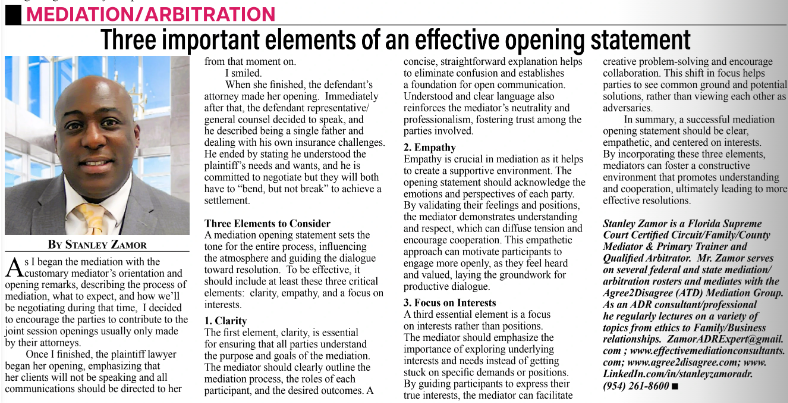
Three Important Elements of an Effective Opening Statement

Three Important Elements of an Effective Opening Statement

As I began the mediation with the customary Mediator’s Orientation/Opening Remarks describing the process of mediation, what to expect, and how we’ll be negotiating during that time.  I decided to encourage the parties to contribute to the joint session openings usually only made by their attorneys.  Once I finished, the plaintiff lawyer began her opening emphasizing that her clients will not be speaking and all communications should be directed to her from that moment on.  I smiled. When she finished, the Defendant’s Attorney made her opening.  Immediately after she finished, the Defendant Representative/General Counsel, decided to speak and he described being a single father and dealing with his own insurance challenges. He ended by stating he understood the Plaintiff’s needs/wants and he is commitment to negotiate but they will both have to “bend, but not break” to achieve a settlement.  

Three Elements to Consider

A mediation opening statement sets the tone for the entire process, influencing the atmosphere and guiding the dialogue toward resolution.  To be effective, it should include at least these three critical elements:  clarity, empathy, and a focus on interests.

  1. Clarity

The first element, clarity, is essential for ensuring that all parties understand the purpose and goals of the mediation. The mediator should clearly outline the mediation process, the roles of each participant, and the desired outcomes. A concise, straightforward explanation helps to eliminate confusion and establishes a foundation for open communication. Understood and clear language also reinforces the mediator’s neutrality and professionalism, fostering trust among the parties involved.

2. Empathy

Empathy is crucial in mediation as it helps to create a supportive environment. The opening statement should acknowledge the emotions and perspectives of each party. By validating their feelings/positions, the mediator demonstrates understanding and respect, which can diffuse tension and encourage cooperation. This empathetic approach can motivate participants to engage more openly, as they feel heard and valued, laying the groundwork for productive dialogue.

3. Focus on Interests

A third essential element is a focus on interests rather than positions. The mediator should emphasize the importance of exploring underlying interests and needs instead of getting stuck on specific demands or positions. By guiding participants to express their true interests, the mediator can facilitate creative problem-solving and encourage collaboration. This shift in focus helps parties to see common ground and potential solutions, rather than viewing each other as adversaries.

In summary, a successful mediation opening statement should be clear, empathetic, and centered on interests. By incorporating these three elements, mediators can foster a constructive environment that promotes understanding and cooperation, ultimately leading to more effective resolutions.

Stanley Zamor is a Florida Supreme Court Certified Circuit/Family/County Mediator & Primary Trainer and Qualified Arbitrator.  Mr. Zamor serves on several federal and state mediation/arbitration rosters and mediates with the Agree2Disagree (ATD) Mediation Group. As an ADR consultant/professional he regularly lectures on a variety of topics from ethics to Family/Business relationships.  ZamorADRExpert@gmail.com ; www.effectivemediationconsultants.com; www.agree2disagree.com; www.LinkedIn.com/in/stanleyzamoradr. (954) 261-8600

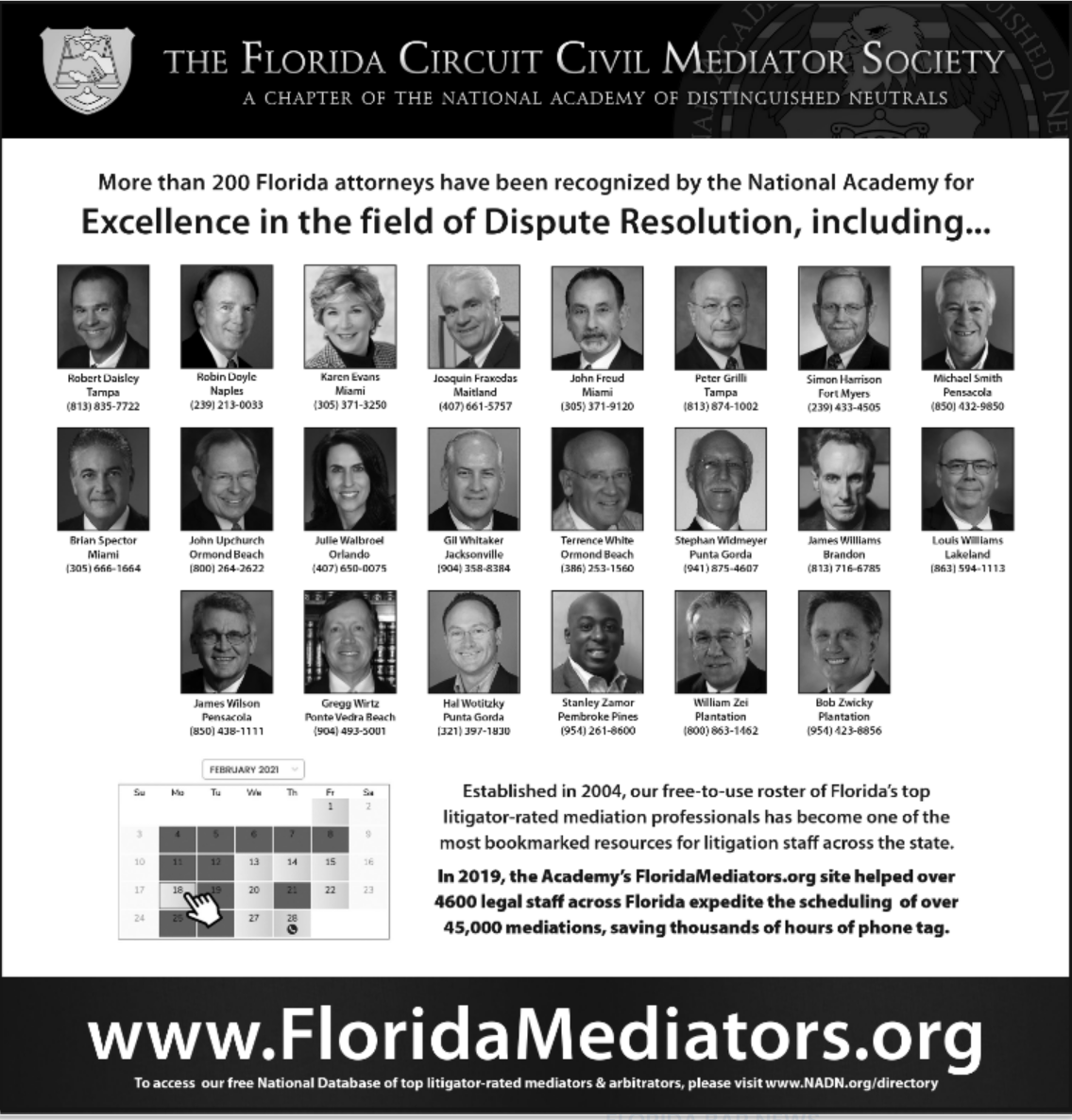
Recognized by The National Academy!

Mr. Zamor is privileged to serve disputants and their advocates. Mr. Zamor remains uniquely qualified to assist with complex matters (commercial and family) and challenging issues. He is listed with the American Arbitration Association (AAA), and FINRA and other federal agencies as a neural. His hybrid conflict resolution style/approach has proven to be highly effective. Mr. Zamor’s area of mediation extends (but is not limited to) Contract, Construction, Insurance, Real Estate, Employment/EEO, Family Law, HOA/Condo. He is featured as a speaker /presenter and panelist of experts in discussions regarding ethics and conflict resolution industry standards.  

Mr. Zamor is also a conflict resolution consultant and provides advanced Negotiation and Mediation Advocacy training (CLE/CME) training monthly. 

A Companion Piece By Friend and Colleague John Freud: “Turning Water into Wine”

By John S. Freud

“Be like water making its way through cracks. Do not be assertive, but adjust to the object, and you shall find a way around or through it. If nothing within you stays rigid, outward things will disclose themselves…”

–Bruce Lee


[1] This is a companion piece to “Mediate, Like Water My Friend – Reflecting on Bruce Lee” By Stanley Zamor, September 2022

Miracles don’t just happen.  They occur, and are then revealed.  For many if not most of us, we must take a giant leap of faith to even begin to be open to the possibility that Miracles can, or could, happen.  Others might argue that Miracles are present for those that choose to acknowledge or recognize the “miraculous” for what it is, or may be – an unexplained phenomenon for which there is no easy answer as to how or why it seemingly, or simply, is.

Christ’s Turning Water Into Wine story (John 2:1-11) is, to his believers, a seminal example of the “miraculous”.  But whether miraculous or not, is interestingly, not the point.  It’s the Belief in the metaphorical outcome of the story that provides the enduringly powerful message to all of us, rather than its historical accuracy or its factual efficacy.  And that message is, anything is possible.

Which leads us to Bruce Lee.  The analogy is not a stretch.  Imaging we are “ water making its way through cracks” might seem at first blush farfetched.  Just like Jesus turning water into wine. But the sentiments underlying both images are the same.  Anything is possible.  What Lee does – and what Jesus omits – is how to make anything possible:

“Do not be assertive, but adjust to the object…nothing within you stays rigid…”

Lee’s “how to” admonitions may be summed up thusly – when adversity comes calling, rather than stiffening your response, soften your resolve.  One “shall find a way around or through” adversity or deep conflict in mediation – “like water finding its way through cracks” – until suddenly “outward things will disclose themselves”. In a negotiation in mediation, the disclosure of “outward things” – drivers of decision making by principals, motivation of lawyers and insurers, and the like – must reveal themselves in order to find the space necessary for compromise.  Belief – and its discontents – must give way to decision-making that opens parties in deep conflict to the possibility for “anything is possible”, which in mediation includes voluntary resolution of the dispute.

Is the mediation environment a crucible for miracles, or as the saying goes, “mediation magic”?  No.  However, it can be, with fully engaged participants and a skilled mediator committed to “anything is possible”, an environment where unexpected, voluntary resolutions for parties in conflict “disclose themselves”.  

If that is Turning Water Into Wine, I’ll have a glass of your finest!

John S. Freud, Esquire, is a Florida Supreme Court Certified County/Circuit/Appellate Mediator, Master Trainer; NADN – Executive Board Member; Texas Mediator Credentialing Association, Credentialed Distinguished Mediator; Nationally Certified Construction Dispute Resolution Services, LLC, mediator (see, johnfreud@cdrsllc.com)

“Negotiating with the Enemy – Thoughts”

The Washington-Relocation


Father’s Attorney: “My client will not give in or consider anything less than what “we” currently have.
My client did not make her leave Florida or the condo he purchased for her. So, for her to now ask for
full time-sharing is NOT going to happen.”


Mother (Pro Se): Please Mr. Stanley help me! I understand everything they said. But here. Read these.
See? I dealt with 3 Domestic Violence cases with him/his family. So, I left my son and Florida. But now
that I am more stable. I am here to fight for my son. All I am asking is that he finishes up to middle
school with me in Texas; then he can do High School with his dad. That is fair. Right?


CONFRONTING THE “ENEMY”


Whether it’s a family or business matter entering a negotiation is never as simple as people think. At
almost every stage of a negotiation emotion plays a part of how you negotiate and ultimately how you
respond. What is also a factor is who you are negotiating with/against and how they respond.
Understanding both sides does contribute to the type of resolve achieved. As I mediate, parties are
usually, only focused on what law, statute, or case-law is used to persuade their position. I understand
that and get it. But then what? During mediation rarely is one side persuaded to giving-in just because
the law/facts (as it is interpreted by that side) convinced them to “take the deal and run”. No. It does
not happen that way. They would just agree to disagree and let the court decide, right? Why is it not
understood that being face-to-face at mediation, is the best time to negotiate with transparency? Yes, I
said transparency. It doesn’t need to be adversarial.


ENGAGING THE “ENEMY”


Negotiation “is” an emotional event and although many promote/expect disputants to “take the
emotion out of it…” that is not so easy to do. When dealing with the human condition you are always
dealing with issues of disappointment, unmet expectations, insecurities, and feelings of betrayal that
have permeated the relationships’ core. That is not so simple to ignore; and is always paramount.


SEEING THE “ENEMY”


After thousands of hours of creating solutions and addressing family/business matters I have found that
every dispute is unique, in its own way. However, when seeing people dealing with their adversary, they
often must “see” themselves, or their missed opportunities to recognize concerns that would have
saved them years of conflict/grief. So, for many, the enemy they must confront and deal with, is the
enemy within.

Stanley Zamor is a Florida Supreme Court Certified Circuit/Family/County Mediator & Primary Trainer and Qualified
Arbitrator. Mr. Zamor serves on several federal and state mediation/arbitration rosters and mediates with the Agree2Disagree
(ATD) Mediation Group. As an ADR consultant he regularly lectures on a variety of topics from ethics, cross-cultural issues,
diversity, and Family/Business relationships.


ZamorADRExpert@gmail.com ; www.effectivemediationconsultants.com; www.LinkedIn.com/in/stanleyzamoradr
(954) 261-8600

Prepared. Lawyered-Up. We’re Ready to Fight…But Not Settle

“No One Wins a War…” & “Litigation is War…”

As I closed the door. Exhaled and turned to take my seat at the head of the sixteen person table. I again noticed the impressive tech-heavy modern conference room.  As I looked at the adverse parties and observed the mountains of papers, binders, notes, pens, highlighters and personnel on both sides. I surmised, “Wow, both sides came prepared to ‘war’”.  

My opening statement was short, concise, and I focused on being open to exploring the value of a diversity of perspectives and ideas. LMAO! Once I saw the Plaintiff’s attorney’s smirk and give a “low key” grin I paused, broke protocol, stood up and said to that attorney, “Why are you hear today?” They were silent and appeared caught off guard. Then I turned to the other attorney, “Did you come here to WIN, or negotiate?” Again, another facial surprised expression…” I continued. “We are here to negotiate. We are here to hear and explore opportunities of resolution that may not be what we saw possible. Mediation is not an opportunity to impress upon the mediator how sound your case is or how flawed is the opposing side is, or how “Stare decisis law” compels your legal position… Although you may feel the merits of your case is just. It is the ambiguity that has not allowed you to prevail yet… So! Here, we are. What do you want? And how much are you willing to mutually agree to so you can fight the next fight, move past this issue so you can engage in more pressing ones?”

The room was silent, but the faces were easily understood.  This mediation was not going to be like others. And mediation never has to be a continuation of what they see/feel/do/exercise/experience in court.  Mediation is an opportunity to learn, grow, explore solutions and go beyond what the strategic moves litigation offers.  Litigation is WAR, MEDIATION is the FIRST AND ONLY TIME WHERE SELF-DETERMINATON CAN BE ACHIEVED!

So, as you engage and prepare with your legal team and/or legal counsel, ask yourself, “At the end of the day what do I want to achieve?”  If you want to destroy your adversary; embarrass your former spouse; business partner, relative, friend or employer… mediation may not be what you need/expect.  I have seen the harshest/ugliest of relationships find solace, healing, empathy, understanding and respect within the construct of a “well-facilitated” mediation process, by a full-time dedicated skilled neutral (not a part-timer). Do You Really Want War or Mutual Agreement?

Stanley Zamor is a Florida Supreme Court Certified Circuit/Family/County Mediator & Primary Trainer and Qualified.  Mr. Zamor serves on several federal and state mediation/arbitration rosters and mediates with the Agree2Disagree (ATD) Mediation Group. As an ADR consultant he regularly lectures on a variety of topics from ethics, cross-cultural issues, diversity, bullying, and Family/Business relationships. 

szamor@effectivemediationconsultants.com

www.effectivemediationconsultants.com

www.LinkedIn.com/in/stanleyzamoradr

(954) 261-8600

“When You Negotiate/Mediate BEWARE WHO YOU BRING!?!”

By Stanley Zamor

I was recently called by a mediator colleague who seemed hushed, rushed & speaking in a whispering tone. He was at the commencement of a mediation and excused himself to secretly call me in private.  He nervously explained that as he was about to start a commercial mediation conference, and while ushering the Plaintiff and his attorney into the conference room, they abruptly stopped, turned around and refused to enter after seeing the Defendant and the Defendant’s attorney were sitting with a third person unrelated to the lawsuit. The Plaintiff was highly upset and marched into a smaller conference room stating that he refused to mediate if the other person stayed in the mediation. The Plaintiff felt that the third person is largely responsible for most of the dispute.  The Defendants insisted the third person stay.  The Defendants being sued is a small family business and its principal individually.  The third person identified himself as an Attorney-CPA but wanted to participate in support of his cousin (the business owner) and as a friend of the business; he initially assisted with the company’s accounting, vendor accounts and setup.

My colleague stated that he knew the intricacies of the Florida Mediation rules/statutes/ procedures but was stuck. He did not know quite what to do since both sides appeared so ridged and this mediation took months to set up.  What to do?

INSIGHT, PARTY SELF-DETERMINATION

Mediation is a consensual process whereby parties have the unique opportunity to be in control of their own destiny.  Unlike being in court or an arbitration parties can determine how they negotiate and with who.  Often one side may bring someone to the mediation that they other side feels disrupts negotiations. A skilled mediator will know the difference and will encourage a constructive process and dialogue.  

MY SUGGESTION, HOW TO DISCUSS PARTICIPATION

With the Defendant, discuss that only named parties/parties of interest participate in mediation. However, if the Plaintiff agrees there will be restrictions that must be adhered to. The mediator will ask the third party to leave if his behavior less than constructive.

With the Plaintiff, discuss how a third party may have a value and influence on how the Defendant negotiates by setting them at ease. People usually negotiate better when they feel supported, less stress and anxiety doesn’t cloud their judgement.  

OUTCOME

I was later told that the third-party participated in the mediation conference and offered several strategies regarding how to resolve the matter while maintaining vital portions of the business relationship. They settled in four hours.

Stanley Zamor is a Florida Supreme Court Certified Circuit/Family/County Mediator & Primary Trainer and Qualified Arbitrator.  Mr. Zamor serves on several federal and state mediation/arbitration rosters and mediates with the Agree2Disagree (ATD) Mediation Group. As an ADR consultants he regularly lectures on a variety of topics from ethics, cross-cultural issues, diversity, bullying, and Family/Business relationships. 

szamor@effectivemediationconsultants.com

www.effectivemediationconsultants.com

www.LinkedIn.com/in/stanleyzamoradr

(954) 261-8600