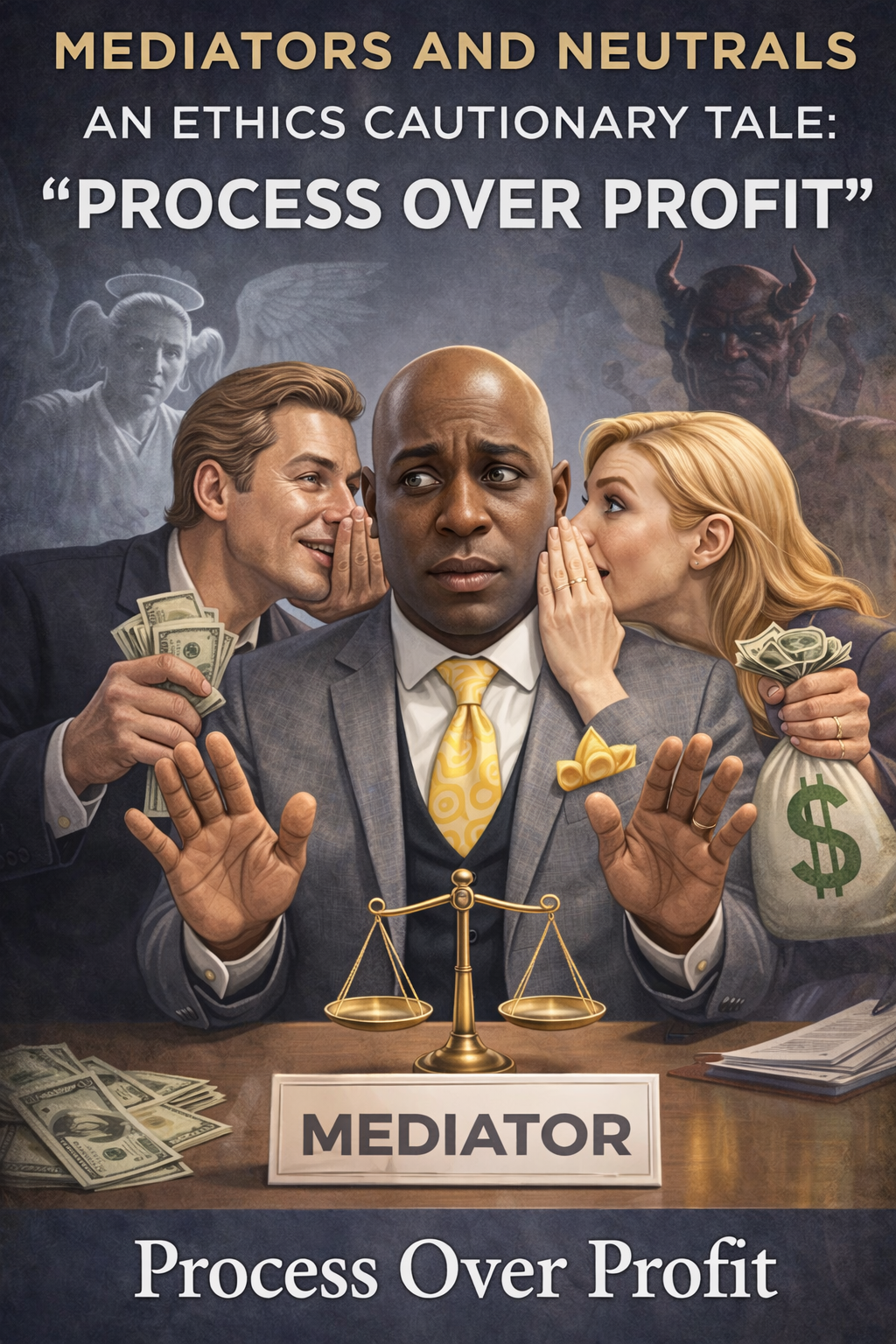
An Ethics Cautionary Tale: Process Over Profit — Translations, How About You?

By Stanley Zamor — Podcast Summary

In the podcast episode “An Ethics Cautionary Tale: Process Over Profit — Translations, How About You?”, Stanley Zamor reflects on a recent mediation experience that raises an issue many neutrals encounter but few openly discuss: the ethical responsibility surrounding proper translation during mediation and the mediator’s duty to safeguard understanding throughout the process.

At the core of the discussion is a foundational principle of mediation — the parties, not the attorneys or the mediator, are the ultimate decision-makers. Because settlement decisions can carry life-altering consequences, mediators have an ongoing obligation to ensure that every participant fully understands the process, the proposals being discussed, and the “parties/litigants” understand implications of their choices. This responsibility does not end once a translator is present; rather, it requires continual monitoring, clarification, and vigilance throughout the mediation session.

The episode highlights an incident that happened during a real litigation commercial case and how ethical obligations, that may seem minor or procedural to other professionals are, in mediation, central to the integrity of the process. Failure to address translation issues, misunderstandings, or communication gaps can undermine self-determination and compromise fairness — both core values of professional mediation practice.

Zamor emphasizes that mediators carry duties that extend beyond client satisfaction or case resolution. Their responsibility is owed simultaneously to the parties, the profession, the mediation process itself, and the courts that rely on mediators to uphold ethical standards. These obligations often differ sharply from the role of advocates, whose focus is understandably aligned with advancing their clients’ interests. This tension can create ethical crossroads for neutrals who must decide whether to prioritize efficiency or procedural integrity.

A central question posed in the podcast challenges mediators directly: How many neutrals truly place process before profit? While the answer may seem obvious in theory, Zamor argues that the reality is more complex. Mediators operate businesses and face economic pressures, making ethical decision-making less straightforward than many assume. The willingness to pause, slow down, or even challenge participants when ethical concerns arise may conflict with business incentives — yet it is precisely in these moments that professional integrity is tested.

The discussion also references the Florida Rules for Certified and Court-Appointed Mediators, which clearly articulate the mediator’s ethical obligations, as well as multiple opinions issued by the Mediator Ethics Advisory Committee (MEAC) addressing translation and communication issues. Despite this guidance, translation concerns remain common and are frequently mishandled, underscoring the need for continued dialogue and education.

Ultimately, the episode serves as both cautionary tale and call to reflection. It challenges mediators to examine their own practices and ask whether they are consistently putting the integrity of the process ahead of convenience or financial considerations. In doing so, Zamor invites the mediation community to reaffirm that ethical vigilance — especially in seemingly routine details — is what protects party self-determination and sustains trust in the profession.

The question lingering at the end is simple but profound: When ethical tensions arise, will you choose process over profit?

Click here for the podcast: https://youtu.be/B2oL-ExMOHo

====================================================================
Stanley Zamor is a Florida Supreme Court Certified Circuit/Family/County Mediator & Primary Trainer and Qualified Arbitrator. Mr. Zamor is a private mediator and serves on several federal and state mediation/arbitration rosters. As an ADR consultant/professional he regularly lectures on a variety of topics from ethics, diversity/culture, bullying, Community Resolution Design, and Family/Business relationships. ZamorADRExpert@gmail.com ; www.effectivemediationconsultants.com; www.LinkedIn.com/in/stanleyzamoradr. (954) 261-8600
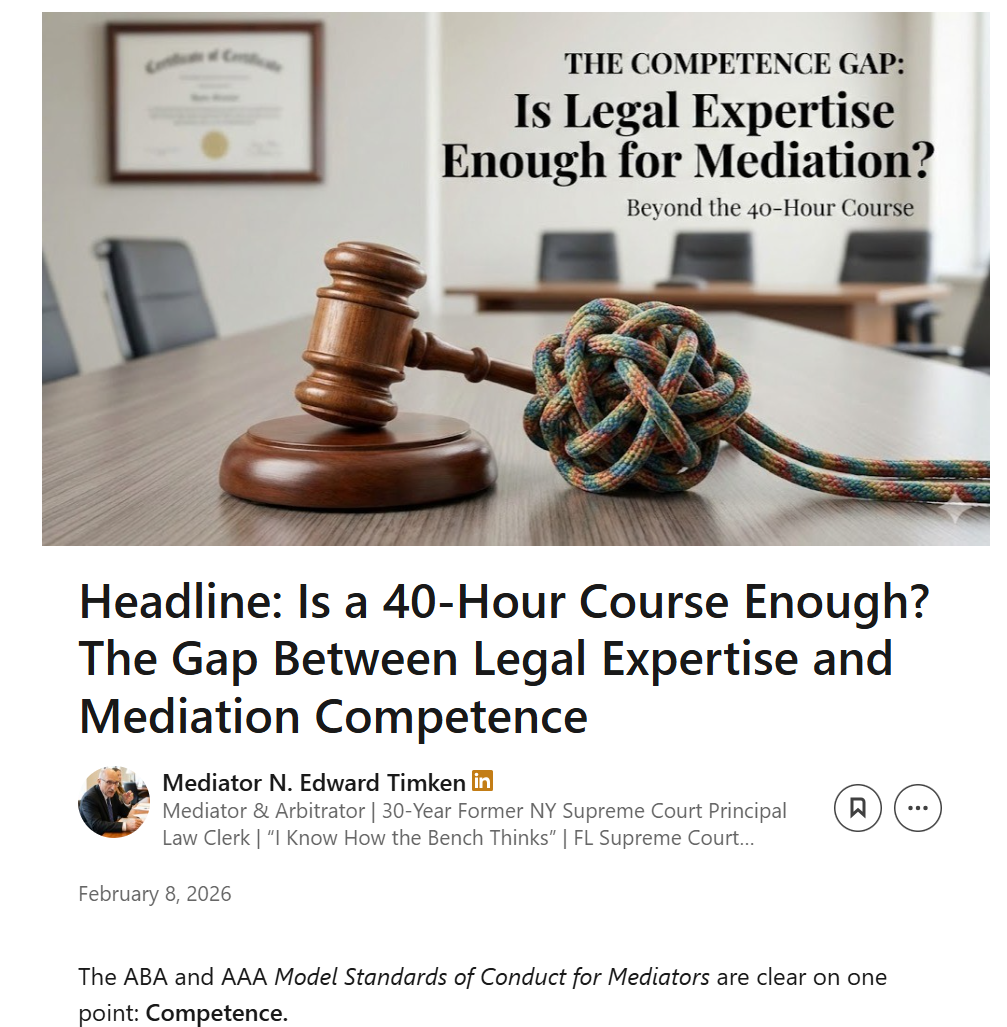
Beyond the 40-Hour Course: Why New Mediators Must Treat Mediation as a Profession — Not a Credential

By Stanley Zamor

Companion Article Inspired by “Is a 40-Hour Course Enough? The Gap Between Legal Expertise and Mediation Competence”

The debate surrounding mediator competency is not new, but it has resurfaced with urgency as more experienced lawyers and retired judges enter the mediation field. The recent discussion raised by Mediator N. Edward Timken challenges a longstanding assumption: that decades of legal or judicial experience, combined with a standard 40-hour certification course, automatically produce a competent mediator.

The short answer is no — and the profession must be honest about why.

Mediation Is a Distinct Skill Set, Not a Legal Extension

The ABA/AAA Model Standards emphasize that mediators should act only when they possess the qualifications necessary to meet reasonable party expectations. Competence is not measured solely by legal knowledge or years in litigation; it is rooted in process mastery, communication skill, emotional intelligence, and the ability to facilitate self-determination.

A judge is trained to decide.

A litigator is trained to persuade.

A mediator is trained to facilitate.

These roles overlap but are fundamentally different. The transition from advocate or decision-maker to neutral facilitator often requires unlearning habits developed over decades — a transformation that cannot realistically be achieved in one week of coursework.

The Instant Competency Myth

One of the most persistent misconceptions in the ADR field is the “instant expert” belief: the idea that prior professional prestige automatically translates into mediation skill.

In reality:

  • Legal analysis does not equal conflict analysis.
  • Case evaluation does not equal process design.
  • Authority does not equal neutrality.

Experienced professionals often possess exceptional substantive knowledge, yet mediation demands something else entirely: the ability to hold competing narratives without endorsing any of them, manage emotional dynamics, and resist the urge to direct outcomes. As the original article notes, mediation is process expertise, not substantive law practice.

Why 40 Hours Is Only the Beginning

The 40-hour training model was designed as an introduction — a structured entry point into mediation principles. It provides vocabulary, ethics frameworks, and exposure to facilitative techniques. It does not, however, produce mastery.

True competency typically requires:

  • Deliberate Practice: Repeated application in varied dispute contexts.
  • Mentorship and Observation: Learning from seasoned neutrals who model advanced techniques.
  • Co-Mediation: Sharing responsibility while receiving real-time feedback.
  • Reflective Development: Continuous self-assessment and improvement.

No serious profession assumes competency after introductory training alone. Pilots, therapists, and surgeons all undergo supervised practice before working independently. Mediation should be no different.

The Lawyer-Mediator Transition: A Psychological Shift

For attorneys and judges entering mediation, the challenge is often psychological rather than intellectual.

Common hurdles include:

  • The instinct to evaluate rather than explore.
  • A tendency to narrow issues instead of expanding possibilities.
  • Overreliance on legal frameworks when parties are driven by emotional, relational, or identity-based concerns.

Effective mediators learn to slow down, invite ambiguity, and tolerate uncertainty — skills rarely rewarded in adversarial legal systems.

The Risk to the Profession

When mediation is treated as a “second-career add-on” rather than a disciplined profession, several risks emerge:

  1. Parties may receive process-poor mediation disguised as legal evaluation.
  2. Public trust in mediation outcomes may weaken.
  3. New mediators may struggle silently, mistaking difficulty for personal failure rather than an expected stage of professional growth.

Raising competency standards is not about gatekeeping; it is about protecting the integrity of the process and ensuring parties receive the quality of facilitation they reasonably expect.

What Serious Skill Development Looks Like

Aspiring and new mediators should approach the profession as an ongoing craft:

  • Engage in advanced negotiation and psychology training.
  • Study conflict dynamics, not just settlement strategies.
  • Seek feedback after every mediation.
  • Develop skills in active listening, reframing, emotional regulation, and rapport building.
  • Participate in peer consultation groups or mentor circles.

The most respected mediators are rarely those with the longest legal résumés — they are often those who treated mediation as its own discipline and committed to continuous learning.

A Call to the Next Generation of Mediators

The mediation field is evolving. Parties increasingly expect neutrals who can manage complexity, emotion, and power imbalance while preserving self-determination. Meeting that expectation requires humility: recognizing that a certification is a beginning, not a declaration of mastery.

The question is not whether a 40-hour course is valuable — it absolutely is. The question is whether we are willing to acknowledge that true mediator competence begins only after the course ends.

For new mediators, the message is clear:

Take the craft seriously. Study deeply. Practice intentionally. Seek mentorship relentlessly.

Because mediation is not a title you earn — it is a skill you continually develop.

Reference: https://www.linkedin.com/pulse/headline-40-hour-course-enough-gap-between-legal-timken–nm30e/?trackingId=X1%2BP7SLPQRWw%2Fx4fe1V0qQ%3D%3D

https://www.linkedin.com/pulse/headline-40-hour-course-enough-gap-between-legal-timken–nm30e/?trackingId=X1%2BP7SLPQRWw%2Fx4fe1V0qQ%3D%3D

How I-DEAL: The Shadow of Mediation

This short podcast is a discussion to introduce the “The Shadow of Mediation”; which is the timeframe that occurs after a mediation conference is held and has ended. The majority of professionals who participate in mediation often behave like once a mediation has concluded, the mediator’s ethical obligations has ended. They are wrong! A mediator’s ethical duty is to the process, profession, parties and the court and does not end when the process does. So neutrals should be be careful.

Stanley Zamor conducts periodic advanced negotiation and mediation advocacy trainings throughout the year where this and other nuances are discussed. During these advanced negotiation/mediation trainings techniques are discussed and demonstrated.

Subscribe, comment about this video and share it with others. If you have any questions for suggestions for future discussions or a question, please forward them to ZamorADRExpert@gmail.com with the subject line “Podcast Inquiry”

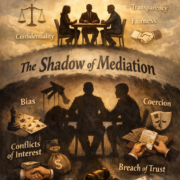
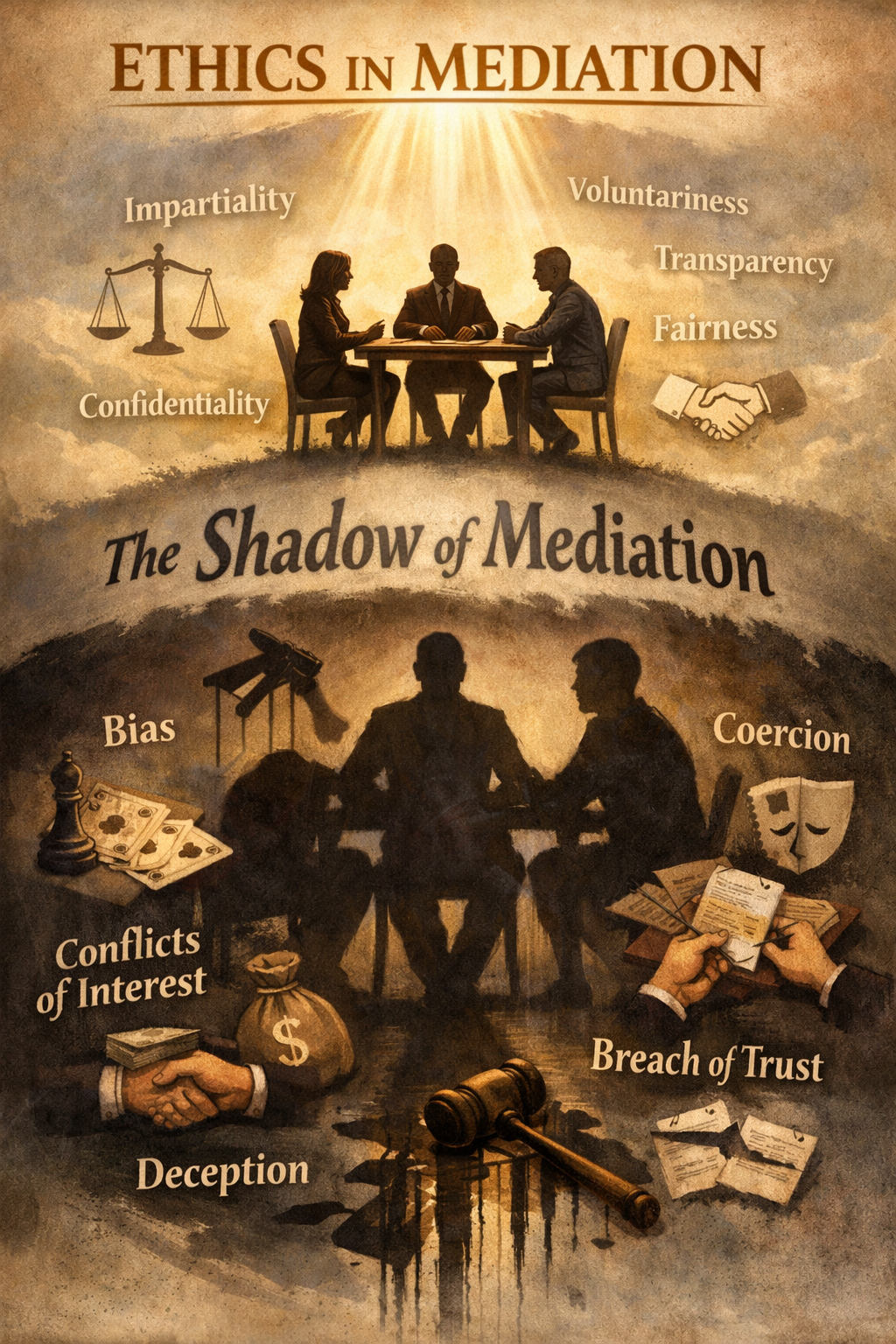
The Shadow of Mediation: Mediator Ethics, Perception, and the Quiet Risk of Post-Mediation Interactions

Mediation does not always end when the parties leave the room. Sometimes it lingers in follow-up emails, chance encounters at bar events, LinkedIn connections, referrals, post-settlement clarification calls, or even casual comments made months later. This lingering presence is what can be called the “shadow of mediation.” It is the ethical space where perception matters as much as reality. For mediators and neutrals, especially those operating within structured ethical frameworks such as the Florida Rules for Certified and Court-Appointed Mediators, the greatest risk is often not overt misconduct — it is the appearance of bias created unintentionally after the case concludes.

  1. The Ethical Foundation: Impartiality Beyond the Session

Under Florida Rule 10.330, impartiality means freedom from favoritism or bias in word, action, or appearance. appearance, and includes a commitment to assist all parties, as opposed to any one individual. The rule is not limited to what occurs during the mediation session itself. It extends to conduct that could undermine public confidence in neutrality. Similarly, Rule 10.340 (Conflicts of Interest) and Rule 10.370 (Authority and Professional Advice) reinforce a mediator’s obligation to avoid actions that could compromise neutrality or party self-determination. The key phrase embedded throughout mediator ethics is not simply actual bias, but the appearance of partiality. The shadow forms when conduct, even if innocent, creates doubt.

II. The “Shadow” Defined

The shadow of mediation refers to post-mediation conduct that:

  • Creates a perception that the mediator favors one party or counsel
  • Suggests confidential information influenced later interactions
  • Implies a continuing advisory or strategic role
  • Undermines the mediator’s neutrality in future related matters

It is subtle. Often unintentional. Sometimes If not always, social.

But perception drives trust — and mediation depends entirely on trust.

III. Cautionary Tales: Where Shadows Begin

1. The Post-Settlement Strategy Conversation

A mediator runs into defense counsel at a CLE event. The lawyer casually says, “Thanks for pushing the plaintiff hard on damages — that helped.”

The mediator responds with a smile: “I knew they were overvaluing the case.”

Even if said jokingly, the comment can be interpreted as alignment with one side’s strategy. If repeated, it could undermine future mediations involving that counsel or opposing parties.

Avoidance Strategy: Do not characterize your mediation moves in partisan terms. Neutral responses protect neutrality.

2. Social Media Proximity

After mediating a contentious commercial dispute, the mediator connects on LinkedIn with only one side’s counsel and later comments publicly on that attorney’s litigation victories.

The opposing side sees the visible online interaction.

Perception shifts.

Avoidance Strategy: Apply consistent professional boundaries across parties. If connecting online, consider balanced professional conduct or simply refrain.

3. Post-Mediation Clarification That Becomes Advice

A party calls the mediator months later asking: “Can you look at this enforcement issue? What do you think the judge would do?” If the mediator begins offering predictive legal analysis, especially favoring one party’s enforcement position, the line between neutral facilitator and advisor blurs. Rule 10.370 warns against providing professional opinion that overrides self-determination or suggests alignment.

Avoidance Strategy: Redirect parties to independent counsel. Provide process clarification, not substantive advocacy or predictive opinion.

4. Subsequent Representation in Related Matters

A mediator is later asked to serve as consultant or expert witness for one party in a related dispute arising from the mediated case. Even if technically permissible under certain conditions, the optics are dangerous. Confidential knowledge — even if not used — creates unavoidable appearance concerns.

Avoidance Strategy: Decline roles that derive from knowledge gained during mediation unless clear ethical authority and full informed consent exist — and even then, consider the reputational cost.

5. Casual Commentary About Parties

Statements such as:

  • “That plaintiff was impossible.”
  • “Defense counsel always lowballs.”
  • “I had to reality-check him.”

Even when anonymized, these comments can signal alignment, disclose confidential impressions, or diminish party dignity.

The shadow deepens when mediators speak too freely.

IV. Why Appearance Matters More Than Intent

Mediators often defend themselves by saying:

  • “I wasn’t biased.”
  • “Both attorneys/parties asked, so I provide both of them expected as I have the experience, training and expertise.”
  • “That’s not what I meant.”
  • “It was just a joke.”

Intent does not govern perception.

Public confidence in mediation rests on the belief that the neutral is, and remains, neutral. When appearance erodes, the process erodes.

Ethical discipline therefore requires restraint not only in conduct but in proximity.

V. Practical Guardrails to Avoid the Shadow

1. Adopt a Post-Case Neutrality Protocol

  • No strategic debriefs with one side.
  • No characterization of party performance.
  • No predictive analysis favoring one party.
  • No selective social media engagement tied to the case.

2. Standardize Your Responses

Develop neutral phrases such as:

  • “My role was to assist both parties in evaluating options.”
  • “The resolution resulted from the parties’ own decision-making.”
  • “I cannot comment on party positions or strategy.”

Consistency protects you.

3. Maintain Equal Professional Distance

Familiarity is not favoritism — but unequal familiarity creates perception.

Be aware of optics:

  • Who sees your public affiliations?
  • Be continuously aware of your body-language/behavior.
  • Who perceives your endorsements?
  • Who hears your praise?

4. Reflect Before Accepting Related Engagements

Ask:

  • Would a reasonable observer question my neutrality?
  • Could this create the appearance that confidential knowledge influenced my new role?
  • Would I be comfortable if this appeared in a grievance complaint?

If hesitation exists, the shadow already exists.

VI. The Ethical Discipline of Silence

Sometimes the most powerful ethical tool a mediator possesses is silence.

Silence after the session.
Silence about party strategy.
Silence about impressions.
Silence about perceived weaknesses.

The shadow shrinks when the mediator’s footprint remains light.

VII. Conclusion: Neutrality Extends Beyond the Room

Mediation is built on credibility.

Credibility is built on impartiality.

Impartiality requires vigilance — not only during caucus, not only during negotiation — but in the weeks, months, and professional interactions that follow.

The shadow of mediation is not misconduct.

It is risk. And ethical excellence requires not only avoiding actual bias, but guarding against its appearance — even when no one is watching.

“Is This Really the Hill You’re Ready to Die On?”A Negotiator’s Call to Strategic Decision-Making

By Stanley Zamor

In negotiation and mediation, few questions are as revealing—or as effective—as: “Is this the hill you’re ready to die on?”  Borrowed from military strategy, the phrase challenges decision-makers to assess whether a contested position truly warrants the cost of defending it. In mediation, this question becomes a catalyst for clarity, helping parties distinguish core interests from ego, habit, or reflexive resistance.

Conflict itself is not the enemy. Misplaced commitment is. Disputes escalate when parties invest time, money, and emotional energy into positions that no longer serve their objectives. Mediation succeeds when it creates space to reassess those commitments. Three mediation skills are particularly effective in turning that reflection into resolution.

1. Interest Clarification: Separating “What” from “Why”

The most common barrier to settlement is confusion between positions and interests. A position states what a party demands; an interest explains why it matters. Skilled mediators help parties articulate the underlying drivers—fairness, security, reputation, control, or closure—beneath rigid demands.

When parties reconnect with their “why,” flexibility increases. A $10,000 impasse may dissolve once a litigant realizes the true concern is acknowledgment, an apology. By clarifying interests, mediators transform entrenched standoffs into problem-solving conversations.

2. Concession-Mapping: Prioritizing What Truly Matters

Not all issues carry equal weight. Effective mediators guide parties through a concession hierarchy—identifying needs, wants, symbolic moves and walkaways.  This mapping allows parties to trade intelligently rather than concede blindly.

When parties see which “hills” are strategic and which are merely familiar, they negotiate with purpose. Concession mapping also enables face-saving solutions, allowing a party to step back from a defended position without appearing weak—an essential ingredient for durable agreements.

3. Risk and Decision Analysis: Replacing Assumptions with Reality

Many disputes persist because parties misjudge risk. Skilled mediators introduce plain-language decision analysis: best- and worst-case outcomes, litigation costs, time value of money, emotional fatigue, and opportunity costs. This is not pressure; it is perspective.

When the imagined battlefield is replaced with realistic forecasting, parties often recalibrate. The question shifts from “Can I win?” to “Is winning this point worth the cost?” That reframing frequently opens the door to settlement.

Strategy Over Stubbornness

Effective negotiation is not about surrender; it is about discernment. The most credible advocates fight hard—but selectively. They conserve resources, protect relationships, and advance outcomes by choosing battles aligned with their true goals.

When parties pause to ask, “Is this really the hill I’m ready to die on?” they move from reaction to strategy. And in mediation, that moment of

 clarity is often the gateway to resolution.

Stanley Zamor is a Florida Supreme Court Certified Circuit/Family/County Mediator & Primary Trainer and Qualified Arbitrator.  Mr. Zamor is a private mediator and is on the panel of mediators at Salmon & Dulberg. He also serves on several federal and state mediation/arbitration rosters. As an ADR consultant/professional he regularly lectures on a variety of topics from ethics to Family/Business relationships.  To SCHEDULE A MEDIATION click the link to Stanley Zamor’s calendar https://sd-adr.com/attorney/stanley-zamor/ email his case manager: mariana@sd-adr.com

For direct contact ZamorADRExpert@gmail.com ; www.effectivemediationconsultants.com; www.LinkedIn.com/in/stanleyzamoradr. (954) 261-8600