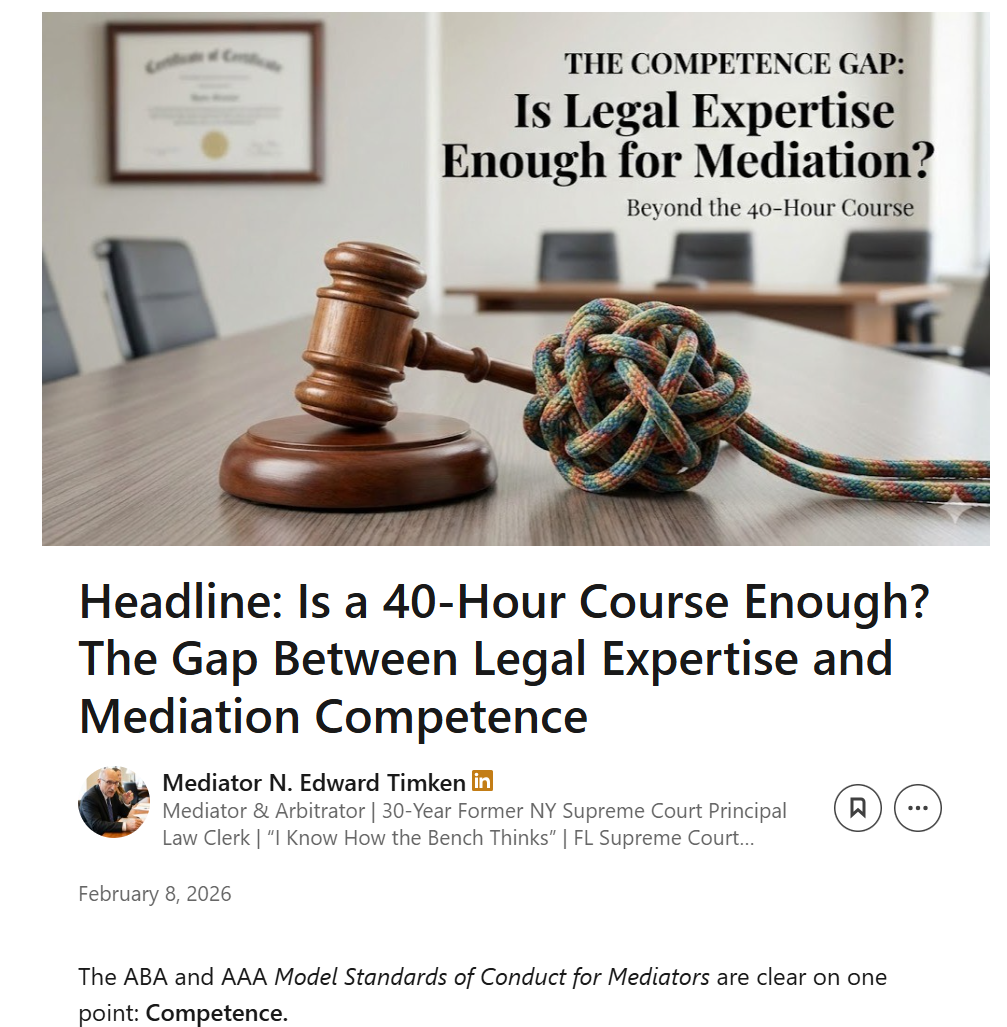
Beyond the 40-Hour Course: Why New Mediators Must Treat Mediation as a Profession — Not a Credential
By Stanley Zamor
Companion Article Inspired by “Is a 40-Hour Course Enough? The Gap Between Legal Expertise and Mediation Competence”
The debate surrounding mediator competency is not new, but it has resurfaced with urgency as more experienced lawyers and retired judges enter the mediation field. The recent discussion raised by Mediator N. Edward Timken challenges a longstanding assumption: that decades of legal or judicial experience, combined with a standard 40-hour certification course, automatically produce a competent mediator.
The short answer is no — and the profession must be honest about why.
Mediation Is a Distinct Skill Set, Not a Legal Extension
The ABA/AAA Model Standards emphasize that mediators should act only when they possess the qualifications necessary to meet reasonable party expectations. Competence is not measured solely by legal knowledge or years in litigation; it is rooted in process mastery, communication skill, emotional intelligence, and the ability to facilitate self-determination.
A judge is trained to decide.
A litigator is trained to persuade.
A mediator is trained to facilitate.
These roles overlap but are fundamentally different. The transition from advocate or decision-maker to neutral facilitator often requires unlearning habits developed over decades — a transformation that cannot realistically be achieved in one week of coursework.
The Instant Competency Myth
One of the most persistent misconceptions in the ADR field is the “instant expert” belief: the idea that prior professional prestige automatically translates into mediation skill.
In reality:
- Legal analysis does not equal conflict analysis.
- Case evaluation does not equal process design.
- Authority does not equal neutrality.
Experienced professionals often possess exceptional substantive knowledge, yet mediation demands something else entirely: the ability to hold competing narratives without endorsing any of them, manage emotional dynamics, and resist the urge to direct outcomes. As the original article notes, mediation is process expertise, not substantive law practice.
Why 40 Hours Is Only the Beginning
The 40-hour training model was designed as an introduction — a structured entry point into mediation principles. It provides vocabulary, ethics frameworks, and exposure to facilitative techniques. It does not, however, produce mastery.
True competency typically requires:
- Deliberate Practice: Repeated application in varied dispute contexts.
- Mentorship and Observation: Learning from seasoned neutrals who model advanced techniques.
- Co-Mediation: Sharing responsibility while receiving real-time feedback.
- Reflective Development: Continuous self-assessment and improvement.
No serious profession assumes competency after introductory training alone. Pilots, therapists, and surgeons all undergo supervised practice before working independently. Mediation should be no different.
The Lawyer-Mediator Transition: A Psychological Shift
For attorneys and judges entering mediation, the challenge is often psychological rather than intellectual.
Common hurdles include:
- The instinct to evaluate rather than explore.
- A tendency to narrow issues instead of expanding possibilities.
- Overreliance on legal frameworks when parties are driven by emotional, relational, or identity-based concerns.
Effective mediators learn to slow down, invite ambiguity, and tolerate uncertainty — skills rarely rewarded in adversarial legal systems.
The Risk to the Profession
When mediation is treated as a “second-career add-on” rather than a disciplined profession, several risks emerge:
- Parties may receive process-poor mediation disguised as legal evaluation.
- Public trust in mediation outcomes may weaken.
- New mediators may struggle silently, mistaking difficulty for personal failure rather than an expected stage of professional growth.
Raising competency standards is not about gatekeeping; it is about protecting the integrity of the process and ensuring parties receive the quality of facilitation they reasonably expect.
What Serious Skill Development Looks Like
Aspiring and new mediators should approach the profession as an ongoing craft:
- Engage in advanced negotiation and psychology training.
- Study conflict dynamics, not just settlement strategies.
- Seek feedback after every mediation.
- Develop skills in active listening, reframing, emotional regulation, and rapport building.
- Participate in peer consultation groups or mentor circles.
The most respected mediators are rarely those with the longest legal résumés — they are often those who treated mediation as its own discipline and committed to continuous learning.
A Call to the Next Generation of Mediators
The mediation field is evolving. Parties increasingly expect neutrals who can manage complexity, emotion, and power imbalance while preserving self-determination. Meeting that expectation requires humility: recognizing that a certification is a beginning, not a declaration of mastery.
The question is not whether a 40-hour course is valuable — it absolutely is. The question is whether we are willing to acknowledge that true mediator competence begins only after the course ends.
For new mediators, the message is clear:
Take the craft seriously. Study deeply. Practice intentionally. Seek mentorship relentlessly.
Because mediation is not a title you earn — it is a skill you continually develop.