
Posts

Avoiding The F –Bomb While Mediating, Is that Possible?

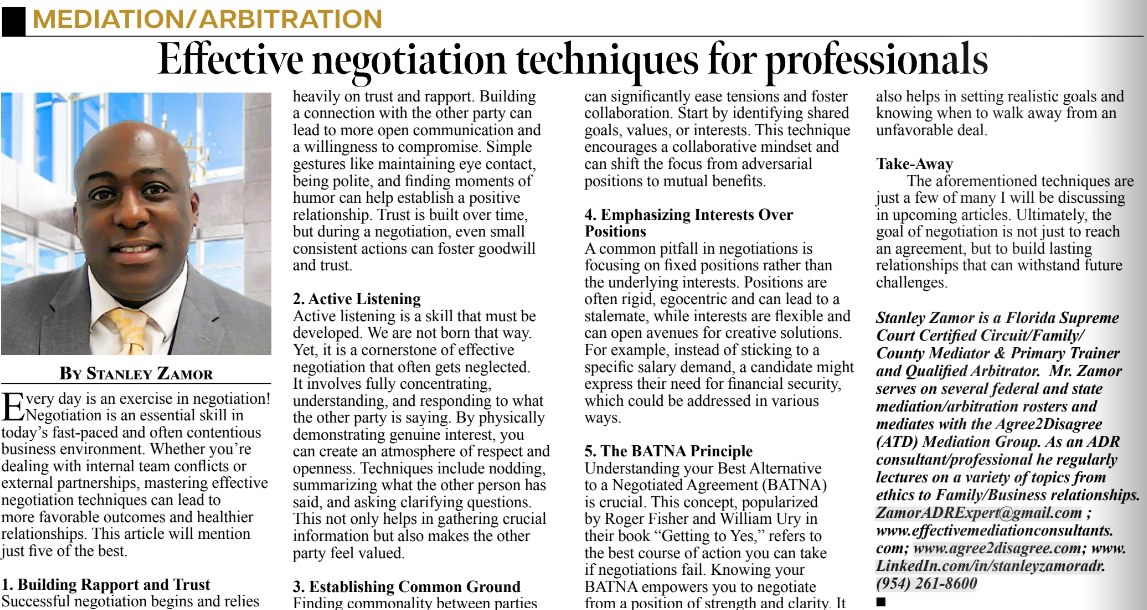
Ok. I have to finally say it! There just seems to be no way around the F-bomb being dropped or used during mediations (or a negotiation).  I mean, if it is not used by the parties, then it will be used by their advocates/representatives.  And advocates/representatives drop the F-bomb more than most, because as advocates/representatives, that is their job. I get it. I’ve been told that divorce/family attorneys, must drop that F-bomb during their opening presentations or they’ll be perceived as not doing their job? Wow! And as a third-party neutral the F-bomb almost makes the hairs on my neck, stand-on-end. Because once I hear them start their statement, end their statement, or even worse, look me in and say in an inquisitive AND probing tone, “Isn’t that ‘fair’ Mr. Mediator”… “I just want what is fair for my client”…. “We’re trying to be ‘fair’ here” … “We are being more than ‘fair’”…   Yes, Fair. That F-Bomb can completely make a mediation negotiation go left. 

So I ask, is it possible to avoid the F-bomb during a mediation? The simple answer is no.  The more complex answer is, “maybe” or “so what”.  What is fair? Fair is about perspective. When negotiating it is completely subjective. When dealing with heightened emotions it cannot be achieved because the parties and their advocates believe only their perspective is the best and more fair and reasonable (shhhhh! The R-Bomb, that’s for another article). 

Expanding Fair

The perception of what is fair; or being fair in mediation negotiation hinges on several key factors, one of which is the ability of the parties involved to set aside their ego. When disputants are entrenched in their positions, driven by personal pride or a fear of losing face, it becomes challenging to engage in constructive dialogue. Here are a few reasons why letting go of ego is essential when trying to be fair in mediation negotiations:

1. Openness to Compromise: When individuals prioritize their ego, they become less flexible and more focused on winning rather than finding a mutually beneficial solution. Letting go of ego allows for a willingness to consider alternative viewpoints and compromise.

2. Active Listening: Fair negotiation requires active listening, where each party genuinely seeks to understand the other’s perspective. Ego can hinder this process, as individuals may be more focused on defending their stance rather than listening to the other side.

3. Building Trust: Negotiations thrive on trust. If parties are defensive or overly concerned with their self-image, it can create an atmosphere of suspicion. By minimizing ego, negotiators can foster an environment of mutual respect and collaboration.

4. Focus on Interests, Not Positions: Effective negotiation involves focusing on underlying interests rather than rigid positions. Letting go of ego enables parties to explore their true needs and desires, leading to more creative and satisfactory solutions.

5. Reducing Conflict: Ego-driven negotiations often escalate into conflicts. By setting aside personal pride, parties can approach the negotiation with a problem-solving mindset rather than a combative one, reducing the likelihood of confrontation.

The Take-Away

In summary, fair negotiation is only achievable when parties can transcend their egos, allowing for open communication, trust-building, and a focus on collaborative solutions. This shift not only enhances the negotiation process but also fosters better relationships moving forward. A skilled mediator is tasked with continually adjusting and refocusing the participants throughout the mediation negotiation process. It is therefore the skilled, and ethical mediator that is essential in assisting the participants negotiate beyond the ego. A subsequent article will better explore mediator’s best practices and ethical skills that addresses ego and creative solution building.

So rather than debate and attempt to convince why opposing parties are wrong, third-party neutrals should help acknowledge the emotion in the dispute then focus the parties on adjusting the emotional component and reframing it as what makes good “business sense” or what are the best ways to maximize outcomes given the circumstance as they appear that day.  By helping the parties adjust their lens regarding receiving justice and reaching/giving what is fair, they are more open to reaching a agreement that is acceptable that they helped craft.  

So, there is no “fair” in mediation negotiation in the sense that most expect. There is accepting an idea that being fair is not going to be the same for everyone involved in the conflict. And, there is respecting another’s perspective of fair and adjusting participants’ ego while negotiating so a mutually acceptable resolve can be achieved if that is the common goal.   

May 2019 New Administrative Order! Fresh, New & Responsive

[fusion_builder_container hundred_percent=”no” equal_height_columns=”no” menu_anchor=”” hide_on_mobile=”small-visibility,medium-visibility,large-visibility” class=”” id=”” background_color=”” background_image=”” background_position=”center center” background_repeat=”no-repeat” fade=”no” background_parallax=”none” parallax_speed=”0.3″ video_mp4=”” video_webm=”” video_ogv=”” video_url=”” video_aspect_ratio=”16:9″ video_loop=”yes” video_mute=”yes” overlay_color=”” video_preview_image=”” border_size=”” border_color=”” border_style=”solid” padding_top=”” padding_bottom=”” padding_left=”” padding_right=””][fusion_builder_row][fusion_builder_column type=”1_1″ layout=”1_1″ background_position=”left top” background_color=”” border_size=”” border_color=”” border_style=”solid” border_position=”all” spacing=”yes” background_image=”” background_repeat=”no-repeat” padding_top=”” padding_right=”” padding_bottom=”” padding_left=”” margin_top=”0px” margin_bottom=”0px” class=”” id=”” animation_type=”” animation_speed=”0.3″ animation_direction=”left” hide_on_mobile=”small-visibility,medium-visibility,large-visibility” center_content=”no” last=”no” min_height=”” hover_type=”none” link=””][fusion_text columns=”” column_min_width=”” column_spacing=”” rule_style=”default” rule_size=”” rule_color=”” hide_on_mobile=”small-visibility,medium-visibility,large-visibility” class=”” id=””]

From Anticipated Changes to Innovative Responses, This New Administrative Order Responds to What Many Have Been Waiting For….

A new administrative order governing the certification and renewal of mediators has been issued and is effective immediately.  Some changes you will note:

  • Allowing mentorship activities (up to four hours) and lecturing to count as a live method of continuing mediator education (CME);
  • Elimination of the four-hour appellate specific CME requirement for certified appellate mediators;
  • Including attendance at court alternative dispute resolution (ADR) committee and board meetings for time spent on mediation topics as a live method of CME;
  • Inclusion of pre-suit homeowner association (HOA) disputes, within the jurisdiction of the circuit court, mediated by a certified circuit mediator, to qualify for circuit mentorship;
  • Inclusion of the process for the Florida Department of Law Enforcement (FDLE) background screening for mediators seeking certification and certified mediators adding an area of certification;
  • Adoption of the expanded interpersonal violence (IPV) definition for CME activities; and
  • Consolidation of administrative orders AOSC11-1 and AOSC12-48.

There were no increases to the fees for certification or renewal.

AOSC19-26 Governing Certification of Mediators

[/fusion_text][/fusion_builder_column][/fusion_builder_row][/fusion_builder_container]

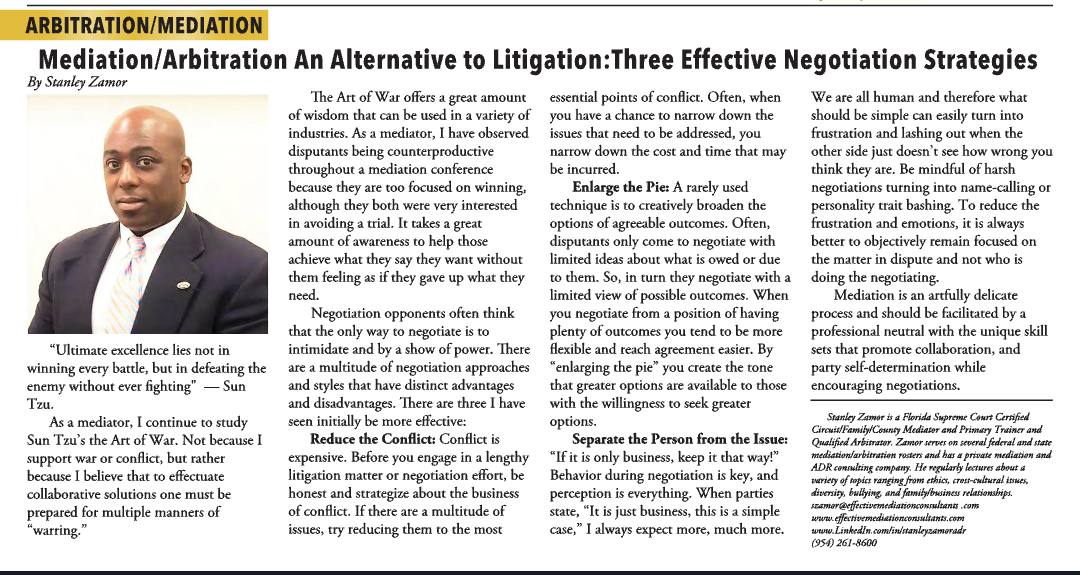
An Alternative to Litigation: “3 Effective Negotiation Strategies”

“Ultimate excellence lies not in winning every battle, but in defeating the enemy without ever fighting…” –Sun Tzu.


As a mediator I continue to study the Sun Tzu’s the “Art of War”. Not because I support War/conflict but rather, I believe that to effectuate collaborative solutions one must be prepared for multiple manners of “warring”. The Art of War offers a great amount of wisdom that can be used in a variety of industries.  As a mediator I have observed disputants being counterproductive throughout a mediation conference because they are too focused on winning, although they both were very interested in avoiding a trial.  It takes a great amount of awareness to help those achieve what they say they want, without them feeling like they gave up what they need


Negotiation opponents often think that the only way to negotiate is to intimidate and by a show of power.  There are a multitude negotiation approaches/styles and they all have distinct advantages and disadvantages. The following are the 3 that I’ve seen initially be more effective:


3 Negotiation Strategies


  • Reduce the Conflict – Conflict is expensive.  Before you engage in a lengthy litigation matter or negotiation effort, be honest and strategize on the business of conflict.  If there are a multitude of issues, try reducing them to the most essential points of conflict. Often when you have a chance to narrow down the issues that need to be address, you narrow down the cost/time that may be incurred.


  • “Enlarge the Pie”– A rarely used technique is to creatively broaden the options of agreeable outcomes. Often disputants only come to negotiate with limited ideas of what is owed or due to them. So, in turn they negotiate with a limited view of possible outcomes.  When you negotiate from a position of having plenty of outcomes you tend to be more flexible and reach agreement easier.  By “enlarging the pie” you create the tone that greater options are available to those with the willingness to seek greater options.


  • Separate the Person from the Issue – “If it is only business, keep it that way!” Behavior during negotiation is key, and perception is everything. When parties state “…it is just business, this is a simple case…”, I always expect more much more.  We are all human and therefore what should be simple can easily turn into frustration and lashing out when the other side just doesn’t see how wrong you think they are. Be mindful of harsh negotiations turning into name-calling or personality trait bashing.  To reduce the frustration/emotions, it is always better to objectively remain on the matter in dispute and not who is doing the negotiating.


Mediation is artfully delicate process and should be facilitated by a professional neutral with the unique skill sets that promote collaboration, party self-determination while encouraging negotiations.


Stanley Zamor is a Florida Supreme Court Certified Circuit/Family/County Mediator & Primary Trainer and Qualified Arbitrator.  Mr. Zamor serves on several federal and state mediation/arbitration rosters and has a private mediation and ADR consulting company.  He regularly lectures on a variety of topics from ethics, cross-cultural issues, diversity, bullying, and Family/Business relationships.


“Getting What You Want in Mediation”

“Getting What You Want in Mediation”

By Stanley Zamor

(January 2018)

Set The Stage

As the parties entered the room, I stood smiling and welcomed each person as they took their seat around the conference table. I stood at the head of the table and observed the perfectly quaffed group of 10, they all seemed to share the same blank expressionless face. Something recently happened… And that something was not good.  As each side gave their opening statement they mentioned the results of a Summary Judgement hearing that took place just 2 hours prior to the commencement this mediation.  The judge made a partial ruling that both parties claimed to give them some sort of victory.

In brief, for over 3 years of litigation multiple businessmen, in two consolidated cases, spent millions of dollars to prominent law firms to keep pushing their positions until the eve of trial.  But now, after long eloquent statements outlining how the law supports their position(s), I asked them something that seemed to perplex the entire group.  I asked, “Now that we have heard each perspective and how right each party thinks they are; what do you want?…” They all agreed that they wanted finality and (read below for the rest). I said, “Good.  Then let’s get to work…”

At The Ready…

One of the difficult defining points of mediation is to reduce the barriers of communication.  Litigation is innately adversarial in tone and process.  Mediation conversely encourages collaboration while reframing the tone of the dispute, to where parties may feel able to design their own resolution.

Often, once a case is filed in court, disputants never see each other outside of a court related event.  Since mediation is an informal process, disputants have an opportunity to use their own words during mediation in a conversational tone, and not only in the usual adversarial posture.  A skillful mediator can use that opportunity, to shape the discussion to where both parties can feel heard/good about being flexible and seeing where resolution may creatively lie.

Mediation will not replace litigation, it is simply an option that works when parties need an alternative.  Legal rights and duties are important but many times when parties are given a neutral space to express what they want, they are able to resolve issues themselves.

Their Wants:

So, what did these disputants want, and did mediation give to them?  The following are a few of the things that the disputants told me they wanted and after a 5 hour mediation, they created an agreement that was satisfied with:

  • Someone to admit wrong and to be held accountable,
  • To be able to move forward and beyond that business dispute,
  • To take the lessons learned and establish better systems to limit/protect themselves from future litigation,
  • To recoup/cover a portion of monies spent on legal fees,
  • To make more money, smarter.


Stanley Zamor is a Florida Supreme Court Certified Circuit/Family/County Mediator & Primary Trainer and Qualified Arbitrator.  Mr. Zamor serves on several federal and state mediation/arbitration rosters and has a private mediation and ADR consulting company.  He regularly lectures on a variety of topics from ethics, cross-cultural issues, diversity, bullying, and Family/Business relationships.

szamor@effectivemediationconsultants.com

www. effectivemediationconsultants.com

www.LinkedIn.com/in/stanleyzamoradr

(954) 261-8600