
Effective Negotiation Techniques for Professionals
Mediation/Arbitration
“Effective Negotiation Techniques for Professionals”
Every day is an exercise in negotiation! Negotiation is an essential skill in today’s fast-paced and often contentious business environment. Whether you’re dealing with internal team conflicts or external partnerships, mastering effective negotiation techniques can lead to more favorable outcomes and healthier relationships. This article will mention just five of the best negotiation techniques that professionals can utilize.
1. Building Rapport and Trust
Successful negotiation begins/relies heavily on trust and rapport. Building a connection with the other party can lead to more open communication and a willingness to compromise. Simple gestures like maintaining eye contact, being polite, and finding moments of humor can help establish a positive relationship. Trust is built over time, but during a negotiation even small, consistent actions can foster goodwill/Trust.
2. Active Listening
Active listening is a skill that must be developed. We are not born active listeners. Yet active listening is a cornerstone of effective negotiation that often gets neglected. It involves fully concentrating, understanding, and responding to what the other party is saying. By physically demonstrating genuine interest, you create an atmosphere of respect and openness. Techniques include nodding, summarizing what the other person has said, and asking clarifying questions. This not only helps in gathering crucial information but also makes the other party feel valued.
3. Establishing Common Ground
Finding commonality between parties can significantly ease tensions and foster collaboration. Start by identifying shared goals, values, or interests. This technique encourages a collaborative mindset and can shift the focus from adversarial positions to mutual benefits.
4. Emphasizing Interests Over Positions
A common pitfall in negotiations is focusing on fixed positions rather than the underlying interests. Positions are often rigid egocentric and can lead to a stalemate, while interests are flexible and can open avenues for creative solutions. For example, instead of sticking to a specific salary demand, a candidate might express their need for financial security, which could be addressed in various ways.
5. The BATNA Principle
Understanding your Best Alternative to a Negotiated Agreement (BATNA) is crucial. This concept, popularized by Roger Fisher and William Ury in their book “Getting to Yes,” refers to the best course of action you can take if negotiations fail. Knowing your BATNA empowers you to negotiate from a position of strength and clarity. It helps in setting realistic goals and knowing when to walk away from an unfavorable deal.
Take-Away
The aforementioned techniques are just a few of many I will be discussing in upcoming articles. Ultimately, the goal of negotiation is not just to reach an agreement, but to build lasting relationships that can withstand future challenges.
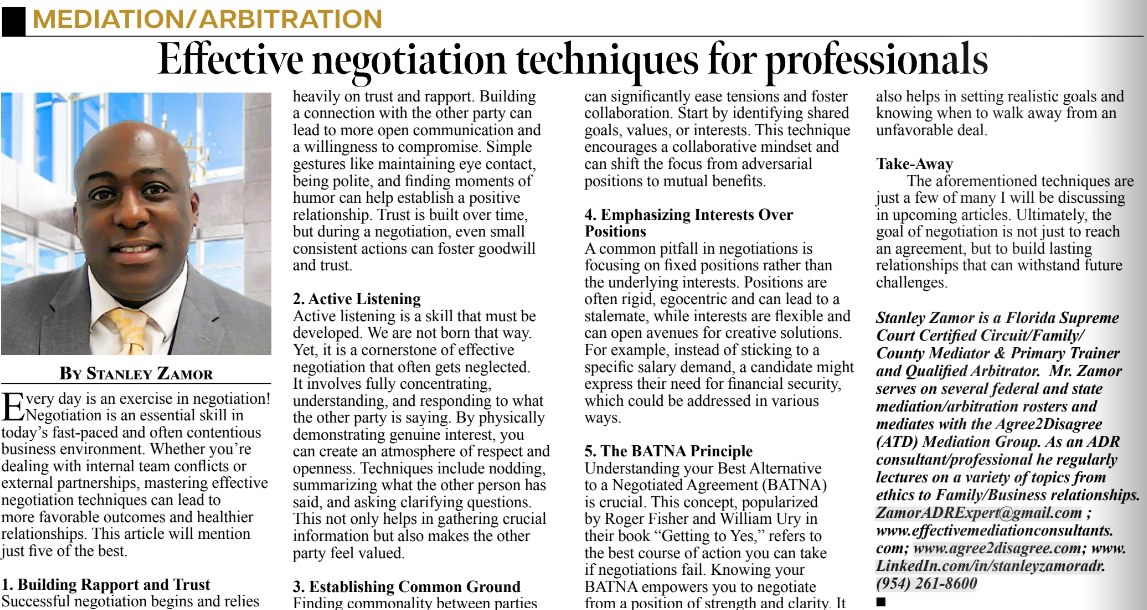
Stanley Zamor is a Florida Supreme Court Certified Circuit/Family/County Mediator & Primary Trainer and Qualified Arbitrator. Mr. Zamor serves on several federal and state mediation/arbitration rosters and mediates with the Agree2Disagree (ATD) Mediation Group. As an ADR consultant/professional he regularly lectures on a variety of topics from ethics to Family/Business relationships. ZamorADRExpert@gmail.com ; www.effectivemediationconsultants.com; www.agree2disagree.com; www.LinkedIn.com/in/stanleyzamoradr. (954) 261-8600