
Posts

Effective Negotiation Techniques for Professionals

Mediation/Arbitration

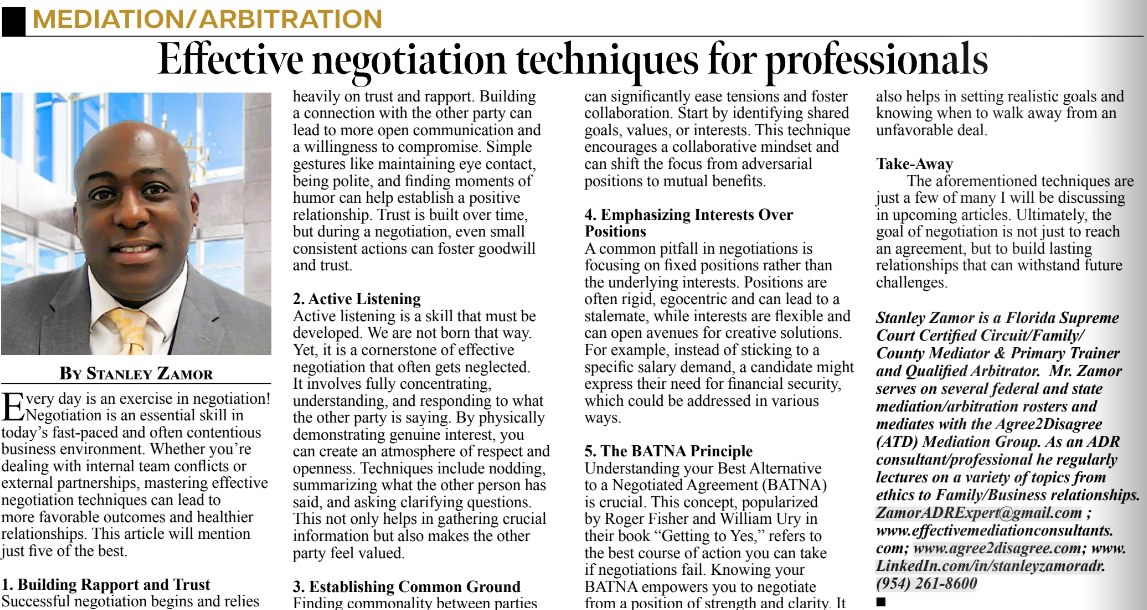
“Effective Negotiation Techniques for Professionals”

Every day is an exercise in negotiation! Negotiation is an essential skill in today’s fast-paced and often contentious business environment. Whether you’re dealing with internal team conflicts or external partnerships, mastering effective negotiation techniques can lead to more favorable outcomes and healthier relationships. This article will mention just five of the best negotiation techniques that professionals can utilize.

 1. Building Rapport and Trust

Successful negotiation begins/relies heavily on trust and rapport. Building a connection with the other party can lead to more open communication and a willingness to compromise. Simple gestures like maintaining eye contact, being polite, and finding moments of humor can help establish a positive relationship. Trust is built over time, but during a negotiation even small, consistent actions can foster goodwill/Trust.


 2. Active Listening

Active listening is a skill that must be developed. We are not born active listeners. Yet active listening is a cornerstone of effective negotiation that often gets neglected. It involves fully concentrating, understanding, and responding to what the other party is saying. By physically demonstrating genuine interest, you create an atmosphere of respect and openness. Techniques include nodding, summarizing what the other person has said, and asking clarifying questions. This not only helps in gathering crucial information but also makes the other party feel valued.

 3. Establishing Common Ground

Finding commonality between parties can significantly ease tensions and foster collaboration. Start by identifying shared goals, values, or interests. This technique encourages a collaborative mindset and can shift the focus from adversarial positions to mutual benefits.

4. Emphasizing Interests Over Positions

A common pitfall in negotiations is focusing on fixed positions rather than the underlying interests. Positions are often rigid egocentric and can lead to a stalemate, while interests are flexible and can open avenues for creative solutions. For example, instead of sticking to a specific salary demand, a candidate might express their need for financial security, which could be addressed in various ways.  

5. The BATNA Principle

Understanding your Best Alternative to a Negotiated Agreement (BATNA) is crucial. This concept, popularized by Roger Fisher and William Ury in their book “Getting to Yes,” refers to the best course of action you can take if negotiations fail. Knowing your BATNA empowers you to negotiate from a position of strength and clarity. It helps in setting realistic goals and knowing when to walk away from an unfavorable deal.


 Take-Away

The aforementioned techniques are just a few of many I will be discussing in upcoming articles. Ultimately, the goal of negotiation is not just to reach an agreement, but to build lasting relationships that can withstand future challenges.

Stanley Zamor is a Florida Supreme Court Certified Circuit/Family/County Mediator & Primary Trainer and Qualified Arbitrator.  Mr. Zamor serves on several federal and state mediation/arbitration rosters and mediates with the Agree2Disagree (ATD) Mediation Group. As an ADR consultant/professional he regularly lectures on a variety of topics from ethics to Family/Business relationships.  ZamorADRExpert@gmail.com ; www.effectivemediationconsultants.com; www.agree2disagree.com; www.LinkedIn.com/in/stanleyzamoradr. (954) 261-8600

Avoiding The F –Bomb While Mediating, Is that Possible?

Ok. I have to finally say it! There just seems to be no way around the F-bomb being dropped or used during mediations (or a negotiation).  I mean, if it is not used by the parties, then it will be used by their advocates/representatives.  And advocates/representatives drop the F-bomb more than most, because as advocates/representatives, that is their job. I get it. I’ve been told that divorce/family attorneys, must drop that F-bomb during their opening presentations or they’ll be perceived as not doing their job? Wow! And as a third-party neutral the F-bomb almost makes the hairs on my neck, stand-on-end. Because once I hear them start their statement, end their statement, or even worse, look me in and say in an inquisitive AND probing tone, “Isn’t that ‘fair’ Mr. Mediator”… “I just want what is fair for my client”…. “We’re trying to be ‘fair’ here” … “We are being more than ‘fair’”…   Yes, Fair. That F-Bomb can completely make a mediation negotiation go left. 

So I ask, is it possible to avoid the F-bomb during a mediation? The simple answer is no.  The more complex answer is, “maybe” or “so what”.  What is fair? Fair is about perspective. When negotiating it is completely subjective. When dealing with heightened emotions it cannot be achieved because the parties and their advocates believe only their perspective is the best and more fair and reasonable (shhhhh! The R-Bomb, that’s for another article). 

Expanding Fair

The perception of what is fair; or being fair in mediation negotiation hinges on several key factors, one of which is the ability of the parties involved to set aside their ego. When disputants are entrenched in their positions, driven by personal pride or a fear of losing face, it becomes challenging to engage in constructive dialogue. Here are a few reasons why letting go of ego is essential when trying to be fair in mediation negotiations:

1. Openness to Compromise: When individuals prioritize their ego, they become less flexible and more focused on winning rather than finding a mutually beneficial solution. Letting go of ego allows for a willingness to consider alternative viewpoints and compromise.

2. Active Listening: Fair negotiation requires active listening, where each party genuinely seeks to understand the other’s perspective. Ego can hinder this process, as individuals may be more focused on defending their stance rather than listening to the other side.

3. Building Trust: Negotiations thrive on trust. If parties are defensive or overly concerned with their self-image, it can create an atmosphere of suspicion. By minimizing ego, negotiators can foster an environment of mutual respect and collaboration.

4. Focus on Interests, Not Positions: Effective negotiation involves focusing on underlying interests rather than rigid positions. Letting go of ego enables parties to explore their true needs and desires, leading to more creative and satisfactory solutions.

5. Reducing Conflict: Ego-driven negotiations often escalate into conflicts. By setting aside personal pride, parties can approach the negotiation with a problem-solving mindset rather than a combative one, reducing the likelihood of confrontation.

The Take-Away

In summary, fair negotiation is only achievable when parties can transcend their egos, allowing for open communication, trust-building, and a focus on collaborative solutions. This shift not only enhances the negotiation process but also fosters better relationships moving forward. A skilled mediator is tasked with continually adjusting and refocusing the participants throughout the mediation negotiation process. It is therefore the skilled, and ethical mediator that is essential in assisting the participants negotiate beyond the ego. A subsequent article will better explore mediator’s best practices and ethical skills that addresses ego and creative solution building.

So rather than debate and attempt to convince why opposing parties are wrong, third-party neutrals should help acknowledge the emotion in the dispute then focus the parties on adjusting the emotional component and reframing it as what makes good “business sense” or what are the best ways to maximize outcomes given the circumstance as they appear that day.  By helping the parties adjust their lens regarding receiving justice and reaching/giving what is fair, they are more open to reaching a agreement that is acceptable that they helped craft.  

So, there is no “fair” in mediation negotiation in the sense that most expect. There is accepting an idea that being fair is not going to be the same for everyone involved in the conflict. And, there is respecting another’s perspective of fair and adjusting participants’ ego while negotiating so a mutually acceptable resolve can be achieved if that is the common goal.   

“Let’s Make A Business Decision, Let’s Mediate”

“Let’s Make A Business Decision, Let’s Mediate”

By Stanley Zamor

(July 2017)

“Greg, if you would have better advised me of the extensive cost of this litigation, I might not have let it go this far. But now, I am so financially committed, I have to see it through, even though it may bankrupt me…” I stated, “Although you are heavily engaged in litigation, now that you are at mediation, you have a real opportunity to reduce further expenses while reaching a resolution you create…”  Unfortunately, this was a real statement made by a Plaintiff expressing his frustration to his attorney.  The mediation ended, and resulted in a settlement 3 hours later.

The Real Cost of Litigation

We live in a great country where our legal system is not perfect, but is available to those who choose to use it.  So how expensive is litigation anyway? Um, although the initial cost of a civil suit varies depending on the lawyer you choose and the type of case, it is not unusual for either party to spend close to $100,000 in a contentious business lawsuit.  How? Well, a brief example is when taking the deposition of five people, who are potential witnesses:

*  Attorney’s replenishable retainer of $5,000, used for initial costs/filing and commencing discovery of the lawsuit;

*  Attorney charging $300 per hour – research and preparation for five, eight hour witness depositions – $2400 x 5= $12,000.  Further consider the cost of travel and deposition transcripts (usual cost $1000 each x 5= $5,000);

*  Other basics litigation costs include (but is not limited to) hiring expert witnesses; research/study of reports, analysis, or other projects ordered by the court; attorney hourly fees; copy fees; computer legal research services; secretarial and paralegal fees; external consultants, and specialist fees; private investigator, electronic discovery maintenance, and trial demonstrative aids, etc.


The Truth Is Real

Unfortunately, even though our civil litigation system is considered to be the best in the world, it is so costly, and the rewards (if any), are sometimes too far delayed to enjoy the benefits.  So that is why mediation is available and the courts are encouraging parties to mediation early as an alternative to trial.  In many areas of the law, like in Condo & Home Owners Association cases, you must mediate before you litigate.

The Cost of Mediation

Contrary to litigation mediation cost fractions less and mediating before you file a lawsuit can save you tens of thousands of dollars.  The comparative math is:

*  Typically, mediators charge $300 per hour for five-hours. (shared between the parties) So, $1500, and you are done!

*  If you have an attorney, add the cost of their time too. Regardless, your cost can be under $3000 and you’ve reached a resolution that you’ve created and controlled. When you litigate you will triple that cost for the uncertainty of an outcome.  Hmmmm…  Make a business decision, you have options.


Stanley Zamor is a Florida Supreme Court Certified Circuit/Family/County Mediator & Primary Trainer and Qualified Arbitrator.  Mr. Zamor serves on several federal and state mediation/arbitration rosters and has a private mediation and ADR consulting company.  He regularly lectures on a variety of topics from ethics, cross-cultural issues, diversity, bullying, and Family/Business relationships.


szamor@i-mediateconsulting.com

www.i-mediateconsulting.com

www.LinkedIn.com/in/stanleyzamoradr

(954) 261-8600


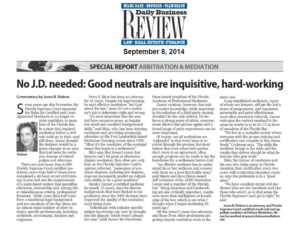
Good Neutrals Are Hard Working: “No J.D. NEEDED…”?

CLICK HERE:  Daily Business Review 9.8.14 hard copy

The Daily Business Review decided to look at civil mediation and the Florida Supreme Court’s change in 2007 to remove the restriction allowing for non-attorneys to mediate civil cases.  What is a good for the mediation, the process, and the public? The answer is….. YES. I am a featured contributor to this article as well as some of the states most well-known trainer and mediation practitioners.  Perry Itkin was a Primary Trainer and a lawyer for 41 years when this article was originally published.  For those who do not know who Perry Itkin is, since 1992 he was one of Florida’s most sought-after mediation Primary-Trainers until he retired in 2015.  In this article, he states that effective mediation is not about the law since it is not a mediator’s job to determine right or wrong… It’s most important that the neutral have common sense, an inquisitive mind, and excellent interpersonal skills…


This is a good short article that in my opinion starts the conversation and shows that, there are a lot of good mediators that are members of the bar, and there are a lot of mediators who are not members of the bar.  A good mediator should bring a broad set of skills and have a heightened awareness of interpersonal communication and how to assist people to move beyond conflict. Mediation is a uniquely flexible process that is not as limited and rigid as people initially think.

Click the text below to see the .pdf hardcopy.