
Posts

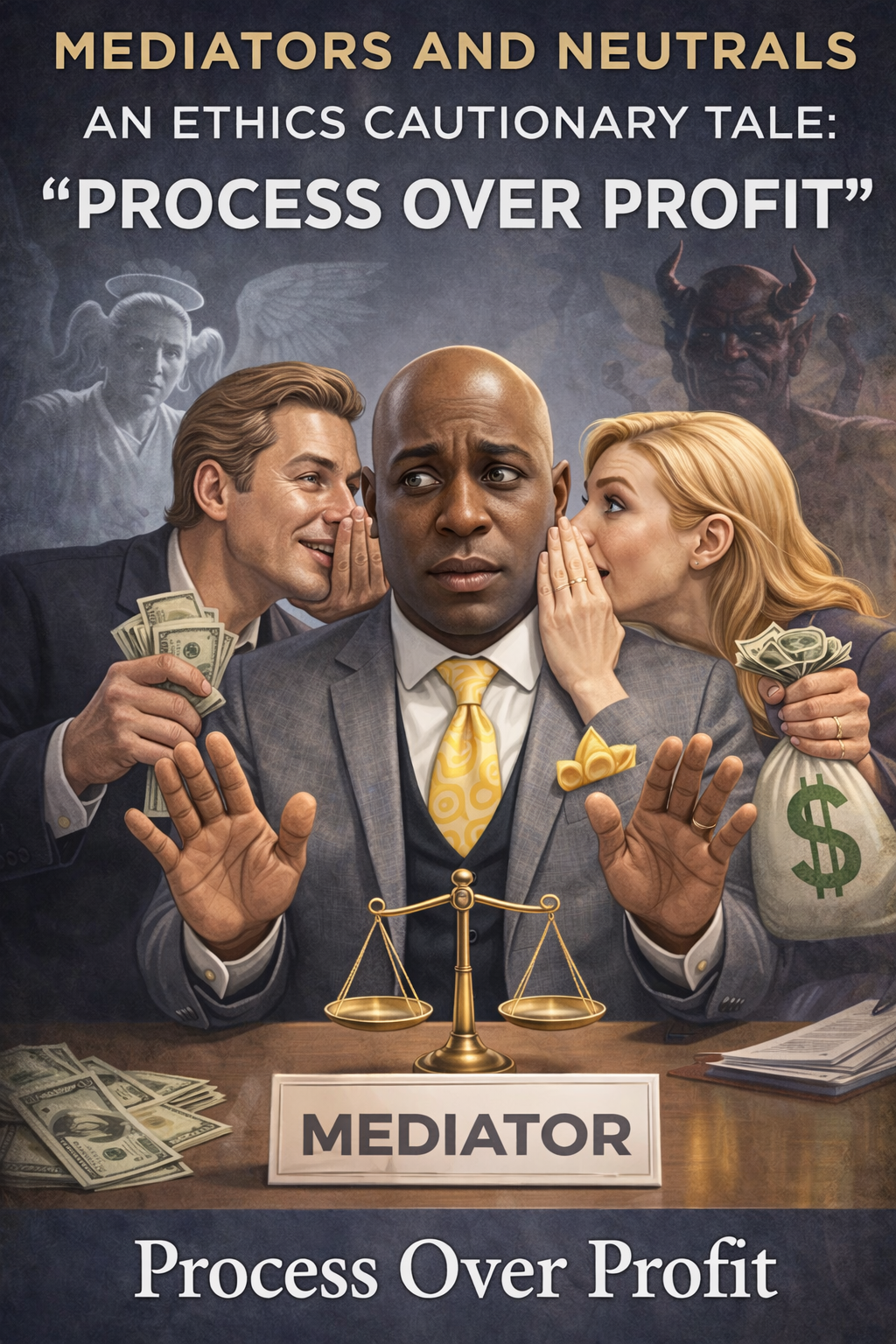
An Ethics Cautionary Tale: Process Over Profit — Translations, How About You?

By Stanley Zamor — Podcast Summary

In the podcast episode “An Ethics Cautionary Tale: Process Over Profit — Translations, How About You?”, Stanley Zamor reflects on a recent mediation experience that raises an issue many neutrals encounter but few openly discuss: the ethical responsibility surrounding proper translation during mediation and the mediator’s duty to safeguard understanding throughout the process.

At the core of the discussion is a foundational principle of mediation — the parties, not the attorneys or the mediator, are the ultimate decision-makers. Because settlement decisions can carry life-altering consequences, mediators have an ongoing obligation to ensure that every participant fully understands the process, the proposals being discussed, and the “parties/litigants” understand implications of their choices. This responsibility does not end once a translator is present; rather, it requires continual monitoring, clarification, and vigilance throughout the mediation session.

The episode highlights an incident that happened during a real litigation commercial case and how ethical obligations, that may seem minor or procedural to other professionals are, in mediation, central to the integrity of the process. Failure to address translation issues, misunderstandings, or communication gaps can undermine self-determination and compromise fairness — both core values of professional mediation practice.

Zamor emphasizes that mediators carry duties that extend beyond client satisfaction or case resolution. Their responsibility is owed simultaneously to the parties, the profession, the mediation process itself, and the courts that rely on mediators to uphold ethical standards. These obligations often differ sharply from the role of advocates, whose focus is understandably aligned with advancing their clients’ interests. This tension can create ethical crossroads for neutrals who must decide whether to prioritize efficiency or procedural integrity.

A central question posed in the podcast challenges mediators directly: How many neutrals truly place process before profit? While the answer may seem obvious in theory, Zamor argues that the reality is more complex. Mediators operate businesses and face economic pressures, making ethical decision-making less straightforward than many assume. The willingness to pause, slow down, or even challenge participants when ethical concerns arise may conflict with business incentives — yet it is precisely in these moments that professional integrity is tested.

The discussion also references the Florida Rules for Certified and Court-Appointed Mediators, which clearly articulate the mediator’s ethical obligations, as well as multiple opinions issued by the Mediator Ethics Advisory Committee (MEAC) addressing translation and communication issues. Despite this guidance, translation concerns remain common and are frequently mishandled, underscoring the need for continued dialogue and education.

Ultimately, the episode serves as both cautionary tale and call to reflection. It challenges mediators to examine their own practices and ask whether they are consistently putting the integrity of the process ahead of convenience or financial considerations. In doing so, Zamor invites the mediation community to reaffirm that ethical vigilance — especially in seemingly routine details — is what protects party self-determination and sustains trust in the profession.

The question lingering at the end is simple but profound: When ethical tensions arise, will you choose process over profit?

Click here for the podcast: https://youtu.be/B2oL-ExMOHo

====================================================================
Stanley Zamor is a Florida Supreme Court Certified Circuit/Family/County Mediator & Primary Trainer and Qualified Arbitrator. Mr. Zamor is a private mediator and serves on several federal and state mediation/arbitration rosters. As an ADR consultant/professional he regularly lectures on a variety of topics from ethics, diversity/culture, bullying, Community Resolution Design, and Family/Business relationships. ZamorADRExpert@gmail.com ; www.effectivemediationconsultants.com; www.LinkedIn.com/in/stanleyzamoradr. (954) 261-8600
How I-DEAL: The Shadow of Mediation

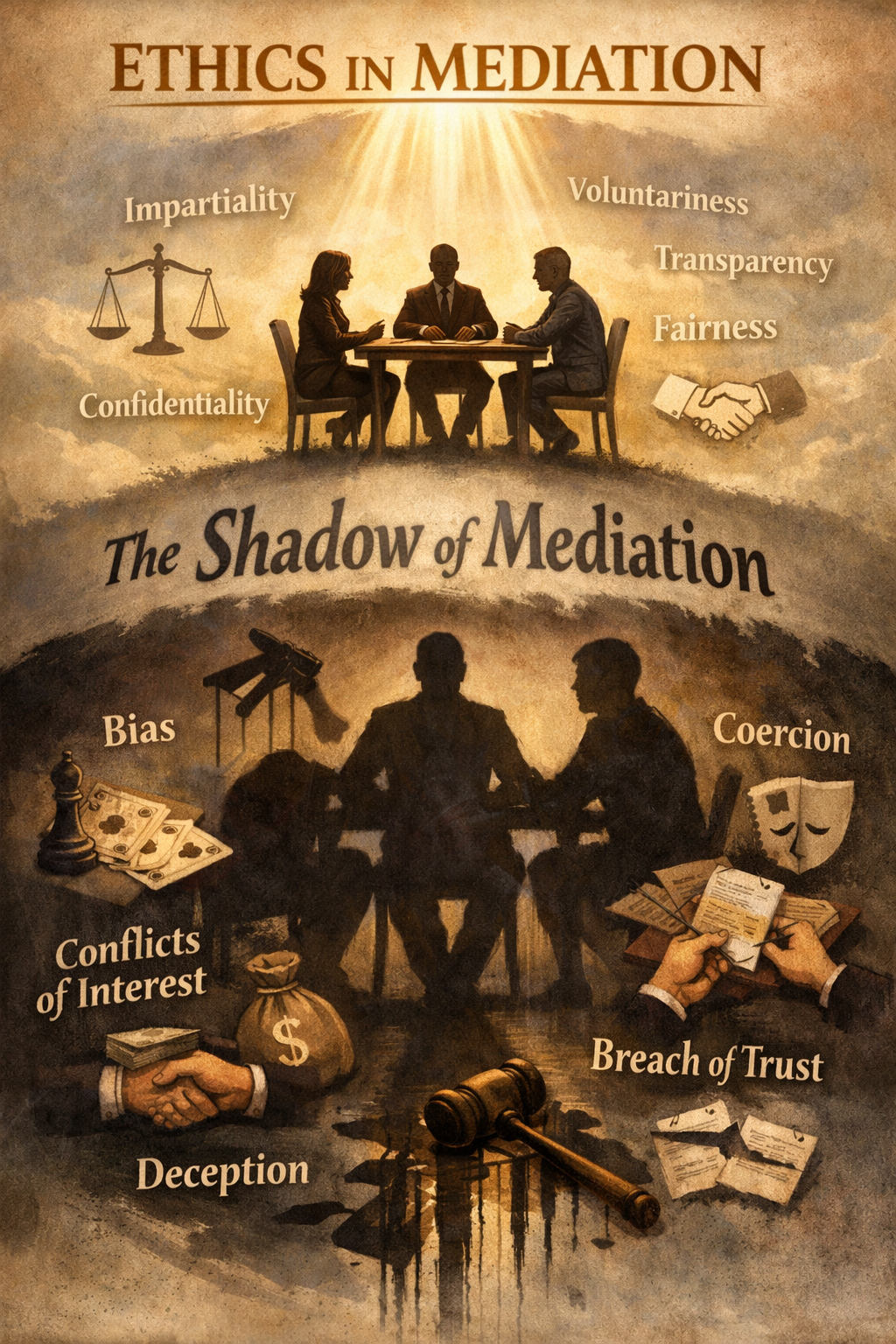
This short podcast is a discussion to introduce the “The Shadow of Mediation”; which is the timeframe that occurs after a mediation conference is held and has ended. The majority of professionals who participate in mediation often behave like once a mediation has concluded, the mediator’s ethical obligations has ended. They are wrong! A mediator’s ethical duty is to the process, profession, parties and the court and does not end when the process does. So neutrals should be be careful.

Stanley Zamor conducts periodic advanced negotiation and mediation advocacy trainings throughout the year where this and other nuances are discussed. During these advanced negotiation/mediation trainings techniques are discussed and demonstrated.

Subscribe, comment about this video and share it with others. If you have any questions for suggestions for future discussions or a question, please forward them to ZamorADRExpert@gmail.com with the subject line “Podcast Inquiry”

The Shadow of Mediation: Mediator Ethics, Perception, and the Quiet Risk of Post-Mediation Interactions

Mediation does not always end when the parties leave the room. Sometimes it lingers in follow-up emails, chance encounters at bar events, LinkedIn connections, referrals, post-settlement clarification calls, or even casual comments made months later. This lingering presence is what can be called the “shadow of mediation.” It is the ethical space where perception matters as much as reality. For mediators and neutrals, especially those operating within structured ethical frameworks such as the Florida Rules for Certified and Court-Appointed Mediators, the greatest risk is often not overt misconduct — it is the appearance of bias created unintentionally after the case concludes.

  1. The Ethical Foundation: Impartiality Beyond the Session

Under Florida Rule 10.330, impartiality means freedom from favoritism or bias in word, action, or appearance. appearance, and includes a commitment to assist all parties, as opposed to any one individual. The rule is not limited to what occurs during the mediation session itself. It extends to conduct that could undermine public confidence in neutrality. Similarly, Rule 10.340 (Conflicts of Interest) and Rule 10.370 (Authority and Professional Advice) reinforce a mediator’s obligation to avoid actions that could compromise neutrality or party self-determination. The key phrase embedded throughout mediator ethics is not simply actual bias, but the appearance of partiality. The shadow forms when conduct, even if innocent, creates doubt.

II. The “Shadow” Defined

The shadow of mediation refers to post-mediation conduct that:

  • Creates a perception that the mediator favors one party or counsel
  • Suggests confidential information influenced later interactions
  • Implies a continuing advisory or strategic role
  • Undermines the mediator’s neutrality in future related matters

It is subtle. Often unintentional. Sometimes If not always, social.

But perception drives trust — and mediation depends entirely on trust.

III. Cautionary Tales: Where Shadows Begin

1. The Post-Settlement Strategy Conversation

A mediator runs into defense counsel at a CLE event. The lawyer casually says, “Thanks for pushing the plaintiff hard on damages — that helped.”

The mediator responds with a smile: “I knew they were overvaluing the case.”

Even if said jokingly, the comment can be interpreted as alignment with one side’s strategy. If repeated, it could undermine future mediations involving that counsel or opposing parties.

Avoidance Strategy: Do not characterize your mediation moves in partisan terms. Neutral responses protect neutrality.

2. Social Media Proximity

After mediating a contentious commercial dispute, the mediator connects on LinkedIn with only one side’s counsel and later comments publicly on that attorney’s litigation victories.

The opposing side sees the visible online interaction.

Perception shifts.

Avoidance Strategy: Apply consistent professional boundaries across parties. If connecting online, consider balanced professional conduct or simply refrain.

3. Post-Mediation Clarification That Becomes Advice

A party calls the mediator months later asking: “Can you look at this enforcement issue? What do you think the judge would do?” If the mediator begins offering predictive legal analysis, especially favoring one party’s enforcement position, the line between neutral facilitator and advisor blurs. Rule 10.370 warns against providing professional opinion that overrides self-determination or suggests alignment.

Avoidance Strategy: Redirect parties to independent counsel. Provide process clarification, not substantive advocacy or predictive opinion.

4. Subsequent Representation in Related Matters

A mediator is later asked to serve as consultant or expert witness for one party in a related dispute arising from the mediated case. Even if technically permissible under certain conditions, the optics are dangerous. Confidential knowledge — even if not used — creates unavoidable appearance concerns.

Avoidance Strategy: Decline roles that derive from knowledge gained during mediation unless clear ethical authority and full informed consent exist — and even then, consider the reputational cost.

5. Casual Commentary About Parties

Statements such as:

  • “That plaintiff was impossible.”
  • “Defense counsel always lowballs.”
  • “I had to reality-check him.”

Even when anonymized, these comments can signal alignment, disclose confidential impressions, or diminish party dignity.

The shadow deepens when mediators speak too freely.

IV. Why Appearance Matters More Than Intent

Mediators often defend themselves by saying:

  • “I wasn’t biased.”
  • “Both attorneys/parties asked, so I provide both of them expected as I have the experience, training and expertise.”
  • “That’s not what I meant.”
  • “It was just a joke.”

Intent does not govern perception.

Public confidence in mediation rests on the belief that the neutral is, and remains, neutral. When appearance erodes, the process erodes.

Ethical discipline therefore requires restraint not only in conduct but in proximity.

V. Practical Guardrails to Avoid the Shadow

1. Adopt a Post-Case Neutrality Protocol

  • No strategic debriefs with one side.
  • No characterization of party performance.
  • No predictive analysis favoring one party.
  • No selective social media engagement tied to the case.

2. Standardize Your Responses

Develop neutral phrases such as:

  • “My role was to assist both parties in evaluating options.”
  • “The resolution resulted from the parties’ own decision-making.”
  • “I cannot comment on party positions or strategy.”

Consistency protects you.

3. Maintain Equal Professional Distance

Familiarity is not favoritism — but unequal familiarity creates perception.

Be aware of optics:

  • Who sees your public affiliations?
  • Be continuously aware of your body-language/behavior.
  • Who perceives your endorsements?
  • Who hears your praise?

4. Reflect Before Accepting Related Engagements

Ask:

  • Would a reasonable observer question my neutrality?
  • Could this create the appearance that confidential knowledge influenced my new role?
  • Would I be comfortable if this appeared in a grievance complaint?

If hesitation exists, the shadow already exists.

VI. The Ethical Discipline of Silence

Sometimes the most powerful ethical tool a mediator possesses is silence.

Silence after the session.
Silence about party strategy.
Silence about impressions.
Silence about perceived weaknesses.

The shadow shrinks when the mediator’s footprint remains light.

VII. Conclusion: Neutrality Extends Beyond the Room

Mediation is built on credibility.

Credibility is built on impartiality.

Impartiality requires vigilance — not only during caucus, not only during negotiation — but in the weeks, months, and professional interactions that follow.

The shadow of mediation is not misconduct.

It is risk. And ethical excellence requires not only avoiding actual bias, but guarding against its appearance — even when no one is watching.

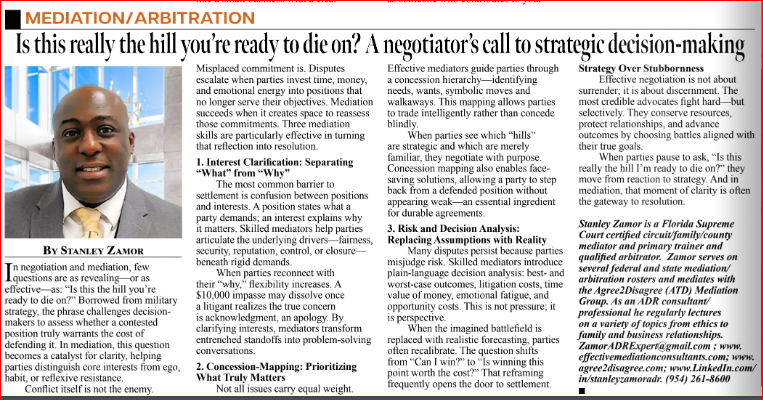
“Is This Really the Hill You’re Ready to Die On?”A Negotiator’s Call to Strategic Decision-Making

By Stanley Zamor

In negotiation and mediation, few questions are as revealing—or as effective—as: “Is this the hill you’re ready to die on?”  Borrowed from military strategy, the phrase challenges decision-makers to assess whether a contested position truly warrants the cost of defending it. In mediation, this question becomes a catalyst for clarity, helping parties distinguish core interests from ego, habit, or reflexive resistance.

Conflict itself is not the enemy. Misplaced commitment is. Disputes escalate when parties invest time, money, and emotional energy into positions that no longer serve their objectives. Mediation succeeds when it creates space to reassess those commitments. Three mediation skills are particularly effective in turning that reflection into resolution.

1. Interest Clarification: Separating “What” from “Why”

The most common barrier to settlement is confusion between positions and interests. A position states what a party demands; an interest explains why it matters. Skilled mediators help parties articulate the underlying drivers—fairness, security, reputation, control, or closure—beneath rigid demands.

When parties reconnect with their “why,” flexibility increases. A $10,000 impasse may dissolve once a litigant realizes the true concern is acknowledgment, an apology. By clarifying interests, mediators transform entrenched standoffs into problem-solving conversations.

2. Concession-Mapping: Prioritizing What Truly Matters

Not all issues carry equal weight. Effective mediators guide parties through a concession hierarchy—identifying needs, wants, symbolic moves and walkaways.  This mapping allows parties to trade intelligently rather than concede blindly.

When parties see which “hills” are strategic and which are merely familiar, they negotiate with purpose. Concession mapping also enables face-saving solutions, allowing a party to step back from a defended position without appearing weak—an essential ingredient for durable agreements.

3. Risk and Decision Analysis: Replacing Assumptions with Reality

Many disputes persist because parties misjudge risk. Skilled mediators introduce plain-language decision analysis: best- and worst-case outcomes, litigation costs, time value of money, emotional fatigue, and opportunity costs. This is not pressure; it is perspective.

When the imagined battlefield is replaced with realistic forecasting, parties often recalibrate. The question shifts from “Can I win?” to “Is winning this point worth the cost?” That reframing frequently opens the door to settlement.

Strategy Over Stubbornness

Effective negotiation is not about surrender; it is about discernment. The most credible advocates fight hard—but selectively. They conserve resources, protect relationships, and advance outcomes by choosing battles aligned with their true goals.

When parties pause to ask, “Is this really the hill I’m ready to die on?” they move from reaction to strategy. And in mediation, that moment of

 clarity is often the gateway to resolution.

Stanley Zamor is a Florida Supreme Court Certified Circuit/Family/County Mediator & Primary Trainer and Qualified Arbitrator.  Mr. Zamor is a private mediator and is on the panel of mediators at Salmon & Dulberg. He also serves on several federal and state mediation/arbitration rosters. As an ADR consultant/professional he regularly lectures on a variety of topics from ethics to Family/Business relationships.  To SCHEDULE A MEDIATION click the link to Stanley Zamor’s calendar https://sd-adr.com/attorney/stanley-zamor/ email his case manager: mariana@sd-adr.com

For direct contact ZamorADRExpert@gmail.com ; www.effectivemediationconsultants.com; www.LinkedIn.com/in/stanleyzamoradr. (954) 261-8600
“An Offer They Can Understand”: Mediation Lessons Through the Lens of The Godfather

“An Offer They Can Understand”: Mediation Lessons Through the Lens of The Godfather

By Stanley Zamor

PART 1

How a cinematic classic reveals enduring truths about negotiation, power dynamics, and the human side of conflict resolution

Few films capture the complexity of human conflict and negotiation as vividly as The Godfather. Although the movie centers on organized crime—a world far removed from professional mediation—its storytelling is steeped in themes of power, loyalty, persuasion, and conflict management. When stripped of its violence and illegality, the film offers surprisingly rich insights into how people navigate disputes, build consensus, and reach agreements under pressure.

This article explores the practice and philosophy of mediation through the lens of The Godfather, focusing on the behaviors, principles, and psychological frameworks that skilled mediators embody.


1. Understanding Interests Beneath Positions: Don Corleone’s Quiet Genius

One of the clearest lessons comes from Don Vito Corleone’s approach to negotiation. He listens carefully, quietly watched, asks open-ended questions, and seeks to understand what each party truly wants, and why. With every single ask, he posed a deeper inquiry which was uncomfortable and revealed the true nature of the want and need.

When Bonasera requests “justice,” the Don reframes the request to uncover the deeper interests—respect, acknowledgment, dignity.
This mirrors a core mediation principle:

People state positions, but they settle based on interests.

A mediator, like Don Corleone in that opening scene, must:

  • Listen beyond the spoken demand
  • Identify underlying motivators
  • Reframe issues into solvable components
  • Recognize emotional drivers (e.g., fear, loyalty, pride)

Successful mediation rests not on adjudicating right and wrong, but on decoding the human needs fueling each party’s stance.


2. Neutrality and Perceived Impartiality: A Lesson in Credibility

Although Don Corleone is not neutral in the political world of the Five Families, he often functions as an impartial convener during disputes. His reputation for fairness, consistency, and honor makes him a trusted figure—even by rivals.

In mediation:

  • Credibility is currency
  • Process fairness builds trust
  • Consistency fosters cooperation
  • Trust is given when competence in the desired want is understood

Participants will not negotiate in good faith if they suspect bias. The mediator’s ability to maintain neutrality—real and perceived—is essential to productive dialogue.

The Godfather demonstrates that neutrality is not the absence of opinion but the disciplined management of influence.


3. “A Man Who Doesn’t Spend Time With His Family…”: Balancing Power and Relationship

Mediation recognizes that relationships are assets, not obstacles. Don Corleone’s strength comes not from fear, but from the deep loyalty of those around him. He builds alliances through respect, reciprocity, and understanding.

Similarly, mediation emphasizes:

  • Preserving relationships where possible
  • Reducing unnecessary hostility
  • Building solutions that allow ongoing cooperation
  • Encouraging parties to see each other as partners, not enemies

Even in business disputes, family conflicts, employment disagreements, or commercial cases, resolution often requires people to continue working together. The Corleone model reminds us that maintaining dignity and relationships often creates more durable outcomes than “winning.”


4. The Power of Framing: “It’s Not Personal, It’s Strictly Business”

Perhaps the most famous line in the film offers a profound mediation truth:
Parties often personalize conflict that is fundamentally structural or systemic.

Mediators help reframe:

  • Emotion → Interests
  • Blame → Understanding
  • Past injuries → Future solutions

This reframing lowers defensiveness and clears space for creative problem-solving. It allows parties to see disputes not as existential threats but as solvable challenges.


5. Managing Power Imbalances: Lessons from the Five Families Summit

During the historic meeting of the Five Families, cooler heads prevail. Each representative brings power, resources, and entrenched perspectives—but the conversation is structured to prevent escalation.

Key mediation parallels:

  • Establish clear ground rules
  • Normalize diverse viewpoints
  • Encourage equal voice despite unequal power
  • Redirect aggressive tactics into constructive dialogue

Effective mediators, like Don Corleone in this scene, leverage calm authority to manage high-conflict personalities and keep the conversation focused on resolution.


6. Timing and Opportunity: “I’ll Wait”

Much of The Godfather revolves around the strategic use of timing. Don Corleone and Michael both understand the importance of waiting for the right moment to engage, negotiate, or respond.

In mediation, timing is often the hidden variable determining success:

  • Parties may need emotional readiness
  • External pressures (deadlines, costs, risk) can create openings for agreement
  • Settlement momentum builds when both parties face meaningful incentives

Skilled mediators read these cues and guide the process accordingly.


7. Respect: The Foundation of Effective Conflict Resolution

Throughout the film, respect is a universal cultural currency. Disputes arise not only from substantive issues, but from perceived affronts, broken trust, or violations of dignity.

Mediation recognizes that:

  • Respect is the gateway to communication
  • Parties engage more constructively when they feel heard
  • Acknowledgment of harm often matters more than remedies

The Corleone philosophy—“You come into my house…with respect”—underscores a core mediation tenet:
Respectful dialogue is the foundation for sustainable agreements.


Conclusion: What The Godfather Teaches Us About Mediation

While The Godfather is not a model of lawful dispute resolution, its narrative illuminates timeless truths about human behavior and negotiation:

  • Understanding interests is more powerful than reacting to positions
  • Neutrality and credibility anchor the process
  • Relationships shape outcomes
  • Reframing creates space for solutions
  • Power dynamics must be managed, not ignored
  • Timing matters
  • Respect transforms conflict

In mediation—as in the world of The Godfather—resolution is ultimately about human psychology. It is about creating processes where people feel heard, respected, and empowered to make decisions they can live with.

The film’s most enduring lesson for mediators may be this:

When you understand people—what they fear, what they value, and what they hope for—you can help them find agreements that were previously unthinkable.

“Conflict is inevitable, so is the resolve…”  -Stanley Zamor

Why Year-End May Be the Best Time to Resolve Cases

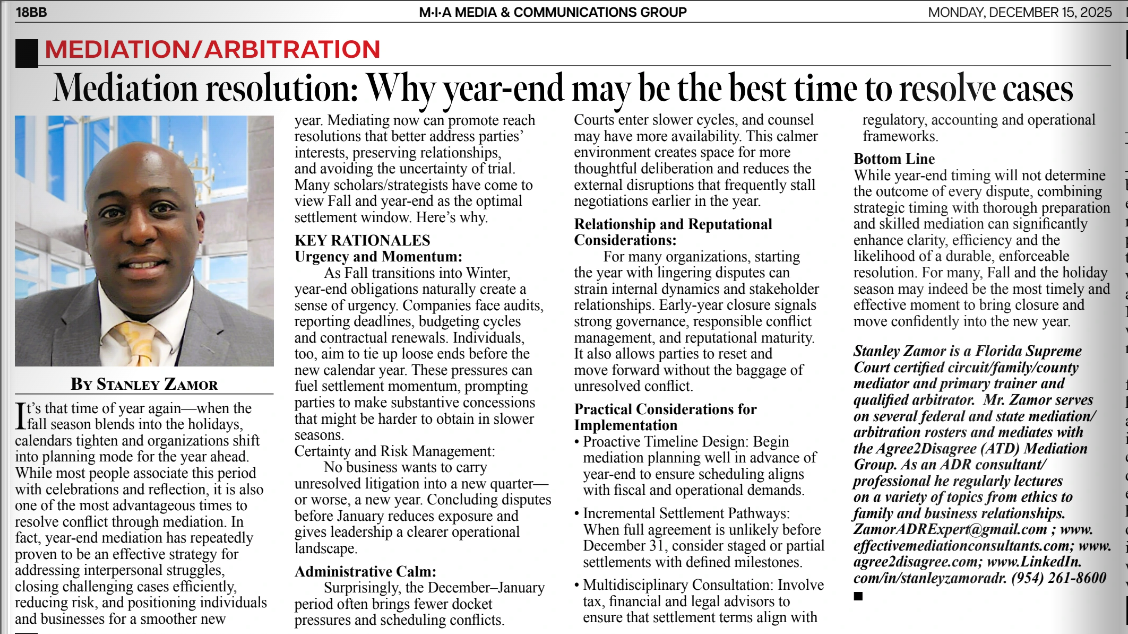
Mediation Resolution: Why Year-End May Be the Best Time to Resolve Cases
By Stanley Zamor

It’s that time of year again—when the fall season blends into the holidays, calendars tighten, and organizations shift into planning mode for the year ahead. While most people associate this period with celebrations and reflection, it is also one of the most advantageous times to resolve conflict through mediation. In fact, year-end mediation has repeatedly proven to be an effective strategy for addressing interpersonal struggles, closing challenging cases efficiently, reducing risk, and positioning individuals and businesses for a smoother new year. Mediating now can promote reach resolutions that better address parties’ interests, preserving relationships, and avoiding the uncertainty of trial. Many scholars/strategist have come to view Fall and year-end as the optimal settlement window. Here’s why.

Key Rationales

Urgency and Momentum:
As Fall transitions into Winter, year-end obligations naturally create a sense of urgency. Companies face audits, reporting deadlines, budgeting cycles, and contractual renewals. Individuals, too, aim to tie up loose ends before the new calendar year. These pressures can fuel settlement momentum, prompting parties to make substantive concessions that might be harder to obtain in slower seasons.

Certainty and Risk Management:
No business wants to carry unresolved litigation into a new quarter—or worse, a new year. Concluding disputes before January reduces exposure and gives leadership a clearer operational landscape.

Administrative Calm:
Surprisingly, the December–January period often brings fewer docket pressures and scheduling conflicts. Courts enter slower cycles, and counsel may have more availability. This calmer environment creates space for more thoughtful deliberation and reduces the external disruptions that frequently stall negotiations earlier in the year.

Relationship and Reputational Considerations:
For many organizations, starting the year with lingering disputes can strain internal dynamics and stakeholder relationships. Early-year closure signals strong governance, responsible conflict management, and reputational maturity. It also allows parties to reset and move forward without the baggage of unresolved conflict.

Practical Considerations for Implementation

  • Proactive Timeline Design: Begin mediation planning well in advance of year-end to ensure scheduling aligns with fiscal and operational demands.
  • Incremental Settlement Pathways: When full agreement is unlikely before December 31, consider staged or partial settlements with defined milestones.
  • Multidisciplinary Consultation: Involve tax, financial, and legal advisors to ensure that settlement terms align with regulatory, accounting, and operational frameworks.

Bottom Line

While year-end timing will not determine the outcome of every dispute, combining strategic timing with thorough preparation and skilled mediation can significantly enhance clarity, efficiency, and the likelihood of a durable, enforceable resolution. For many, Fall and the holiday season may indeed be the most timely and effective moment to bring closure and move confidently into the new year.


Stanley Zamor is a Florida Supreme Court Certified Circuit/Family/County Mediator & Primary Trainer and Qualified Arbitrator.  Mr. Zamor serves on several federal/state mediation/arbitration rosters and mediates with the Agree2Disagree (ATD) Mediation Group. As an ADR consultant/professional he regularly lectures on a variety of topics from ethics to Family/Business relationships.  ZamorADRExpert@gmail.com ; www.effectivemediationconsultants.com

Effective Negotiation Techniques for Professionals

Mediation/Arbitration

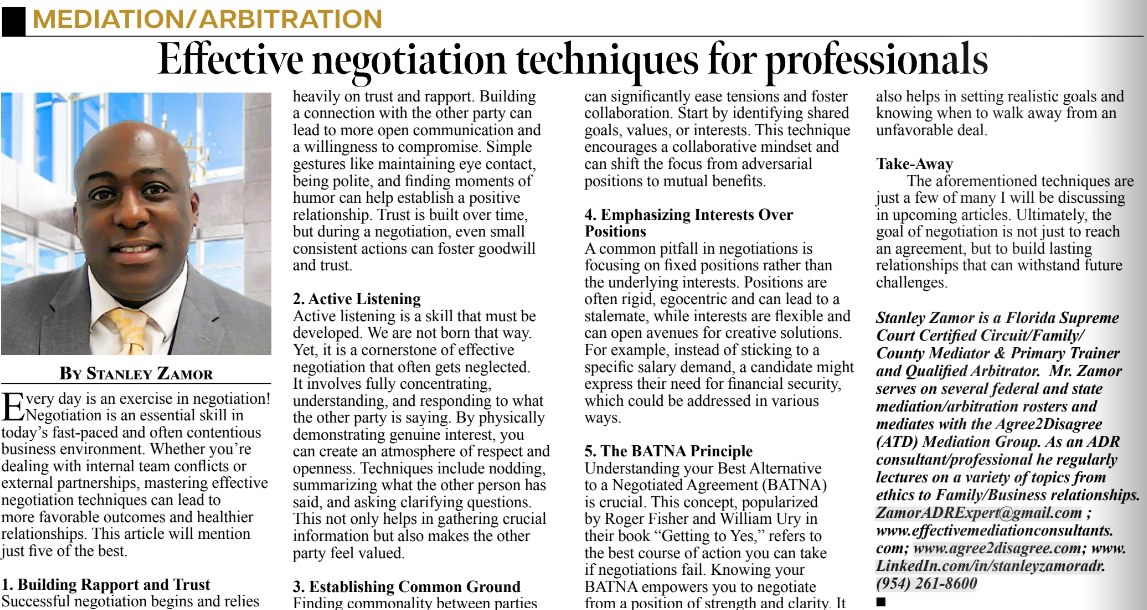
“Effective Negotiation Techniques for Professionals”

Every day is an exercise in negotiation! Negotiation is an essential skill in today’s fast-paced and often contentious business environment. Whether you’re dealing with internal team conflicts or external partnerships, mastering effective negotiation techniques can lead to more favorable outcomes and healthier relationships. This article will mention just five of the best negotiation techniques that professionals can utilize.

 1. Building Rapport and Trust

Successful negotiation begins/relies heavily on trust and rapport. Building a connection with the other party can lead to more open communication and a willingness to compromise. Simple gestures like maintaining eye contact, being polite, and finding moments of humor can help establish a positive relationship. Trust is built over time, but during a negotiation even small, consistent actions can foster goodwill/Trust.


 2. Active Listening

Active listening is a skill that must be developed. We are not born active listeners. Yet active listening is a cornerstone of effective negotiation that often gets neglected. It involves fully concentrating, understanding, and responding to what the other party is saying. By physically demonstrating genuine interest, you create an atmosphere of respect and openness. Techniques include nodding, summarizing what the other person has said, and asking clarifying questions. This not only helps in gathering crucial information but also makes the other party feel valued.

 3. Establishing Common Ground

Finding commonality between parties can significantly ease tensions and foster collaboration. Start by identifying shared goals, values, or interests. This technique encourages a collaborative mindset and can shift the focus from adversarial positions to mutual benefits.

4. Emphasizing Interests Over Positions

A common pitfall in negotiations is focusing on fixed positions rather than the underlying interests. Positions are often rigid egocentric and can lead to a stalemate, while interests are flexible and can open avenues for creative solutions. For example, instead of sticking to a specific salary demand, a candidate might express their need for financial security, which could be addressed in various ways.  

5. The BATNA Principle

Understanding your Best Alternative to a Negotiated Agreement (BATNA) is crucial. This concept, popularized by Roger Fisher and William Ury in their book “Getting to Yes,” refers to the best course of action you can take if negotiations fail. Knowing your BATNA empowers you to negotiate from a position of strength and clarity. It helps in setting realistic goals and knowing when to walk away from an unfavorable deal.


 Take-Away

The aforementioned techniques are just a few of many I will be discussing in upcoming articles. Ultimately, the goal of negotiation is not just to reach an agreement, but to build lasting relationships that can withstand future challenges.

Stanley Zamor is a Florida Supreme Court Certified Circuit/Family/County Mediator & Primary Trainer and Qualified Arbitrator.  Mr. Zamor serves on several federal and state mediation/arbitration rosters and mediates with the Agree2Disagree (ATD) Mediation Group. As an ADR consultant/professional he regularly lectures on a variety of topics from ethics to Family/Business relationships.  ZamorADRExpert@gmail.com ; www.effectivemediationconsultants.com; www.agree2disagree.com; www.LinkedIn.com/in/stanleyzamoradr. (954) 261-8600

Avoiding The F –Bomb While Mediating, Is that Possible?

Ok. I have to finally say it! There just seems to be no way around the F-bomb being dropped or used during mediations (or a negotiation).  I mean, if it is not used by the parties, then it will be used by their advocates/representatives.  And advocates/representatives drop the F-bomb more than most, because as advocates/representatives, that is their job. I get it. I’ve been told that divorce/family attorneys, must drop that F-bomb during their opening presentations or they’ll be perceived as not doing their job? Wow! And as a third-party neutral the F-bomb almost makes the hairs on my neck, stand-on-end. Because once I hear them start their statement, end their statement, or even worse, look me in and say in an inquisitive AND probing tone, “Isn’t that ‘fair’ Mr. Mediator”… “I just want what is fair for my client”…. “We’re trying to be ‘fair’ here” … “We are being more than ‘fair’”…   Yes, Fair. That F-Bomb can completely make a mediation negotiation go left. 

So I ask, is it possible to avoid the F-bomb during a mediation? The simple answer is no.  The more complex answer is, “maybe” or “so what”.  What is fair? Fair is about perspective. When negotiating it is completely subjective. When dealing with heightened emotions it cannot be achieved because the parties and their advocates believe only their perspective is the best and more fair and reasonable (shhhhh! The R-Bomb, that’s for another article). 

Expanding Fair

The perception of what is fair; or being fair in mediation negotiation hinges on several key factors, one of which is the ability of the parties involved to set aside their ego. When disputants are entrenched in their positions, driven by personal pride or a fear of losing face, it becomes challenging to engage in constructive dialogue. Here are a few reasons why letting go of ego is essential when trying to be fair in mediation negotiations:

1. Openness to Compromise: When individuals prioritize their ego, they become less flexible and more focused on winning rather than finding a mutually beneficial solution. Letting go of ego allows for a willingness to consider alternative viewpoints and compromise.

2. Active Listening: Fair negotiation requires active listening, where each party genuinely seeks to understand the other’s perspective. Ego can hinder this process, as individuals may be more focused on defending their stance rather than listening to the other side.

3. Building Trust: Negotiations thrive on trust. If parties are defensive or overly concerned with their self-image, it can create an atmosphere of suspicion. By minimizing ego, negotiators can foster an environment of mutual respect and collaboration.

4. Focus on Interests, Not Positions: Effective negotiation involves focusing on underlying interests rather than rigid positions. Letting go of ego enables parties to explore their true needs and desires, leading to more creative and satisfactory solutions.

5. Reducing Conflict: Ego-driven negotiations often escalate into conflicts. By setting aside personal pride, parties can approach the negotiation with a problem-solving mindset rather than a combative one, reducing the likelihood of confrontation.

The Take-Away

In summary, fair negotiation is only achievable when parties can transcend their egos, allowing for open communication, trust-building, and a focus on collaborative solutions. This shift not only enhances the negotiation process but also fosters better relationships moving forward. A skilled mediator is tasked with continually adjusting and refocusing the participants throughout the mediation negotiation process. It is therefore the skilled, and ethical mediator that is essential in assisting the participants negotiate beyond the ego. A subsequent article will better explore mediator’s best practices and ethical skills that addresses ego and creative solution building.

So rather than debate and attempt to convince why opposing parties are wrong, third-party neutrals should help acknowledge the emotion in the dispute then focus the parties on adjusting the emotional component and reframing it as what makes good “business sense” or what are the best ways to maximize outcomes given the circumstance as they appear that day.  By helping the parties adjust their lens regarding receiving justice and reaching/giving what is fair, they are more open to reaching a agreement that is acceptable that they helped craft.  

So, there is no “fair” in mediation negotiation in the sense that most expect. There is accepting an idea that being fair is not going to be the same for everyone involved in the conflict. And, there is respecting another’s perspective of fair and adjusting participants’ ego while negotiating so a mutually acceptable resolve can be achieved if that is the common goal.   

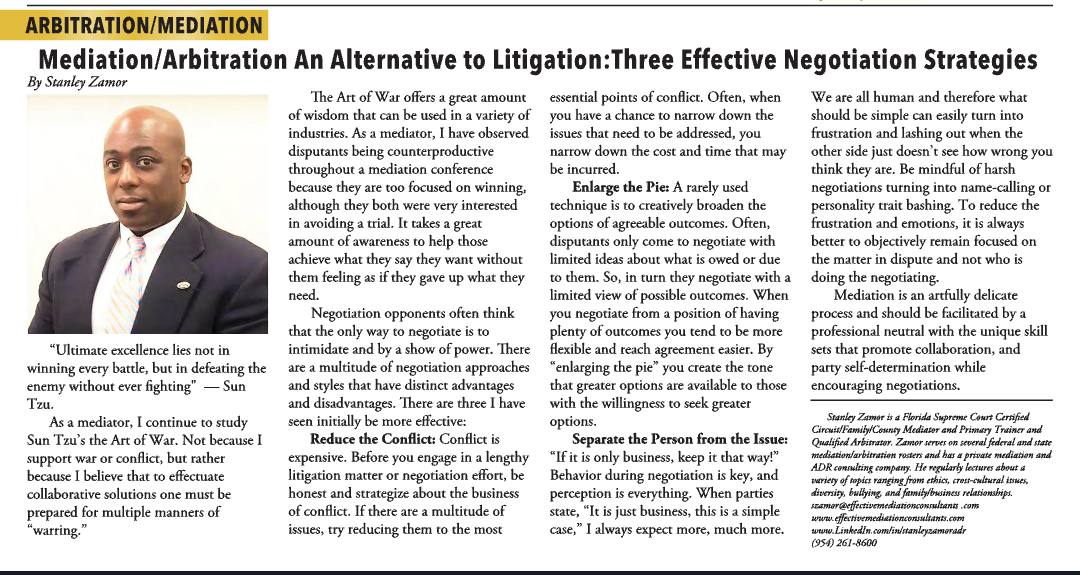
An Alternative to Litigation: “3 Effective Negotiation Strategies”

“Ultimate excellence lies not in winning every battle, but in defeating the enemy without ever fighting…” –Sun Tzu.


As a mediator I continue to study the Sun Tzu’s the “Art of War”. Not because I support War/conflict but rather, I believe that to effectuate collaborative solutions one must be prepared for multiple manners of “warring”. The Art of War offers a great amount of wisdom that can be used in a variety of industries.  As a mediator I have observed disputants being counterproductive throughout a mediation conference because they are too focused on winning, although they both were very interested in avoiding a trial.  It takes a great amount of awareness to help those achieve what they say they want, without them feeling like they gave up what they need


Negotiation opponents often think that the only way to negotiate is to intimidate and by a show of power.  There are a multitude negotiation approaches/styles and they all have distinct advantages and disadvantages. The following are the 3 that I’ve seen initially be more effective:


3 Negotiation Strategies


  • Reduce the Conflict – Conflict is expensive.  Before you engage in a lengthy litigation matter or negotiation effort, be honest and strategize on the business of conflict.  If there are a multitude of issues, try reducing them to the most essential points of conflict. Often when you have a chance to narrow down the issues that need to be address, you narrow down the cost/time that may be incurred.


  • “Enlarge the Pie”– A rarely used technique is to creatively broaden the options of agreeable outcomes. Often disputants only come to negotiate with limited ideas of what is owed or due to them. So, in turn they negotiate with a limited view of possible outcomes.  When you negotiate from a position of having plenty of outcomes you tend to be more flexible and reach agreement easier.  By “enlarging the pie” you create the tone that greater options are available to those with the willingness to seek greater options.


  • Separate the Person from the Issue – “If it is only business, keep it that way!” Behavior during negotiation is key, and perception is everything. When parties state “…it is just business, this is a simple case…”, I always expect more much more.  We are all human and therefore what should be simple can easily turn into frustration and lashing out when the other side just doesn’t see how wrong you think they are. Be mindful of harsh negotiations turning into name-calling or personality trait bashing.  To reduce the frustration/emotions, it is always better to objectively remain on the matter in dispute and not who is doing the negotiating.


Mediation is artfully delicate process and should be facilitated by a professional neutral with the unique skill sets that promote collaboration, party self-determination while encouraging negotiations.


Stanley Zamor is a Florida Supreme Court Certified Circuit/Family/County Mediator & Primary Trainer and Qualified Arbitrator.  Mr. Zamor serves on several federal and state mediation/arbitration rosters and has a private mediation and ADR consulting company.  He regularly lectures on a variety of topics from ethics, cross-cultural issues, diversity, bullying, and Family/Business relationships.


“Getting What You Want in Mediation”

“Getting What You Want in Mediation”

By Stanley Zamor

(January 2018)

Set The Stage

As the parties entered the room, I stood smiling and welcomed each person as they took their seat around the conference table. I stood at the head of the table and observed the perfectly quaffed group of 10, they all seemed to share the same blank expressionless face. Something recently happened… And that something was not good.  As each side gave their opening statement they mentioned the results of a Summary Judgement hearing that took place just 2 hours prior to the commencement this mediation.  The judge made a partial ruling that both parties claimed to give them some sort of victory.

In brief, for over 3 years of litigation multiple businessmen, in two consolidated cases, spent millions of dollars to prominent law firms to keep pushing their positions until the eve of trial.  But now, after long eloquent statements outlining how the law supports their position(s), I asked them something that seemed to perplex the entire group.  I asked, “Now that we have heard each perspective and how right each party thinks they are; what do you want?…” They all agreed that they wanted finality and (read below for the rest). I said, “Good.  Then let’s get to work…”

At The Ready…

One of the difficult defining points of mediation is to reduce the barriers of communication.  Litigation is innately adversarial in tone and process.  Mediation conversely encourages collaboration while reframing the tone of the dispute, to where parties may feel able to design their own resolution.

Often, once a case is filed in court, disputants never see each other outside of a court related event.  Since mediation is an informal process, disputants have an opportunity to use their own words during mediation in a conversational tone, and not only in the usual adversarial posture.  A skillful mediator can use that opportunity, to shape the discussion to where both parties can feel heard/good about being flexible and seeing where resolution may creatively lie.

Mediation will not replace litigation, it is simply an option that works when parties need an alternative.  Legal rights and duties are important but many times when parties are given a neutral space to express what they want, they are able to resolve issues themselves.

Their Wants:

So, what did these disputants want, and did mediation give to them?  The following are a few of the things that the disputants told me they wanted and after a 5 hour mediation, they created an agreement that was satisfied with:

  • Someone to admit wrong and to be held accountable,
  • To be able to move forward and beyond that business dispute,
  • To take the lessons learned and establish better systems to limit/protect themselves from future litigation,
  • To recoup/cover a portion of monies spent on legal fees,
  • To make more money, smarter.


Stanley Zamor is a Florida Supreme Court Certified Circuit/Family/County Mediator & Primary Trainer and Qualified Arbitrator.  Mr. Zamor serves on several federal and state mediation/arbitration rosters and has a private mediation and ADR consulting company.  He regularly lectures on a variety of topics from ethics, cross-cultural issues, diversity, bullying, and Family/Business relationships.

szamor@effectivemediationconsultants.com

www. effectivemediationconsultants.com

www.LinkedIn.com/in/stanleyzamoradr

(954) 261-8600