ebook dispute resolution, mediation, odr

eBook: “TeDR The Future of Dispute Resolution” Stanley’s Dedication

Salutations!!!

A big milestone has finally be achieved! I am thrilled and proud to announce the launch of our new eBook: “TeDR: The Future of Dispute Resolution” was published today.

Thanks to the vision and drive of the founder and my co-author David Puckett of the TeDR Methodology. It has been under development for over a decade, including two patent application processes. In about 90 days, the book will be available on Amazon for free, but for Facebook friends and family, it will be available for free download!

DOWNLOAD: https://cognitive-rs.com/

Here is my dedication:

“I’d like to dedicate this book first to my devoted parents Jean and Paulette Zamor without their firm hands, guidance, “tough-love”, encouragement I would have never accomplished anything. They came to this country as Haitian immigrants not speaking the language or understanding the American culture and they worked extremely hard and taught my four siblings and I that you have to earn your place in this world. And with consistent hard work/study with an open mind and a faithful heart God will always provide. Thank you.

To my children, whose love and laughter fill my life with joy and purpose. You all inspire me every day. And my commitment to lead by example is continuously making me strive for more. You can do anything and everything you want. The only limits you have are those you accept or place on yourself, so never stop.

To my favorite cousins (you know who you are) for the countless memories and the bonds of family that enrich my life. I know I am seen and always referred to as the wild-cousin, so thank you for accepting me for me!

To my teachers at Ss Joachim and Anne and Immaculate Conception private Catholic school in Queens, New York, you pushed me harder than I wanted to and ignited my passion for learning, faith and instilled in me the values of curiosity and critical thinking.

To my piano and guitar teacher(s), who opened the door to a world of music and expression, from 400 year old concert classics, shredding riffs to the Southern Blues, you all always encouraged me to embrace my creativity and never stay in the shadows. Challenge myself, stay humble, remain consistent and yes I do belong on any stage I choose.

To my team sports coaches/tennis coaches, martial arts instructors and Sensei(s) the discipline learned in music is great but I found the measure of my inner strength and what I can handle in what you all put me through, the competitions and tournaments where I succeeded and failed. I always faced bigger and tougher competition but no one person, was tougher than what I had to overcome inside. Thank you.

To my undergraduate Pre-law professors, who provided me with the tools to follow and expand on my dedication in law and a legal professional path. To my esteemed post graduate professors at Nova Southeastern University School of Humanities and Social Sciences, Department of Conflict Analysis and Resolution, whose insights deepened my understanding of the human condition, social science, peace-studies and the importance of empathy in resolving conflicts.

To my co-author David Puckett, WOW! It’s been over a decade since we started this journey and I’ve never lost faith in your vision. Many have come and gone but I believed that your Kentucky charm, vision, natural industry disruptive nature and your shared passion to impact the conflict resolution space would lead us to this very moment. We did it buddy!

With heartfelt gratitude to all of you and to those I may have missed, thank you for your guidance, support, and inspiration throughout my journey.”

Effective Negotiation Techniques for Professionals

Mediation/Arbitration

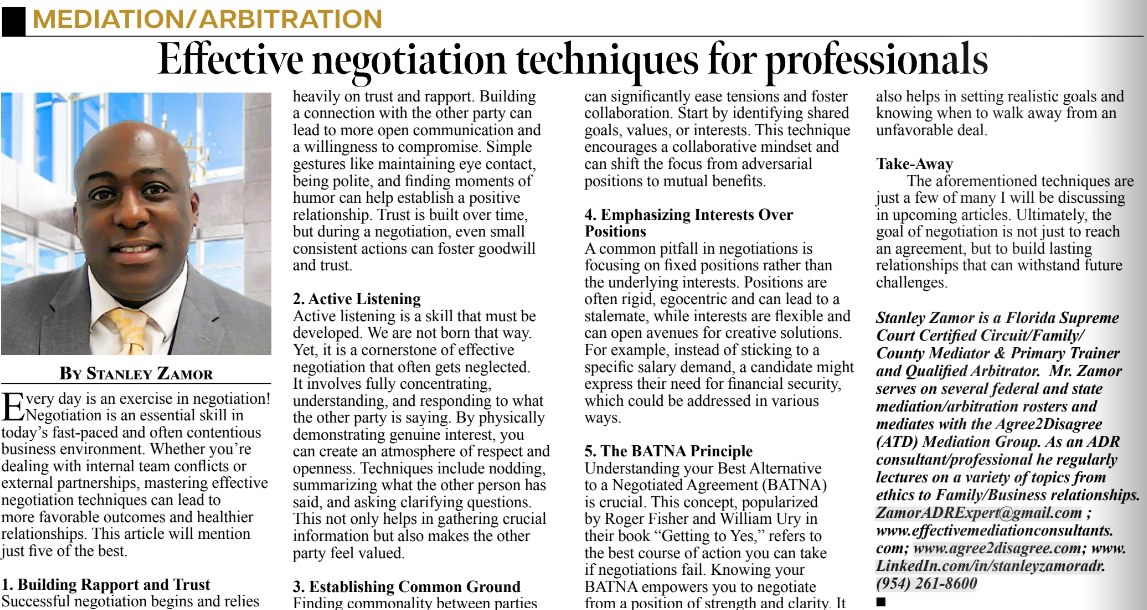
“Effective Negotiation Techniques for Professionals”

Every day is an exercise in negotiation! Negotiation is an essential skill in today’s fast-paced and often contentious business environment. Whether you’re dealing with internal team conflicts or external partnerships, mastering effective negotiation techniques can lead to more favorable outcomes and healthier relationships. This article will mention just five of the best negotiation techniques that professionals can utilize.

 1. Building Rapport and Trust

Successful negotiation begins/relies heavily on trust and rapport. Building a connection with the other party can lead to more open communication and a willingness to compromise. Simple gestures like maintaining eye contact, being polite, and finding moments of humor can help establish a positive relationship. Trust is built over time, but during a negotiation even small, consistent actions can foster goodwill/Trust.


 2. Active Listening

Active listening is a skill that must be developed. We are not born active listeners. Yet active listening is a cornerstone of effective negotiation that often gets neglected. It involves fully concentrating, understanding, and responding to what the other party is saying. By physically demonstrating genuine interest, you create an atmosphere of respect and openness. Techniques include nodding, summarizing what the other person has said, and asking clarifying questions. This not only helps in gathering crucial information but also makes the other party feel valued.

 3. Establishing Common Ground

Finding commonality between parties can significantly ease tensions and foster collaboration. Start by identifying shared goals, values, or interests. This technique encourages a collaborative mindset and can shift the focus from adversarial positions to mutual benefits.

4. Emphasizing Interests Over Positions

A common pitfall in negotiations is focusing on fixed positions rather than the underlying interests. Positions are often rigid egocentric and can lead to a stalemate, while interests are flexible and can open avenues for creative solutions. For example, instead of sticking to a specific salary demand, a candidate might express their need for financial security, which could be addressed in various ways.  

5. The BATNA Principle

Understanding your Best Alternative to a Negotiated Agreement (BATNA) is crucial. This concept, popularized by Roger Fisher and William Ury in their book “Getting to Yes,” refers to the best course of action you can take if negotiations fail. Knowing your BATNA empowers you to negotiate from a position of strength and clarity. It helps in setting realistic goals and knowing when to walk away from an unfavorable deal.


 Take-Away

The aforementioned techniques are just a few of many I will be discussing in upcoming articles. Ultimately, the goal of negotiation is not just to reach an agreement, but to build lasting relationships that can withstand future challenges.

Stanley Zamor is a Florida Supreme Court Certified Circuit/Family/County Mediator & Primary Trainer and Qualified Arbitrator.  Mr. Zamor serves on several federal and state mediation/arbitration rosters and mediates with the Agree2Disagree (ATD) Mediation Group. As an ADR consultant/professional he regularly lectures on a variety of topics from ethics to Family/Business relationships.  ZamorADRExpert@gmail.com ; www.effectivemediationconsultants.com; www.agree2disagree.com; www.LinkedIn.com/in/stanleyzamoradr. (954) 261-8600

When Negotiating: “Stop Expecting the F-Bomb”

After more than twenty years as a professional neutral I’ve postulated that there seems to be no way around the F-bomb being used or sought-after during mediation negotiations. And if it is not used by the parties, then it’s used by their advocates/representatives. And when a party presses the need for the F-bomb like, “Isn’t that ‘fair’ Mr. Mediator”; “I just want what is fair for my client”; “We are being more than ‘fair… etc., the negotiations usually goes left.  Yes, “fair” is the F-bomb. And expecting an adverse party to give you what is “fair” can stagnate negotiations.   

So, I ask, is it possible to avoid the F-bomb during mediation? The simple answer is no.  The more complex answer is, “maybe”.  Fair is about perspective, the emotional connectivity to the dispute, and is completely subjective.    

Disrupting Fair

The perception of what is fair; or being fair in a negotiation hinge on several key factors, one of which is the ability of the negotiation participants to set aside their ego. When disputants are entrenched in their positions, driven by personal pride or a fear of losing face, it becomes challenging to engage in constructive dialogue. Here are a few reasons why letting go of ego is essential when trying to disrupt and change the idea of fair during negotiations:

1. Openness to Compromise: When individuals prioritize their ego, they become less flexible and more focused on winning rather than finding a mutually beneficial solution. Letting go of ego allows for a willingness to consider alternative viewpoints and compromise.

2. Building Trust: Negotiations thrive on trust. If parties are defensive or overly concerned with their self-image, it can create an atmosphere of suspicion. By minimizing ego, negotiators can foster an environment of mutual respect and collaboration.

4. Focus on Interests, Not Positions: Effective negotiation involves focusing on underlying interests rather than rigid positions. Letting go of ego enables parties to explore their true needs and desires, leading to more creative and satisfactory solutions.

5. Reducing Ego-Driven Negotiations: Setting aside ego/pride changes the tone of the conversation and more easily encourages joint problem-solving.


The Take-Away

In summary, fairness in a negotiation is only achievable when parties can transcend their egos, allowing for better communication, trust-building, and a focus on collaborative solutions. This shift not only enhances the negotiation process but also fosters better relationships moving forward (if that is a goal). A skilled ethical mediator is tasked with continually refocusing/encouraging the participants to not seek fairness but mutual agreements. It is therefore essential that an appropriate mediator is selected to assist the participants negotiate beyond the ego.  

Stanley Zamor is a Florida Supreme Court Certified Circuit/Family/County Mediator & Primary Trainer and Qualified Arbitrator.  Mr. Zamor serves on several federal and state mediation/arbitration rosters and mediates with the Agree2Disagree (ATD) Mediation Group. As an ADR consultant/professional he regularly lectures on a variety of topics from ethics to Family/Business relationships.  ZamorADRExpert@gmail.com ; www.effectivemediationconsultants.com; www.agree2disagree.com; www.LinkedIn.com/in/stanleyzamoradr. (954) 261-8600

Three Important Elements of an Effective Opening Statement

Three Important Elements of an Effective Opening Statement

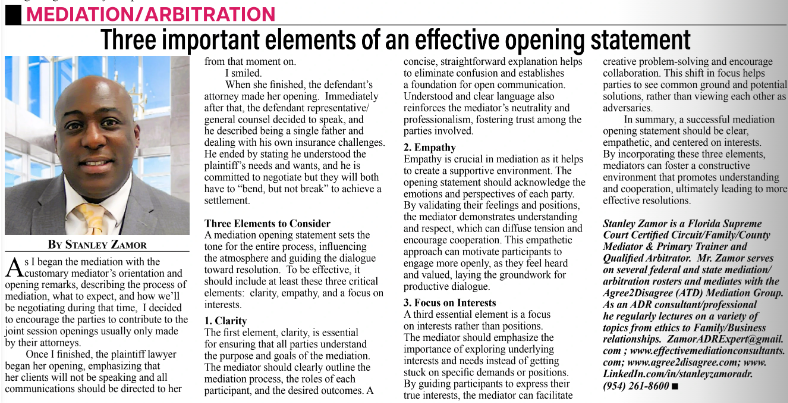
As I began the mediation with the customary Mediator’s Orientation/Opening Remarks describing the process of mediation, what to expect, and how we’ll be negotiating during that time.  I decided to encourage the parties to contribute to the joint session openings usually only made by their attorneys.  Once I finished, the plaintiff lawyer began her opening emphasizing that her clients will not be speaking and all communications should be directed to her from that moment on.  I smiled. When she finished, the Defendant’s Attorney made her opening.  Immediately after she finished, the Defendant Representative/General Counsel, decided to speak and he described being a single father and dealing with his own insurance challenges. He ended by stating he understood the Plaintiff’s needs/wants and he is commitment to negotiate but they will both have to “bend, but not break” to achieve a settlement.  

Three Elements to Consider

A mediation opening statement sets the tone for the entire process, influencing the atmosphere and guiding the dialogue toward resolution.  To be effective, it should include at least these three critical elements:  clarity, empathy, and a focus on interests.

  1. Clarity

The first element, clarity, is essential for ensuring that all parties understand the purpose and goals of the mediation. The mediator should clearly outline the mediation process, the roles of each participant, and the desired outcomes. A concise, straightforward explanation helps to eliminate confusion and establishes a foundation for open communication. Understood and clear language also reinforces the mediator’s neutrality and professionalism, fostering trust among the parties involved.

2. Empathy

Empathy is crucial in mediation as it helps to create a supportive environment. The opening statement should acknowledge the emotions and perspectives of each party. By validating their feelings/positions, the mediator demonstrates understanding and respect, which can diffuse tension and encourage cooperation. This empathetic approach can motivate participants to engage more openly, as they feel heard and valued, laying the groundwork for productive dialogue.

3. Focus on Interests

A third essential element is a focus on interests rather than positions. The mediator should emphasize the importance of exploring underlying interests and needs instead of getting stuck on specific demands or positions. By guiding participants to express their true interests, the mediator can facilitate creative problem-solving and encourage collaboration. This shift in focus helps parties to see common ground and potential solutions, rather than viewing each other as adversaries.

In summary, a successful mediation opening statement should be clear, empathetic, and centered on interests. By incorporating these three elements, mediators can foster a constructive environment that promotes understanding and cooperation, ultimately leading to more effective resolutions.

Stanley Zamor is a Florida Supreme Court Certified Circuit/Family/County Mediator & Primary Trainer and Qualified Arbitrator.  Mr. Zamor serves on several federal and state mediation/arbitration rosters and mediates with the Agree2Disagree (ATD) Mediation Group. As an ADR consultant/professional he regularly lectures on a variety of topics from ethics to Family/Business relationships.  ZamorADRExpert@gmail.com ; www.effectivemediationconsultants.com; www.agree2disagree.com; www.LinkedIn.com/in/stanleyzamoradr. (954) 261-8600

Avoiding The F –Bomb While Mediating, Is that Possible?

Ok. I have to finally say it! There just seems to be no way around the F-bomb being dropped or used during mediations (or a negotiation).  I mean, if it is not used by the parties, then it will be used by their advocates/representatives.  And advocates/representatives drop the F-bomb more than most, because as advocates/representatives, that is their job. I get it. I’ve been told that divorce/family attorneys, must drop that F-bomb during their opening presentations or they’ll be perceived as not doing their job? Wow! And as a third-party neutral the F-bomb almost makes the hairs on my neck, stand-on-end. Because once I hear them start their statement, end their statement, or even worse, look me in and say in an inquisitive AND probing tone, “Isn’t that ‘fair’ Mr. Mediator”… “I just want what is fair for my client”…. “We’re trying to be ‘fair’ here” … “We are being more than ‘fair’”…   Yes, Fair. That F-Bomb can completely make a mediation negotiation go left. 

So I ask, is it possible to avoid the F-bomb during a mediation? The simple answer is no.  The more complex answer is, “maybe” or “so what”.  What is fair? Fair is about perspective. When negotiating it is completely subjective. When dealing with heightened emotions it cannot be achieved because the parties and their advocates believe only their perspective is the best and more fair and reasonable (shhhhh! The R-Bomb, that’s for another article). 

Expanding Fair

The perception of what is fair; or being fair in mediation negotiation hinges on several key factors, one of which is the ability of the parties involved to set aside their ego. When disputants are entrenched in their positions, driven by personal pride or a fear of losing face, it becomes challenging to engage in constructive dialogue. Here are a few reasons why letting go of ego is essential when trying to be fair in mediation negotiations:

1. Openness to Compromise: When individuals prioritize their ego, they become less flexible and more focused on winning rather than finding a mutually beneficial solution. Letting go of ego allows for a willingness to consider alternative viewpoints and compromise.

2. Active Listening: Fair negotiation requires active listening, where each party genuinely seeks to understand the other’s perspective. Ego can hinder this process, as individuals may be more focused on defending their stance rather than listening to the other side.

3. Building Trust: Negotiations thrive on trust. If parties are defensive or overly concerned with their self-image, it can create an atmosphere of suspicion. By minimizing ego, negotiators can foster an environment of mutual respect and collaboration.

4. Focus on Interests, Not Positions: Effective negotiation involves focusing on underlying interests rather than rigid positions. Letting go of ego enables parties to explore their true needs and desires, leading to more creative and satisfactory solutions.

5. Reducing Conflict: Ego-driven negotiations often escalate into conflicts. By setting aside personal pride, parties can approach the negotiation with a problem-solving mindset rather than a combative one, reducing the likelihood of confrontation.

The Take-Away

In summary, fair negotiation is only achievable when parties can transcend their egos, allowing for open communication, trust-building, and a focus on collaborative solutions. This shift not only enhances the negotiation process but also fosters better relationships moving forward. A skilled mediator is tasked with continually adjusting and refocusing the participants throughout the mediation negotiation process. It is therefore the skilled, and ethical mediator that is essential in assisting the participants negotiate beyond the ego. A subsequent article will better explore mediator’s best practices and ethical skills that addresses ego and creative solution building.

So rather than debate and attempt to convince why opposing parties are wrong, third-party neutrals should help acknowledge the emotion in the dispute then focus the parties on adjusting the emotional component and reframing it as what makes good “business sense” or what are the best ways to maximize outcomes given the circumstance as they appear that day.  By helping the parties adjust their lens regarding receiving justice and reaching/giving what is fair, they are more open to reaching a agreement that is acceptable that they helped craft.  

So, there is no “fair” in mediation negotiation in the sense that most expect. There is accepting an idea that being fair is not going to be the same for everyone involved in the conflict. And, there is respecting another’s perspective of fair and adjusting participants’ ego while negotiating so a mutually acceptable resolve can be achieved if that is the common goal.   

Business Negotiation Techniques That Work

Mediation/Arbitration

Business Negotiation Techniques That Work

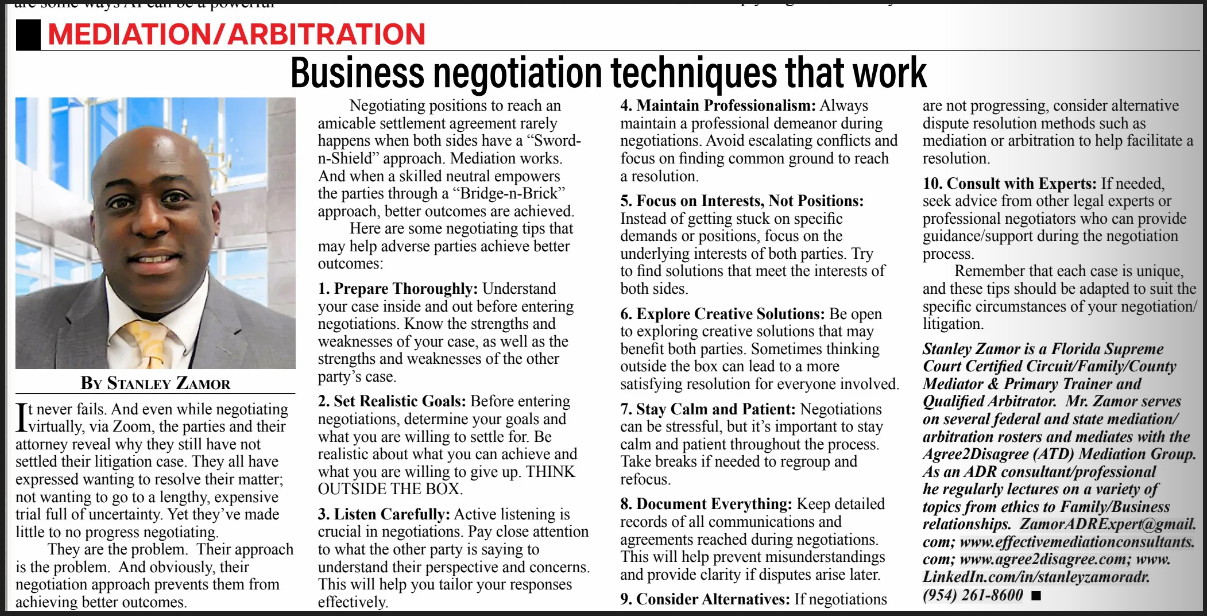
It never fails. And even while negotiating virtually, via Zoom, the parties and their attorney reveal why they still have not settled their litigation case. They all have expressed wanting to resolve their matter; not wanting to go to a lengthy, expensive trial full of uncertainty. Yet they’ve made little to no progress negotiating. They are the problem.  Their approach is the problem.  And obviously, their negotiation approach prevents them from achieving better outcomes.

Negotiating positions to reach an amicable settlement agreement rarely happens when both sides have a “Sword-n-Shield” approach.  Mediation works. And when a skilled neutral empowers the parties through a “Bridge-n-Brick” approach, better outcomes are achieved.

Proven Negotiation Tips:

Here are some negotiating tips that may help adverse parties achieve better outcomes:

  1. Prepare Thoroughly: Understand your case inside and out before entering negotiations. Know the strengths and weaknesses of your case, as well as the strengths and weaknesses of the other party’s case.
  • Set Realistic Goals: Before entering negotiations, determine your goals and what you are willing to settle for. Be realistic about what you can achieve and what you are willing to give up. THINK OUT THE BOX
  • Listen Carefully: Active listening is crucial in negotiations. Pay close attention to what the other party is saying to understand their perspective and concerns. This will help you tailor your responses effectively.
  • Maintain Professionalism: Always maintain a professional demeanor during negotiations. Avoid escalating conflicts and focus on finding common ground to reach a resolution.
  • Focus on Interests, Not Positions: Instead of getting stuck on specific demands or positions, focus on the underlying interests of both parties. Try to find solutions that meet the interests of both sides.
  • Explore Creative Solutions: Be open to exploring creative solutions that may benefit both parties. Sometimes thinking outside the box can lead to a more satisfying resolution for everyone involved.
  • Stay Calm and Patient: Negotiations can be stressful, but it’s important to stay calm and patient throughout the process. Take breaks if needed to regroup and refocus.
  • Document Everything: Keep detailed records of all communications and agreements reached during negotiations. This will help prevent misunderstandings and provide clarity if disputes arise later.
  • Consider Alternatives: If negotiations are not progressing, consider alternative dispute resolution methods such as mediation or arbitration to help facilitate a resolution.
  1. Consult with Experts: If needed, seek advice from other legal experts or professional negotiators who can provide guidance/support during the negotiation process.

Remember that each case is unique, and these tips should be adapted to suit the specific circumstances of your negotiation/litigation.

Stanley Zamor is a Florida Supreme Court Certified Circuit/Family/County Mediator & Primary Trainer and Qualified Arbitrator.  Mr. Zamor serves on several federal and state mediation/arbitration rosters and mediates with the Agree2Disagree (ATD) Mediation Group. As an ADR consultant/professional he regularly lectures on a variety of topics from ethics to Family/Business relationships.  ZamorADRExpert@gmail.com ; www.effectivemediationconsultants.com; www.agree2disagree.com; www.LinkedIn.com/in/stanleyzamoradr. (954) 261-8600

“Victory Can Be Achieved Through Perspective”

By Stanley Zamor

Plaintiff’s Attorney: (after opening presentations) “Mr. Zamor, even though the Defense Attorney presented how we will not be able to have an expert witness because the judge may strike our expert, we feel confident that the judge will not strike our expert. And we are just ready to go to trial, the attorney in charge of this case Mr. Lead Attorney will be there.  We are trial ready and will take our chances at trial, if the Defendant did not come ready to settle today.”

Defendant’s Attorney: “I just provided the transcript to you and Mr. Zamor from our last hearing which you did not attend. The Judge was quite clear, starting on page 16 line 18. She said, ‘… Mr. LeadAttorney, I gave strict instructions. Yet you did not file an expert disclosure or report on time.  And the document you are presenting now from your engineer, is full of conclusory statements. I will not be accepting anything past the missed deadline. I strongly suggest you go to mediation again.’ Mr. Zamor, I must say, should the Plaintiff lose, he will be responsible for all our fees.

So, Mr. Zamor, we are here because the Judge is kind-of giving the Plaintiff another chance at resolving the case before trial. Because as you know this will be a battle of the experts; and they have missed all the deadlines and will not be able to present one. We are here in good faith to negotiate, and we feel more confident than before that we will win.”

The Plaintiff seemed unaware of what was happening. So, I asked, “Ms. Plaintiff Coverage- Attorney, help us to understand what did the judge mean when she said conclusory? Although I understand the legal term, I want to ensure we all have the same understanding.” The Plaintiff leaned in attentively as his coverage-attorney explained that the term means, an inference that has no proof but is stated none the less. After the explanation, the Plaintiff’s body-language changed and he requested to speak privately with his lawyer immediately.  

“The greatest victory is that which requires no battle.”
― Sun Tzu, The Art of War

Take Away – A Victory Begins with Perspective  

The above is just a portion of a long exchange with multiple joint/private sessions. At the commencement of mediation, it was clear that the Plaintiff was not prepared to negotiate. And was not informed about the current posture of the case. Decision makers, regardless of legal education, it is paramount that you maintain a clear understanding of your case and possible legal ramifications.

Stanley Zamor is a Florida Supreme Court Certified Circuit/Family/County Mediator & Primary Trainer and Qualified Arbitrator.  Mr. Zamor serves on several federal and state mediation/arbitration rosters and mediates with the Agree2Disagree (ATD) Mediation Group. As an ADR consultant/professional he regularly lectures on a variety of topics from ethics, cross-cultural issues, diversity, and Family/Business relationships.  ZamorADRExpert@gmail.com ; www.effectivemediationconsultants.com; www.agree2disagree.com; www.LinkedIn.com/in/stanleyzamoradr. (954) 261-8600

2022! A Mediator’s Holiday Wish

By Stanley Zamor

“Happy Holidays”; “Merry Christmas”; “Happy Hanukkah”; “Happy Kwanzaa”; “Happy Festivus!”

“My children’s father still refuses to pay his support. So as a result, even though I’m working more hours, we’re being evicted…” – Parenting Case

“…The anniversary of our mother’s death is Christmas Eve. And still my siblings refuse to sign the documents in order to satisfy the bank’s requirements in order for us to resolve numerous obligations left unresolved. This is becoming a dire situation…None of us are communicating and our families are being torn apart” -Probate/Enforcement of Sale/Liens.

“Mr. Zamor. Forgive my emotion and my tears. But I have not seen my children in 4 months. I missed Thanksgiving with them, a birthday and various school events, and now it’s evident I will not be seeing them for Christmas. This is not justice. How come no one is helping? The judge, the police, no one seems to be helping…Nothing but postponements and more time/money lost…”

– Divorce/Family Case

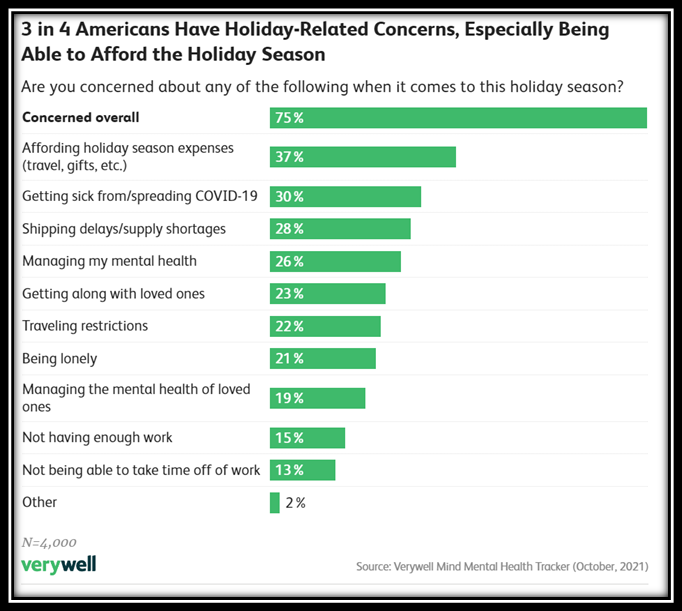
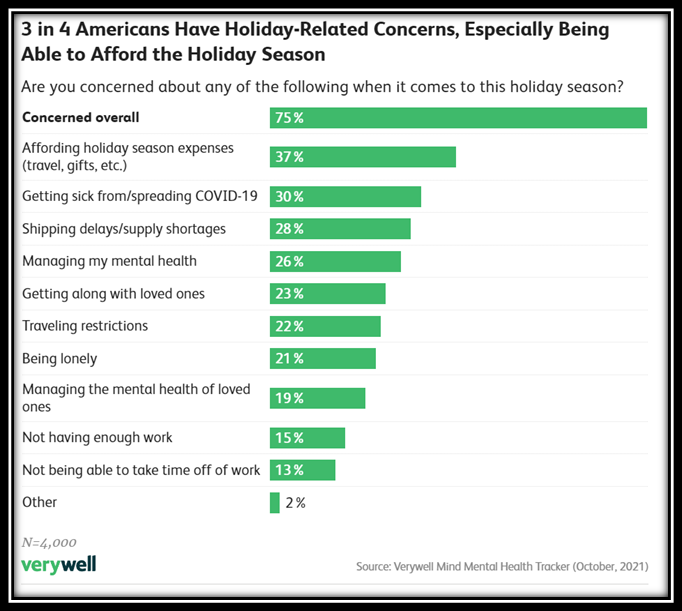
The foregoing are a few of the many statements, sentiments expressed to me by disputants during mediations that occurred during or leading up to the holiday season. Although this is the time of the year where families get together, and most enjoy gifts and seasonal good wishes. That is not the reality for many, many others. For many this is the worst time of the year. According to research the holiday season Is when many families experience the highest levels of stress, interpersonal conflicts and mental health concerns that inhibit the joy and harmony the holiday season promotes. 

            Neutrals can play a profound role during this time. Although we are not in a mental health or counseling role, as we help construct solutions to disputes that are the source of  deep emotional stress, we can encourage better communication and mitigate that stress.

MY WISH

            My wish for this holiday season is that if  you are a professional neutral who deals with individuals or families, during the holiday season you will recognize the important role you play. Go beyond the mundane and provide the disputants with what is the “Promise of Mediation”. Use the best conflict resolution/management skills and techniques to empower the disputants and allow for self-determination. Offer disputants encouragement and suggestions to reduce the barriers to communication.  Doing so may not provide the perfect solutions to their conflict, but it will demonstrate a professional who is dutifully engaged and dedicated to helping creating solutions to complex matters.

The following are 10 suggestions to a better holiday season:

  1. Set/Be Aware of Expectations (what you expect from others and your time with others),
  2. Stay Open to Your Needs and the Needs of Others
  3. Set Your Boundaries and Create Realistic Boundaries
  4. Be Mindful
  5. Approach Every Conversation and Interaction with Good Intentions
  6. Take Time for Yourself when Necessary
  7. Breathe, Breathe, Breathe
  8. Do Not Enter or Contribute to Conversations that YOU KNOW LEAD TO TIGGERS
  9. Know/Recognize Your Own Triggers
  10. Speak For Yourself, Not for Others

Stanley Zamor is a Florida Supreme Court Certified Circuit/Family/County Mediator & Primary Trainer and Qualified Arbitrator.  Mr. Zamor serves on several federal and state mediation/arbitration rosters and mediates with the Agree2Disagree (ATD) Mediation Group. He is also appointed to serve on the Florida Bar Grievance Committee and serves other National organizations as a facilitator and lecturer. As a ADR & Conflict consultant/professional he regularly lectures on a variety of topics from ethics, cross-cultural issues, diversity, and Family/Business relationships.  ZamorADRExpert@gmail.com ; www.effectivemediationconsultants.com; www.agree2disagree.com; www.LinkedIn.com/in/stanleyzamoradr. (954) 261-8600

A HOLIDAY OF ALTERNATIVES: “HAPPY FESTIVUS… FOR THE REST of US” 

Is Festivus a real holiday? Some say No. It is a holiday celebrated to be fun and whacky. The Festivus holiday began when writer Daniel O’Keefe of the 90’s sitcom Seinfeld introduced it when one of the character’s fathers explained how as he was engaged in a physical altercation at a department store attempting to purchase an exclusive doll for his child. He was mad and disappointed in his behavior of having to fight for a doll in order to get a gift for his son. He was then enlightened and created an alternative to what stress and pressure the holiday season brings.

Although the holiday was part of a sitcom episode, Festivus is a now a secular holiday, said to be celebrated on December 23rd. It is meant as an alternative to the pressures and commercialization of the Christmas season.  Those who chose to be part of the holiday take apart in all or portions of the holiday which include 1) the Festivus Pole; 2) the Airing of Grievances;    3) Festivus Dinner; 4) The Feats of Strength. Of the various portions of the Festivus holiday, the airing of grievances offers healthier opportunities to voice disappointments in a transparent safe space, offering a chance to heal from those pains experienced during the year. Other holidays seem to suggest forgetting and forgiving other’s transgressions, which it far too difficult and divine for most to do. At a time where we promote “self-love”; “self-care”; Mindfulness… Knowing and speaking your truth; Festivus offers something that the other do not.  So, while Christmas and other holidays reign as the foremost celebrated holidays, Festivus is gaining popularity as an alternative to fully respond, address and heal from emotional discourse by not disguising or shying away from it.  So Happy Festivus and I wish all of you the best! 

A Mediator’s Holiday Wish

By Stanley Zamor

1- Seasons Greetings: “Happy Holidays”; “Merry Christmas”; “Happy Hanukkah”; “Happy Kwanzaa”; “Happy Festivus!”

2- Statement from CoParenting Case: “My children’s father still refuses to pay his support. So as a result, even though I’m working more hours, we’re being evicted…and it is Christmas.”

3- Statements from Probate Case: “…The anniversary of our mother’s death is Christmas Eve. And still my siblings refuse to sign the documents in order to satisfy the banks requirements for use to resolve numerous obligations left unresolved. This is becoming a dire situation…None of us are communicating and out families are being torn apart” -Probate/Enforcement of Sale/Liens

4- Statements from Divorce/Family Case: “Mr. Zamor. Forgive my emotion and my tears. But I have not seen my children in 4 months. I missed Thanksgiving with them, a birthday and various school events, and now it’s evident I will not be seeing them for Christmas. This is not justice. How come no one his helping. The judge, the police, no one seems to be helping…Nothing but postponements an more time/money lost…”

The above are just a few of the many statements, sentiments expressed to me by disputants during mediations that occurred during in the holiday season. Although this is the time of the year where families get together, and most enjoy gifts and seasonal good wishes. That is not the reality for many, many others. For many this is the worst time of the year. According to various research and reports during the holiday season families experience a highest levels of stress, interpersonal conflicts and mental health concerns that inhibit the joy and harmony the holiday season promotes.  

Neutrals can play a profound role during this time. And although we are not in a mental health or counseling role, as we help construct solutions to very complex and deep emotional stress; we can encourage better communication though effective conflict resolution techniques that help cope and find solutions.

MY WISH

            My wish for this holiday season is that, should you be a professional neutral who deals with individuals or families, during the holiday season recognize the important role you play. Go beyond the mundane and provide the disputants with what is the “Promise of Mediation”. Remain ethical. Use true conflict resolution/management skills and technique to empower the disputants and allow for self-determination. Promote empanty and offer disputants encouragement and soft suggestions to reduce the barriers to communication.  Doing so may not provide the perfect solutions to their conflict, but it will demonstrate a professional who is dutifully engaged and dedicated to helping creating solutions to complex matters.

The following are 10 suggestions to a better holiday season:

  1. Set/Be Aware of Expectations (what you expect from others and your time with others)
  2. Stay Open to Your Needs and the Needs of Others
  3. Set Your Boundaries and Create Realistic Boundaries
  4. Be Mindful
  5. Approach Every Conversations and Interaction with Good Intentions
  6. Take Time for Yourself when Necessary
  7. Breathe, Breathe, Breathe
  8. Do Not Enter or Contribute to Conversations that YOU KNOW LEAD TO TIGGERS
  9. Know/Recognize Your Own Triggers
  10. Answer For/Speak For/Express Yourself, Not for Others

Stanley Zamor is a Florida Supreme Court Certified Circuit/Family/County Mediator & Primary Trainer and Qualified Arbitrator.  Mr. Zamor serves on several federal and state mediation/arbitration rosters and mediates with the Agree2Disagree (ATD) Mediation Group. He is also appointed to serve on the Florida Bar Grievance Committee and serves other National organizations as a facilitator and lecturer. As a ADR & Conflict consultant/professional he regularly lectures on a variety of topics from ethics, cross-cultural issues, diversity, and Family/Business relationships.  ZamorADRExpert@gmail.com ; www.effectivemediationconsultants.com; www.agree2disagree.com; www.LinkedIn.com/in/stanleyzamoradr. (954) 261-8600

An Unusual Approach to Negotiations that Yield Better Results?

By Stanley Zamor

“So, Mr. Zamor, if we do indeed settle, can you offer us a ride in your Porsche GT3 RS around the country road, as part of the settlement?” Everyone laughed.

I smiled and responded, “Mr. Richard, like I’ve said before, this is not my car, and that country road is in the Northeastern part of the country; it’s picturesque background. Although in a few weeks I do plan on driving my colleague’s on that exact road. It’s just a material item, but I see it does impact many and reminds me about the valued of things and what can be achieved. LIKE THIS AGREEMENT. Both sides approached opening statements with a defeatists tone, and that this matter would not settle today. Although, that is a possibility, it was not the reality. And you did find way to settle. Why? I like to believe that because of how you negotiated after every round; you mentioned my background and I continually managed to set and reset expectations and show the value in each of your proposals. Value-creation, no matter what the proposal was, is what you experienced, and is what you did after every negotiating round. What once was thought as being too high, too low, or even thought as being insulting, ceased.   You all began with a position, a valued expectation that you found value in adjusting. You appreciated the other parties’ “why” and “how”.  You began to assign a broader value to their case. You all put away your ego and began to appreciate the interest you all have in settling the matter instead of the importance of your positions. Congratulations.

You saw each other for what you truly are and needed; looked at what could really be achieved, instead of the more difficult/exotic “unattainable”, Porsche GT3 RS type resolve. See. Sometimes people set high expectations and need to reset them to what they truly need to get it done. Um, does that make sense? That is why I kept the background as we negotiated?” The Value-Creation Approach.

The Takeaway: As I have watched, facilitated and help manage thousands of conflict negotiations throughout my years as a professional neutral, there are several truths that continually playout. Many of these truths (values) are how I approach helping disputants find solutions to their conflict. The following are just a few of the elements to finding solutions to business and/or interpersonal conflicts: 

  1. Separate the person from the problem.
  2. Allow them/give them space to reveal their truth and they will.
  3. Let-Go Your Ego as Stratego

Stanley Zamor is a Florida Supreme Court Certified Circuit/Family/County Mediator & Primary Trainer and Qualified Arbitrator.  Mr. Zamor serves on several federal and state mediation/arbitration rosters and mediates with the Agree2Disagree (ATD) Mediation Group. As an ADR consultant/professional he regularly lectures on a variety of topics from ethics, cross-cultural issues, diversity, and Family/Business relationships.  ZamorADRExpert@gmail.com ; www.effectivemediationconsultants.com; www.agree2disagree.com; www.LinkedIn.com/in/stanleyzamoradr. (954) 261-8600

DOWNLOAD THE ARTICLE