

Turning Water Into Wine[1]
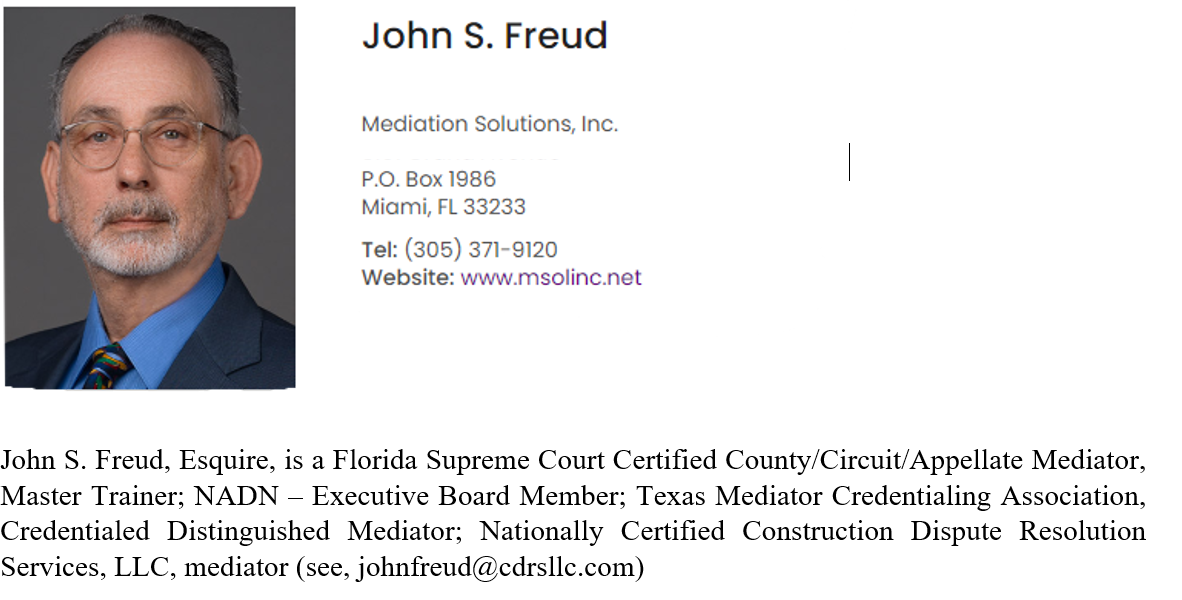
By John S. Freud
“Be like water making its way through cracks. Do not be assertive, but adjust to the object, and you shall find a way around or through it. If nothing within you stays rigid, outward things will disclose themselves…”
–Bruce Lee
Miracles don’t just happen. They occur, and are then revealed. For many if not most of us, we must take a giant leap of faith to even begin to be open to the possibility that Miracles can, or could, happen. Others might argue that Miracles are present for those that choose to acknowledge or recognize the “miraculous” for what it is, or may be – an unexplained phenomenon for which there is no easy answer as to how or why it seemingly, or simply, is.
Christ’s Turning Water Into Wine story (John 2:1-11) is, to his believers, a seminal example of the “miraculous”. But whether miraculous or not, is interestingly, not the point. It’s the Belief in the metaphorical outcome of the story that provides the enduringly powerful message to all of us, rather than its historical accuracy or its factual efficacy. And that message is, anything is possible.
Which leads us to Bruce Lee. The analogy is not a stretch. Imaging we are “ water making its way through cracks” might seem at first blush farfetched. Just like Jesus turning water into wine. But the sentiments underlying both images are the same. Anything is possible. What Lee does – and what Jesus omits – is how to make anything possible:
“Do not be assertive, but adjust to the object…nothing within you stays rigid…”
Lee’s “how to” admonitions may be summed up thusly – when adversity comes calling, rather than stiffening your response, soften your resolve. One “shall find a way around or through” adversity or deep conflict in mediation – “like water finding its way through cracks” – until suddenly “outward things will disclose themselves”.
In a negotiation in mediation, the disclosure of “outward things” – drivers of decision making by principals, motivation of lawyers and insurers, and the like – must reveal themselves in order to find the space necessary for compromise. Belief – and its discontents – must give way to decision-making that opens parties in deep conflict to the possibility for “anything is possible”, which in mediation includes voluntary resolution of the dispute.
Is the mediation environment a crucible for miracles, or as the saying goes, “mediation magic”? No. However, it can be, with fully engaged participants and a skilled mediator committed to “anything is possible”, an environment where unexpected, voluntary resolutions for parties in conflict “disclose themselves”.
If that is Turning Water Into Wine, I’ll have a glass of your finest!
[1] This is a companion piece to “Mediate, Like Water My Friend – Reflecting on Bruce Lee” By Stanley Zamor, September 2022

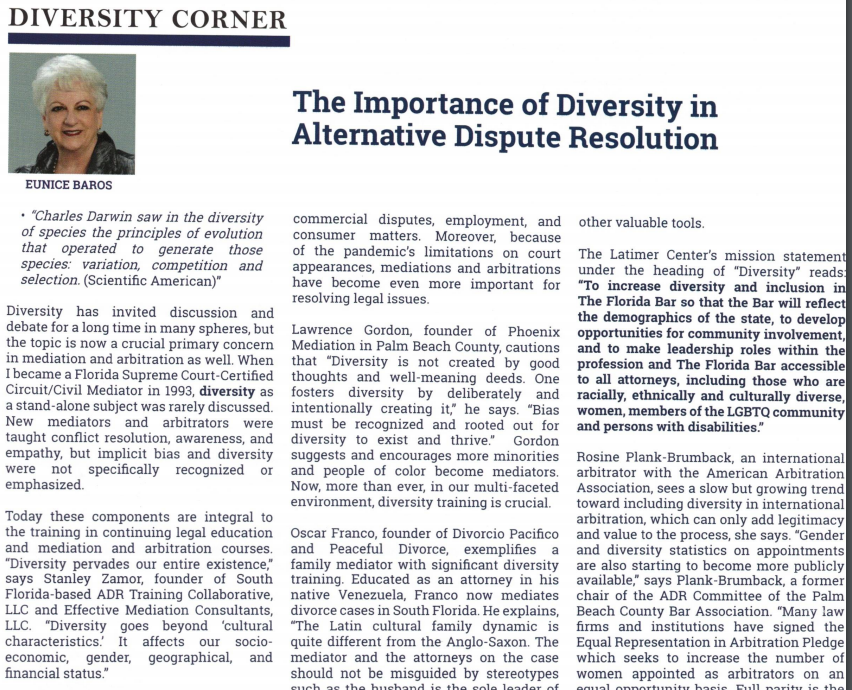 Baros, Eunice, Palm Beach County Bar Bulletin on Diversity.Mediation
Notable article quotes: (Click here for article)
“Diversity pervades our entire existence …Diversity goes beyond cultural characteristics. If affects our socio-economic, gender, geographical, and financial status.”
“The Covid-19 pandemic has forced us all to be aware of others and not just ourselves. We need to emphasize fairness, equity, values, empowerment and self-determination at every level of our interaction and in every situation in our lives now.”
“We are diverse. We want to be valued, we want to be recognized, we want to be respected. Diversity is what we are. It’s part of the human condition.”

Post-Traumatic Stress Disorder can develop after a person is exposed to
a traumatic event…
“… You’re a what!?! Did you say a Mediator?!” As I tried to understand his repulsed face he continued. “Sorry I didn’t mean to interrupt your conversation Stanley, but as I passed by and heard you say you’re heading to do a mediation my stomach turned, my blood ran cold and I was immediately brought back to 8 years ago when I meditated for 12 hours! It was horrible! I HATE mediation, and mediators are worse than lawyers! I mean my lawyer, said that this retired judge was pushy and often was used because she was good at getting deals done. And she can give us a look at what another judge might do. It was the worst decision of my life. Well second worst, staying in my marriage 9 years to long was the 1st. And after 12 hours NOTHING got done. 12 hours man! And, I tell you what. If the judge, I mean mediator, always came in beating me up on me and saying, ‘As a judge, I would rule this way or that- way, or, ‘You know she could get permanent alimony due to her disability… I would strongly consider that when I was on the bench’. I mean come on! Talk about against the man in a divorce. I refused to settle after that… No! she was completely biased and on my wife’s side. It was a pity-party that didn’t need to be done because my ex only uses her disability issue when she wants. And the mediator never wanted to hear that. My ex was a complete bully to me and her family which is why they were all my witnesses at the trial 8 months later. Sorry. But I just hate mediation…”
Wow! I was shocked at how expressive Mr. Jay was. Since I’ve known him for about 18 months and after many conversations after the gym, he never had such a harsh tone… So, with an empathic-understanding tone, I said. “I hear you, Jay. And yeah, many mediators are not well trained in conflict resolution but rather stay within their adversarial-approach to conflict resolution even as they mediate. But I know some fantastic former judge mediators, so do not lump them all the same. And I am sorry you feel that way about mediation. Mediation really is an awesome process and is supposed to be a balanced process. Even in our Florida ethical rules, like 10.200, it promotes the ‘…use, understanding and satisfaction of the process for the parties’”.
Jay shook his head saying, “What I experienced should be illegal. It’s too late now, and I should have done something before, but what, I do not know. I was so distraught from the hurricane of the divorce. I didn’t think I could do anything anyway, she was a judge, what could I do. I was in no place mentally or emotionally to deal with it. Divorce is just such a terrible thing. But now I am thinking, how many other people did she do that too… it’s just wrong…”
We continued to speak where I hopefully showed him that although his experience was not exclusive, and it does happen quite often, it is not the process or the profession that is at fault, it’s the practitioner and lack of training.
MEDIATION IS NOT ABOUT THE DEAL…
WE HAVE A DUTY TO THE PARTIES, PROCESS, PROFESSION & COURT…
TRAINING MATTERS…

A Positive Impasse? Insurance Property Loss. Kris (mentee) and I discuss and debrief about what she observed and learned by watching Stanley Zamor mediate a First Party Home Insurance case. Debriefing and discussing the process is advantageous for both the observer and a seasoned skilled mediator. The learning process never ends and only makes you better. Every mediation is essentially different, and the dynamics of how parties negotiate is paramount to the process. This mediation ultimately resolved a few days later even though it ended in an no agreement initially. This recap highlights the following (but not limited it): 1) Negotiation styles 2) The stark differences between the Attorney to client relationship and how they negotiation throughout the process 3) Party empowerment 4) Party self-determination 5) The Mediators ethics – Opinion and Advice 6) How to promote negotiations after an impasse 7) Issue presented by advocates/attorneys who may not want to resolve cases.

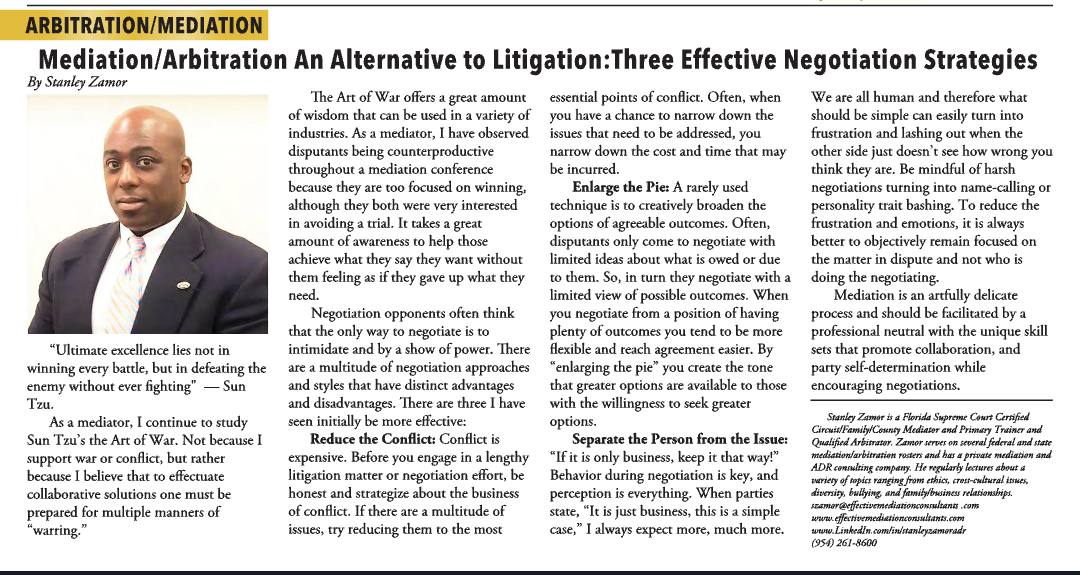
“Ultimate excellence lies not in winning every battle, but in defeating the enemy without ever fighting…” –Sun Tzu.
As a mediator I continue to study the Sun Tzu’s the “Art of War”. Not because I support War/conflict but rather, I believe that to effectuate collaborative solutions one must be prepared for multiple manners of “warring”. The Art of War offers a great amount of wisdom that can be used in a variety of industries. As a mediator I have observed disputants being counterproductive throughout a mediation conference because they are too focused on winning, although they both were very interested in avoiding a trial. It takes a great amount of awareness to help those achieve what they say they want, without them feeling like they gave up what they need…
Negotiation opponents often think that the only way to negotiate is to intimidate and by a show of power. There are a multitude negotiation approaches/styles and they all have distinct advantages and disadvantages. The following are the 3 that I’ve seen initially be more effective:
3 Negotiation Strategies
Mediation is artfully delicate process and should be facilitated by a professional neutral with the unique skill sets that promote collaboration, party self-determination while encouraging negotiations.
Stanley Zamor is a Florida Supreme Court Certified Circuit/Family/County Mediator & Primary Trainer and Qualified Arbitrator. Mr. Zamor serves on several federal and state mediation/arbitration rosters and has a private mediation and ADR consulting company. He regularly lectures on a variety of topics from ethics, cross-cultural issues, diversity, bullying, and Family/Business relationships.

By Stanley Zamor
“It’s 20XX. Time to let LAST-YEAR go! You decide. It is time to accept and expect THIS-YEAR to be the year of RESOLVE!” During the various mediations I facilitated in 20XX, a common theme I heard by participants to explain their discourse, was that 20XX was a year of build-up, peculiarity and conflicts that seemed to spiral out of control; so the parties (and their attorneys) were ready to settle. Although parties, and their counsel, self-described the dispute(s) as being “simple”, as the mediation process progressed, simple issues revealed themselves more intractable. As a professional neutral I am not surprised by parties being unrealistic about the simplicity of their issues (and their resolve). Managing expectation is not a problem, and it is what a trained professional neutral is trained to do.
So, how do mediation participants leave the past and the old year behind (analogous to litigation); and move forward like a New Year’s Eve countdown, eager to see the ball drop in Times Square, and at the stroke of midnight, be ready to usher in a new year, a new resolve, an agreed settlement? The anticipation and expectations of a new year bring new hopes, new dreams, and the achievement of new goals. But timing is the key; and unless participants are ready to reach a resolution, they will not settle. To gauge unsure participants and their preparedness to settle, after their 2013 cynical statements, I offered for consideration, “…Preparing a mediation settlement agreement is like preparing for a new year, with New Year’s resolutions. You craft your goals, and how you want your present and future to be; while litigation focuses on the past year that is now gone. Litigation forces you to relive regrets, wrongs, missed opportunities and hurts. Although litigation is your right, and allows you to receive a decision, others ultimately assign a value to your position, with which you may not agree. Your hurt feelings and intangible concerns are rarely addressed in litigation; and the ‘I SHOULDAS, I WOULDAS, I COULDAS…But I DIDN’T…’ do not get expressed. However, during a mediation session, there is usually an opportunity to address such concerns and that is when it becomes easier to start fresh, new, and agree to resolve the matter through an agreed settlement…”
After further dialogue and self-assessments, most of the participants saw the value of reaching a settlement agreement that day and were ready to resolve the matter. I was told that after the mediation session, the settlement agreement created gave them the ability to move forward, onward and upward. Holding on to the past through litigation felt like dwelling on the “yesterday”, it held them back; and also, living to litigate a case, continued to hurt more than help. While creating and preparing a settlement agreement, helped set clear future goals, let them be heard and more importantly, allowed for forgiveness and the acceptance of an, “I’m sorry…”. HAPPY NEW YEAR!
(updated, 2018)

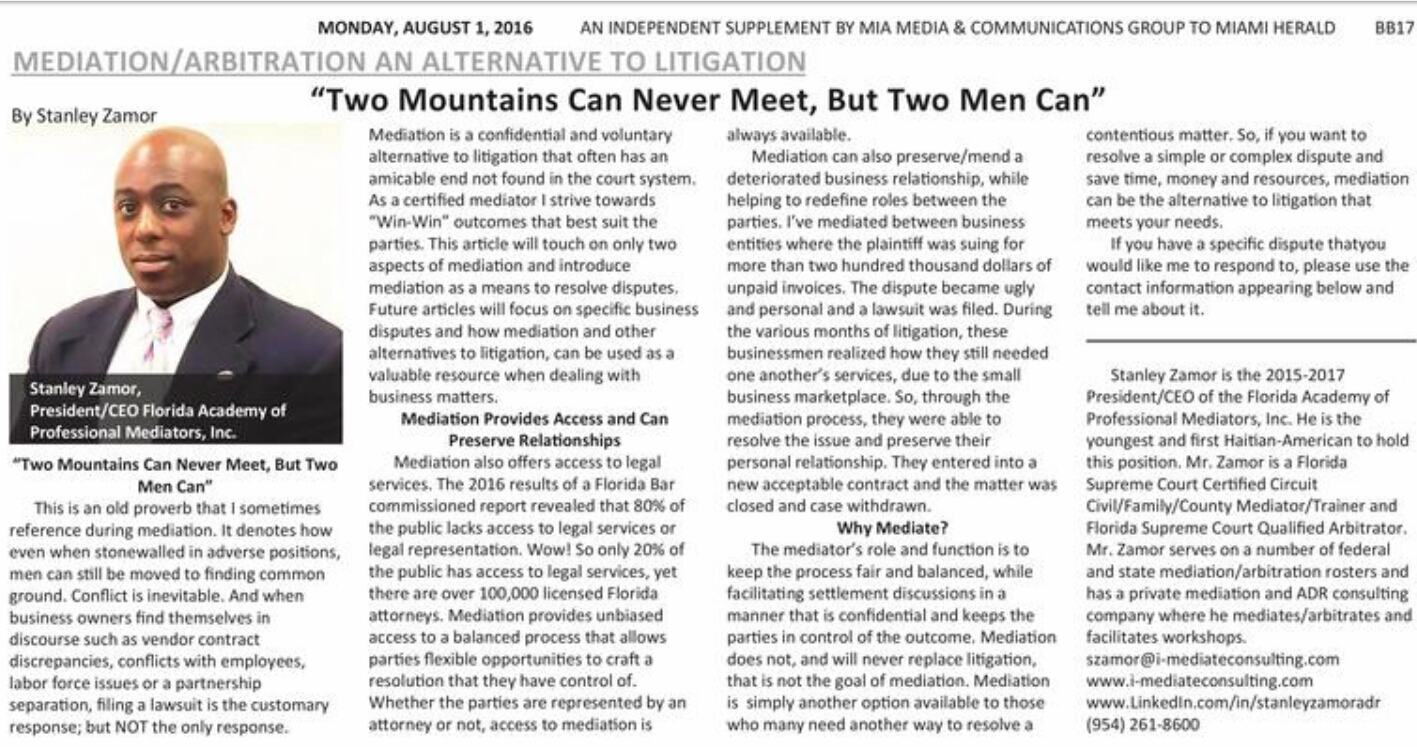
“Let’s Make A Business Decision, Let’s Mediate”
By Stanley Zamor
(July 2017)
“Greg, if you would have better advised me of the extensive cost of this litigation, I might not have let it go this far. But now, I am so financially committed, I have to see it through, even though it may bankrupt me…” I stated, “Although you are heavily engaged in litigation, now that you are at mediation, you have a real opportunity to reduce further expenses while reaching a resolution you create…” Unfortunately, this was a real statement made by a Plaintiff expressing his frustration to his attorney. The mediation ended, and resulted in a settlement 3 hours later.
The Real Cost of Litigation
We live in a great country where our legal system is not perfect, but is available to those who choose to use it. So how expensive is litigation anyway? Um, although the initial cost of a civil suit varies depending on the lawyer you choose and the type of case, it is not unusual for either party to spend close to $100,000 in a contentious business lawsuit. How? Well, a brief example is when taking the deposition of five people, who are potential witnesses:
* Attorney’s replenishable retainer of $5,000, used for initial costs/filing and commencing discovery of the lawsuit;
* Attorney charging $300 per hour – research and preparation for five, eight hour witness depositions – $2400 x 5= $12,000. Further consider the cost of travel and deposition transcripts (usual cost $1000 each x 5= $5,000);
* Other basics litigation costs include (but is not limited to) hiring expert witnesses; research/study of reports, analysis, or other projects ordered by the court; attorney hourly fees; copy fees; computer legal research services; secretarial and paralegal fees; external consultants, and specialist fees; private investigator, electronic discovery maintenance, and trial demonstrative aids, etc.
The Truth Is Real
Unfortunately, even though our civil litigation system is considered to be the best in the world, it is so costly, and the rewards (if any), are sometimes too far delayed to enjoy the benefits. So that is why mediation is available and the courts are encouraging parties to mediation early as an alternative to trial. In many areas of the law, like in Condo & Home Owners Association cases, you must mediate before you litigate.
The Cost of Mediation
Contrary to litigation mediation cost fractions less and mediating before you file a lawsuit can save you tens of thousands of dollars. The comparative math is:
* Typically, mediators charge $300 per hour for five-hours. (shared between the parties) So, $1500, and you are done!
* If you have an attorney, add the cost of their time too. Regardless, your cost can be under $3000 and you’ve reached a resolution that you’ve created and controlled. When you litigate you will triple that cost for the uncertainty of an outcome. Hmmmm… Make a business decision, you have options.
Stanley Zamor is a Florida Supreme Court Certified Circuit/Family/County Mediator & Primary Trainer and Qualified Arbitrator. Mr. Zamor serves on several federal and state mediation/arbitration rosters and has a private mediation and ADR consulting company. He regularly lectures on a variety of topics from ethics, cross-cultural issues, diversity, bullying, and Family/Business relationships.
szamor@i-mediateconsulting.com
www.i-mediateconsulting.com
www.LinkedIn.com/in/stanleyzamoradr
(954) 261-8600

“Getting What You Want in Mediation”
By Stanley Zamor
(January 2018)
Set The Stage
As the parties entered the room, I stood smiling and welcomed each person as they took their seat around the conference table. I stood at the head of the table and observed the perfectly quaffed group of 10, they all seemed to share the same blank expressionless face. Something recently happened… And that something was not good. As each side gave their opening statement they mentioned the results of a Summary Judgement hearing that took place just 2 hours prior to the commencement this mediation. The judge made a partial ruling that both parties claimed to give them some sort of victory.
In brief, for over 3 years of litigation multiple businessmen, in two consolidated cases, spent millions of dollars to prominent law firms to keep pushing their positions until the eve of trial. But now, after long eloquent statements outlining how the law supports their position(s), I asked them something that seemed to perplex the entire group. I asked, “Now that we have heard each perspective and how right each party thinks they are; what do you want?…” They all agreed that they wanted finality and (read below for the rest). I said, “Good. Then let’s get to work…”
At The Ready…
One of the difficult defining points of mediation is to reduce the barriers of communication. Litigation is innately adversarial in tone and process. Mediation conversely encourages collaboration while reframing the tone of the dispute, to where parties may feel able to design their own resolution.
Often, once a case is filed in court, disputants never see each other outside of a court related event. Since mediation is an informal process, disputants have an opportunity to use their own words during mediation in a conversational tone, and not only in the usual adversarial posture. A skillful mediator can use that opportunity, to shape the discussion to where both parties can feel heard/good about being flexible and seeing where resolution may creatively lie.
Mediation will not replace litigation, it is simply an option that works when parties need an alternative. Legal rights and duties are important but many times when parties are given a neutral space to express what they want, they are able to resolve issues themselves.
Their Wants:
So, what did these disputants want, and did mediation give to them? The following are a few of the things that the disputants told me they wanted and after a 5 hour mediation, they created an agreement that was satisfied with:
Stanley Zamor is a Florida Supreme Court Certified Circuit/Family/County Mediator & Primary Trainer and Qualified Arbitrator. Mr. Zamor serves on several federal and state mediation/arbitration rosters and has a private mediation and ADR consulting company. He regularly lectures on a variety of topics from ethics, cross-cultural issues, diversity, bullying, and Family/Business relationships.
szamor@effectivemediationconsultants.com
www. effectivemediationconsultants.com
www.LinkedIn.com/in/stanleyzamoradr
(954) 261-8600

#METOO Trends and Highlights
IN the past few months social media and every industry has been a flooded with allegations of sexual harassment. The silence has been broken, and the once considered “too powerful” and untouchable are being “handled” and striped of their positions/power. Sexual harassment is not industry specific, it is not new and the skeletons in the Walmart-size closets are busting out. Here are some statistics from the U.S. Equal Employment Opportunity Commission and news polls:
No industry is safe from sexual predatory behavior. And the behavior has been allowed to permeate the business/entertainment/ culture. Even the EEOC states that yearly training is not enough and is usually only focused on avoiding legal liability. After doing many EEOC mediations which lead to reviewing thousands of employment manual pages, state and federal rules, regulations, and policies, I am comfortable to say that there remains to be A LOT of work done if we wish to change the sexual harassment culture.
Finding a Resolution Process
We know that victims are ignored and paid off; and litigation and hefty settlements have not prevented predatory behavior. So what is the answer, and what should be considered when seeking arbitration and mediation as alternatives? Honesty, I am not sure, but I am confident that the Victim-shaming, fear, and the industry-cultural norms that allowed sexual harassment to go unchecked and underreported need deeper and broader systemic solutions.
The following are brief points when considering other resolution options:
Arbitration, Akin to Litigation –
Mediation – Pros & Cons (limited and not exhaustive)
Stanley Zamor is a Florida Supreme Court Certified Circuit/Family/County Mediator & Primary Trainer and Qualified Arbitrator. Mr. Zamor serves on several federal and state mediation/arbitration rosters and has a private mediation and ADR consulting company. He regularly lectures on a variety of topics from ethics, cross-cultural issues, diversity, bullying, and Family/Business relationships.
szamor@effectivemediationconsultants.com
www. effectivemediationconsultants.com
www.LinkedIn.com/in/stanleyzamoradr
(954) 261-8600